 KINEO
ONE LAST CALL
The Film Score


AI Slop Meter
Clean 9.0/10Find this film in
Festivals and Awards
 Higgsfield Talent Contest
Score Breakdown
| Storytelling | 10.0 |
| Emotional Connection | 10.0 |
| AI Tool Management | 10.0 |
| Visual Craft | 10.0 |
| Writing & Dialogue | 10.0 |
| Soundtrack | 10.0 |
| Originality | 10.0 |
| Polish | 10.0 |
| Rewatch Value | 10.0 |
| Weighted total (/12) | 10.0 |
Watch on YouTubeWatch on Higgsfield
⚠ Report a problem with this video
Kineograph does not host films on its platform. This video is embedded from the creator’s own account on a platform such as YouTube, TikTok, Instagram, Facebook or Suno. Any ads you see on this video are handled by that platform and the creator. Kineograph does not own this video and does not receive any ad revenue from it. We encourage you to support and follow the creators whose work is showcased on Kineograph. Visit their social media and/or personal websites.
Film Review
This review discusses the ending. If you would rather watch the film first, we recommend you do, and then come back.
Synopsis
An aging hitman takes one more contract. From a derelict high-rise he watches his target — a heavy-set businessman drinking whisky in an armchair — through a rifle scope, and the job is done the way these jobs are done: quietly, at a distance, one bullet. But the night is not over. He walks through Club Sirius in his red and teal tracksuit, past the neon and the dancing and the "EUROBEAT NIGHT / 1992" posters, and in an underground parking garage he finds a man in a black suit lying on the floor and a bloodied young man who tells him, in the film's one legible line, "…You're done, old man." Then a cheap hotel room above the railway tracks, a brown envelope opened on the bed, a card naming Kuroda, and then a funeral — the businessman's portrait on the altar, the ornate coffin carried into a black-and-gold hearse, the hitman standing at the door in a black suit. The maker's own description says the envelope held his own photo, circled in red, a note that says "run", and a funeral notice — and that he doesn't run. The film itself shows the envelope opened and the card on the bed; the rest is the maker's account, and the film earns it: the hitman walks away from the black sedan, pistol in hand, and does not look back.
The Gun at the Camera
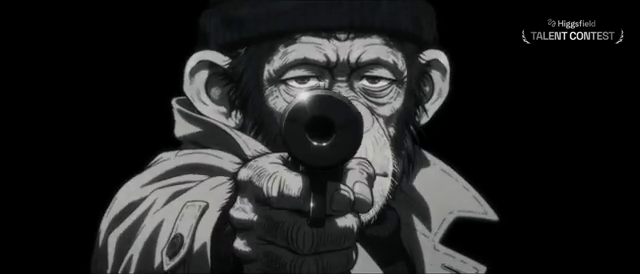
The film opens the way a confident film opens: a black-and-white close-up of the hitman pointing a pistol straight at the camera. No title card, no throat-clearing, no establishing shot to ease us in — just the ape in the beanie and the trench coat, the barrel of the gun filling the frame, and the knowledge that we are being aimed at. It is the whole film in one image: direct, unadorned, and completely sure of itself.
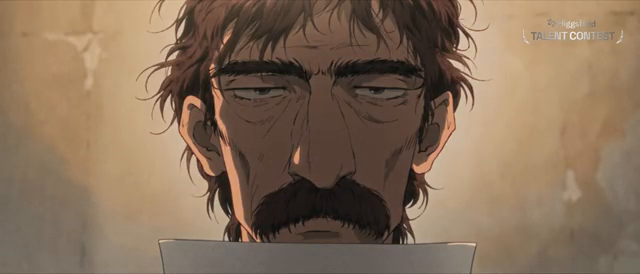
From there Ripley lets the city do the talking. An aerial night city with an unfinished high-rise at its center, the hitman moustached and silent in a white work van marked with Japanese text, the rifle case at his feet by a chain-link fence, the climb up the stairs of a derelict high-rise with the city lights below. There is almost no dialogue in this film, and the silence is the point — the long silences are the film's grammar. We learn who this man is from what he carries, where he goes, and how patiently he waits, and by the time he is prone on the rooftop with the rifle, we understand the shape of his life without a single line of explanation.
The Rooftop
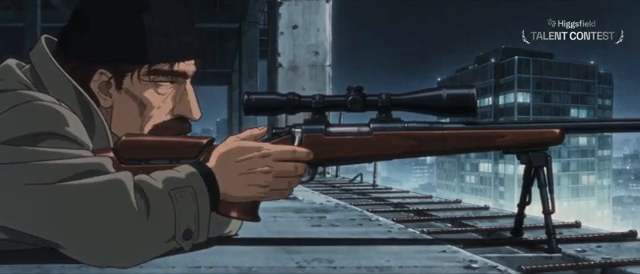
The rooftop sequence, roughly 1:30 to 2:20, is the film at its most disciplined. The hitman lies prone with the scoped rifle against the night skyline, and the film cuts through the scope to what he sees: a woman in a green evening dress in a bathroom applying lipstick; the heavy-set, bespectacled businessman in a suit drinking whisky in an armchair, a bottle and a glass on the side table. The scope's crosshairs turn the watching into a frame inside the frame, and the patience of it — the finger on the trigger, the spent cartridge on the ledge — is what makes the killing feel like work rather than spectacle. Ripley does not stage the shot as a thrill. He stages it as a job, and the job's quiet is what stays with you.
What follows the job is where the film becomes something more than a hitman story. The white van under the overpass, the climb in through a bathroom window with the rifle case on the floor by the toilet, the hitman standing on the toilet to look out of a high window — these are the unglamorous beats of a working killer's night, filmed with the same care as the rooftop. The film never hurries past them, and it never dresses them up. That refusal to hurry is the film's signature: it trusts the viewer to sit in the quiet with this man, and the trust is repaid.
Club Sirius
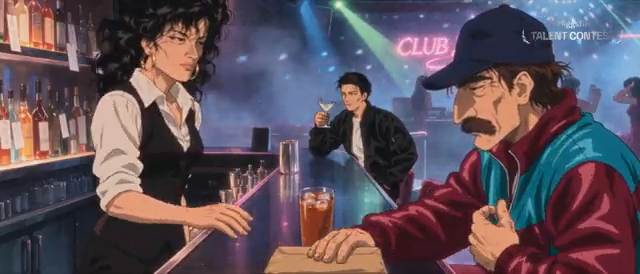
Then the neon. Club Sirius — disco ball, "CLUB SIRIUS" in neon, "EUROBEAT NIGHT / 1992" posters on the wall — is the film's warmest, loudest place, and the hitman walks through it in his red and teal tracksuit like a man visiting a world he no longer belongs to. A woman in a red and pink dress dances; at the bar, a bartender woman and a young man with a martini. The club is not a detour. It is the film showing us what the hitman's life is not — the noise, the dancing, the young — set against the silence he carries, and the contrast is drawn entirely in images. The hand-painted gouache backgrounds are at their best here: the neon, the bottles along the bar, the crowd behind the hitman, all of it rendered with the texture and warmth of a cel-animated frame from thirty years ago.
The music deserves its own word, because the music is the film's second voice. A Japanese ballad — an original Showa-era kayokyoku ballad, in the maker's words — carries the later half of the film, and it is used the way a great score is used: not to tell us what to feel, but to give the silence a shape. The ballad plays under the club, under the hotel room, under the funeral, and it makes the hitman's loneliness audible. I could not verify the lyrics word for word, and I will not quote them; what I can say is that the song is the film's emotional spine, and it never puts a note wrong.
"…You're Done, Old Man."
The turn of the film comes in an underground parking garage, and it comes in a single line. A sneaker steps on a bloodied hand; a man in a black suit lies on the floor. Then the corridor confrontation, shown split-frame — the hitman in his red and teal tracksuit on one side, and on the other the bloodied young man, close up, earring glinting, his face bruised — and the young man speaks the film's one legible line, shown as burned-in English subtitle text: "…You're done, old man." The ellipsis is in the film itself; the words before it were not legible, and I will not guess them. What matters is the line as it stands: a younger man telling an old killer his time is up, and the old killer hearing it and going on anyway.
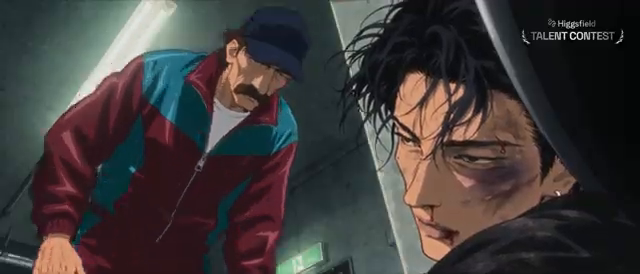
The hitman pulls a card or ID from the young man's jacket pocket, and the film does not explain what it says or what it means. It does not need to. The gesture is the story: the old man still working, still collecting, still going through the motions of a job whose meaning has already slipped away from him. That is the film's great subject, and it is carried here in a single reach into a pocket.
The Envelope
The hotel room above the railway tracks is the film's quiet heart. The hitman in a white T-shirt, his hand bloodied, opens a brown envelope on the bed as a train passes outside. A close-up shows a Japanese business card or document naming Kuroda on the bed. He slumps on the bed, reaches for the light, and the film intercuts a sink full of cut dark hair. I will not claim more than the film shows: the envelope is opened, the card is seen. The maker's description says the envelope held his own photo, circled in red, a note that says "run", and a funeral notice — and whether or not those words are legible in the frames, the film plays as if they are true, because the hitman's face in that room tells the whole of it. The close-up of him reading is the most human image in the film: a tired old killer, alone above the tracks, reading what the job has brought him.
The sink of cut dark hair is the film's strangest, most haunting image, and it is left exactly as strange as it is. No explanation, no flashback, no line of dialogue to pin it down — just the cut hair in the sink, intercut with the man on the bed, and the train going past outside. It is the kind of image that makes a film stay with you after it ends, because it refuses to be solved.
The Funeral
The funeral is filmed with the gravity of a ceremony, and it is the sequence where the film's control is most visible. An incense burner, a funeral altar with the businessman's portrait, the coffin, the mourners, the hitman standing at the door in a black suit. Then the portrait in close-up, the pallbearers carrying the ornate coffin into a black-and-gold hearse, white-gloved hands holding a condolence tray and envelope. The film does not rush the ritual. It lets the incense, the portrait, the hearse and the white gloves do the work of showing us what the hitman's bullet bought, and it lets the hitman stand at the edge of it all — present, in his black suit, and entirely apart. The man he killed is mourned by people who loved him; the man who killed him watches from the door. The film does not judge either side. It simply shows both, and lets the weight of it settle.
Best Scene (6:20–6:38)
"He Doesn't Run"
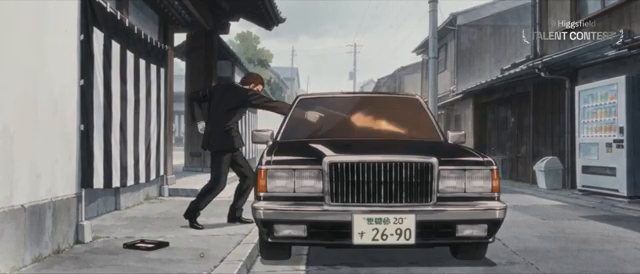
The hitman, black suit and white gloves, pistol in hand, walks away from a black sedan, a dropped tray on the ground behind him. That is the scene, and that is the film. He has opened the envelope, he has stood at the funeral, and he does not run. He walks — unhurried, upright, the pistol still in his hand — away from the car and down the street, and the film holds on him until the last story image, a man shouting in red light, whose identity the film does not give us and I will not guess. The walk is the film's argument made visible: an old killer who has been told his time is up, who has read what was left for him, and who keeps walking anyway. It is the most melancholic image in the film and the most defiant one, and it is why the ending lands the way it does. He doesn't run.
Final Thoughts
ONE LAST CALL is a perfect film: an aging hitman, one more contract, and a final walk that says everything the film needs to say. It is the first 10 on Kineograph, and it earns every point of it — the storytelling, the look, the sound, the restraint, the ending. Allan Ripley has mastered the art of AI anime, he is one of the top three filmmakers at the top of their game in the AI film industry, and he is one of the few writing the playbook everyone else will follow in the future. It reminded me of one of my favorite animes from childhood, Noir — the French secret agent. Verdict: a flawless 1990s anime hitman story, and the new standard for what AI Anime film can be.
★★★★★ — An aging hitman, one more contract, and a final walk that says everything
Scene Breakdown
0:00–0:05 — The gun at the camera. Black-and-white close-up: the ape hitman in a trench coat and beanie points a pistol straight at the camera. No title card.
0:08–0:15 — The city at night. Aerial night city; an unfinished high-rise in the center.
0:15–0:35 — The van. The moustached hitman in a white work van, eyes closed, then carrying a rifle case and getting into the van at night.
0:45–1:02 — The fence and the stairs. At a chain-link fence by a derelict building site, rifle case at his feet; then climbing the stairs of a derelict high-rise at night, city lights below.
1:30–2:20 — The rooftop. Sniper on a rooftop, prone with a rifle. Scope intercuts: a woman in a green evening dress in a bathroom applying lipstick; a heavy-set, bespectacled businessman in a suit drinking whisky in an armchair (around 2:02); the hitman aiming, finger on the trigger, a spent cartridge on the ledge (around 2:17).
2:30–3:05 — The van under the overpass. The white van under an overpass; the hitman climbs in through a bathroom window, rifle case on the floor by the toilet, then stands on the toilet looking out of a high window.
3:30–4:15 — Club Sirius. The hitman in a red and teal tracksuit walks through a neon club (disco ball, "CLUB SIRIUS", "EUROBEAT NIGHT / 1992" posters). A woman in a red and pink dress dances (around 3:46); at the bar (around 4:02) a bartender woman and a young man with a martini.
4:15–4:30 — The parking garage. A sneaker steps on a bloodied hand; a man in a black suit lies on the floor.
4:30–4:40 — The confrontation. Corridor confrontation, shown split-frame, with a bloodied young man with an earring. The film's one legible line, as burned-in English subtitle text: "…You're done, old man." The hitman pulls a card or ID from the young man's jacket pocket (around 4:37).
4:50–5:15 — The hotel room. Cheap hotel room above railway tracks: the hitman in a white T-shirt, bloodied hand, opens a brown envelope on the bed as a train passes outside. Close-up of a Japanese business card or document naming Kuroda on the bed. He slumps on the bed, reaches for a light; a sink full of cut dark hair is intercut (around 5:14).
5:08–5:17 — The funeral begins. Incense burner, then a funeral altar with a portrait of the businessman, coffin and mourners; the hitman stands at the door in a black suit.
5:30–6:10 — The funeral continues. Portrait close-up, pallbearers carrying the ornate coffin into a black-and-gold hearse (around 5:52), white-gloved hands holding a condolence tray and envelope (around 6:06).
6:20–6:38 — The walk away. The hitman, black suit and white gloves, pistol in hand, walks away from a black sedan (plate 26-90), a dropped tray on the ground. A man shouting in red light is the last story shot (around 6:38); the film does not identify him.
6:39–6:47 — Promo tail. A Higgsfield interface carousel of three film stills, a "Dynamic" selector, a silver pill-shaped "GENERATE" button on black, ending on a black screen with red embers floating up. Platform material, not story.
Visitor Reviews
← Ragab's Lens · Wenna Must Die →