 KINEO
Wenna Must Die
The Film Score


AI Slop Meter
Mostly clean 7.0/10Find this film in
Festivals and Awards
 Higgsfield Talent Contest
Score Breakdown
| Storytelling | 7.0 |
| Emotional Connection | 7.0 |
| AI Tool Management | 7.0 |
| Visual Craft | 8.0 |
| Writing & Dialogue | 6.0 |
| Soundtrack | 6.0 |
| Originality | 8.0 |
| Polish | 5.0 |
| Rewatch Value | 7.0 |
| Weighted total (/12) | 6.8 |
⚠ Report a problem with this video
Kineograph does not host films on its platform. This video is embedded from the creator’s own account on a platform such as YouTube, TikTok, Instagram, Facebook or Suno. Any ads you see on this video are handled by that platform and the creator. Kineograph does not own this video and does not receive any ad revenue from it. We encourage you to support and follow the creators whose work is showcased on Kineograph. Visit their social media and/or personal websites.
Film Review
This review discusses the ending. If you would rather watch the film first, we recommend you do, and then come back.
Synopsis
In 1800s northern Europe, a village mob is about to burn a young woman, Wenna, as a witch in a forest clearing at dusk. A lone farmer confronts the chanting, torch-bearing mob, aims his pistol at them, and takes Wenna home with him instead. At his farm they live together as a couple: she tends the animals and rides with him, and they quarrel about the time he spends with his horse. A dead jay is found in the grass — an omen, in the film's terms. Then Wenna begins to show signs that the villagers may have been right: green branches grow out of her mouth and ears as she screams by a lantern, and a mirror cracks and bleeds. The film closes in the farmhouse bedroom at night: the farmer lies awake and afraid beside the sleeping Wenna, then holds her, while the mob's chant returns in the audio. That is where the film ends; it does not show what happens next. And for all the title promises, Wenna does not die on screen — no one is shown being killed, and the only death in the film is the dead jay.
The Clearing
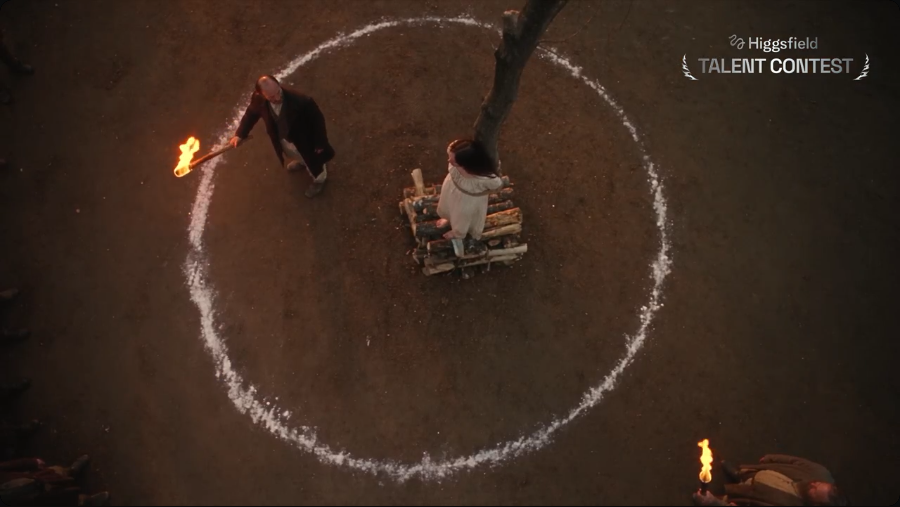
The film opens on its strongest composition and never quite leaves it behind. A dusk forest clearing, a stream at the left of the frame, a torch-bearing mob standing in a circle around a bound woman on a pyre — and the pyre itself inside a large white ritual circle painted on the ground. The camera is wide and still, and the stillness is the point: this is a tableau first and a story second, a picture of a village about to do something terrible in the open, in the light, with everyone watching. The overhead shot at 0:16, looking straight down on the white circle with the torch man and the bound woman inside it, is the film's thesis in a single frame — a woman ringed by chalk, by fire, by a whole village's certainty.
The confrontation that follows is carried almost entirely by voices, and the voices are where the film first shows its strain. The mob chants, a man shouts, and the farmer steps in: "Count your steps, stranger." "She is a witch. Death is her destiny." "Let her go." "I said, let her go." The lines that come through clearly are stark and effective — the film knows how little dialogue a burning needs. But much of the rest is garbled beyond recovery, the voices heavily distorted and often out of sync with the mouths on screen, and the chanting swallows words whole. It is a real weakness, and it is worst exactly where the film needs its words most: in the moment a man talks a mob out of a murder.
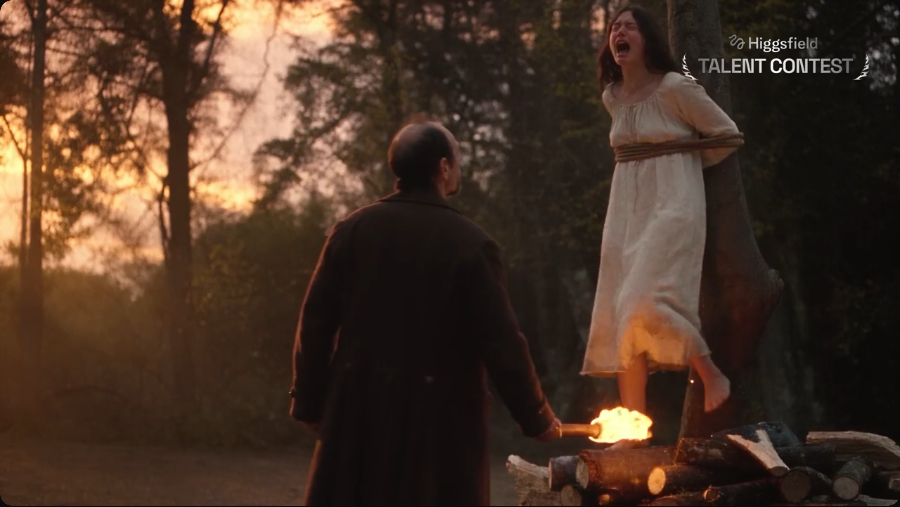
And here is the one thing I have to correct about the film's own telling of itself. The page's logline promises a rescue "with a single shot" — but the film never shows the shot. The farmer aims his pistol toward the mob, and that is all the film shows us: no muzzle flash, no report, no one falling. The rescue happens in the cut between the confrontation and the farm, and whatever the farmer did with that pistol, the film declines to stage it. That restraint is, in its way, of a piece with the film's whole approach — violence in a single moment, never lingered on — but it leaves the central act of the story off screen, and a viewer who takes the logline at its word will be watching for a gunshot that never comes.
The Farm
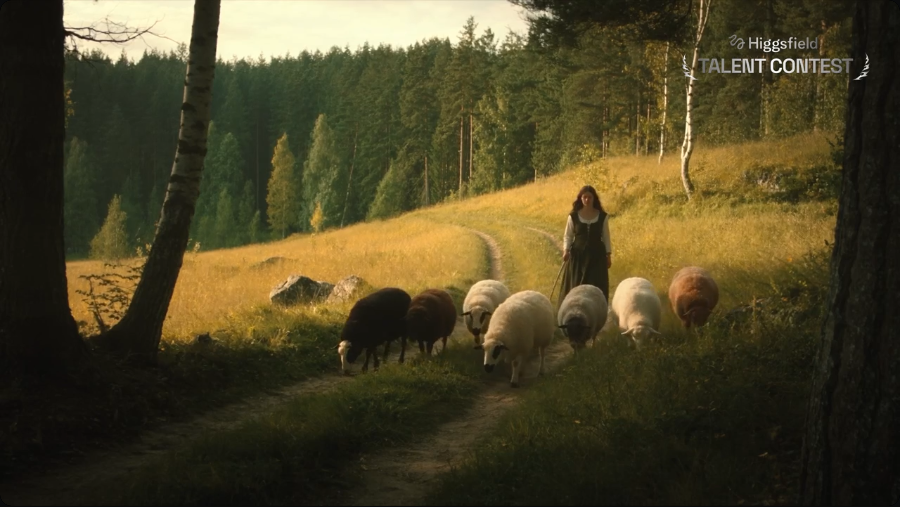
What follows the clearing is the film's gentlest stretch, and its most necessary one. A log cabin at sunset, the farmer with a saddled dark horse, a horse drinking at a lake, a rider leaving the village on a dirt road at dusk — and then farm life in golden light: Wenna at a wooden fence with a basket, cows and sheep and chickens in a farmyard with birch trees and log barns, Wenna smiling with sheep behind her, horse-riding and galloping across the fields. The light does a lot of the storytelling here. The clearing was dusk and torchlight; the farm is warm late sun, and the warmth is the argument: this is a life, built quickly and simply, and it is worth protecting.
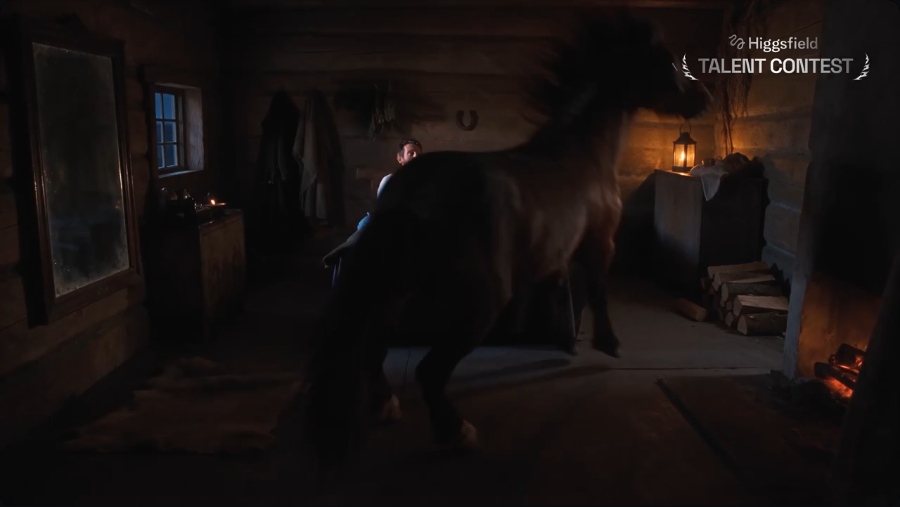
It is also where the film lets its two people be a couple, and where its best dialogue lives. Wenna, leaning on the back of the horse in a golden field, talking to the farmer about the animal: "You spend more time with your horse than me. Do you love it more than me?" It is a small, human quarrel — the kind of line that makes a relationship feel lived in rather than staged — and it lands because the film has earned the ordinariness around it. There is another line in this stretch I heard twice but could not place with certainty in the film's order, so I will not pretend I know where it falls: "What? Answer me. I should not compare a woman to a horse." Whether it is an answer to her question or a thought spoken elsewhere, it is the film's sharpest little sting — the farmer catching himself, mid-sentence, in the exact comparison she is accusing him of. The horse, meanwhile, keeps turning up where it should not be: standing in the dark cabin interior at 3:10, a huge silhouette in a room built for people, with the farmer seated small behind it. It is one of the film's small wrong details, and it works precisely because the film never points at it.
The other voices in this stretch are quieter and mostly practical. "Look after the animals. I know how to handle an animal." "I'm going to get you out of here." The second of those is a promise the film has already shown being kept — and the keeping of it is what makes everything after it matter.
The Omen
Between the farm and the scream, the film pauses on a single silent image, and it is the most honest image in the four minutes. Over Wenna's shoulder, in close-up, her hands hold a dead jay in the grass — blue and black and white wing, brown body, still. No speech in the stretch. Nothing is explained, and nothing needs to be: a dead bird in a woman's hands, in a film about a woman a village wanted dead, does its own work. It is also, I should say plainly, the only death the film shows. For a film called Wenna Must Die, that restraint is the whole of its argument — the title is a sentence the village passed, not a thing the film stages.
What follows is indoor distress: close-ups of the farmer's frightened face in a dark interior, the warmth of the farm gone, the light gone blue. The film has been building dread in small increments — a bird, a horse in a room, a face in the dark — and by the time it reaches the scream, the dread has somewhere to go.
The Branches
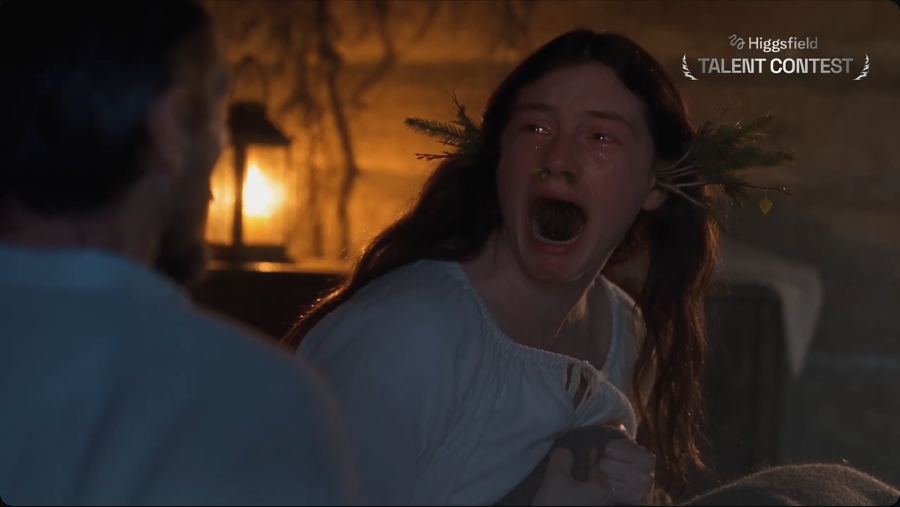
At 2:49 the film pauses on the farmer's wide-eyed face, and at 2:59 it delivers the image everything has been building toward. Wenna, crying and screaming, green leafy branches and ferns sprouting from her mouth and from both ears, from both sides of her head, a lantern glowing behind her, the farmer's shoulder in the left foreground. It is the film's single most arresting image, and it is worth every minute of the slow build that precedes it: the horror is not that she is a witch, but that the thing growing out of her is alive, green, and indifferent — life returning where it should not, in the middle of her face, while she screams.
I want to be careful about what this scene is and is not, because the page's commenters have already mistaken it for the ending. It is not the ending. One minute and sixteen seconds of film follow it — the mirror, the bedroom, the closing chant — and the scream is the climax, not the close. What makes it work as a climax is that it answers nothing and changes everything: after it, there is no going back to the golden field, and the film knows it. The branches are the proof the village would have wanted, delivered too late for the village and too early for the farmer to know what to do with it.
The Mirror and the Bedroom
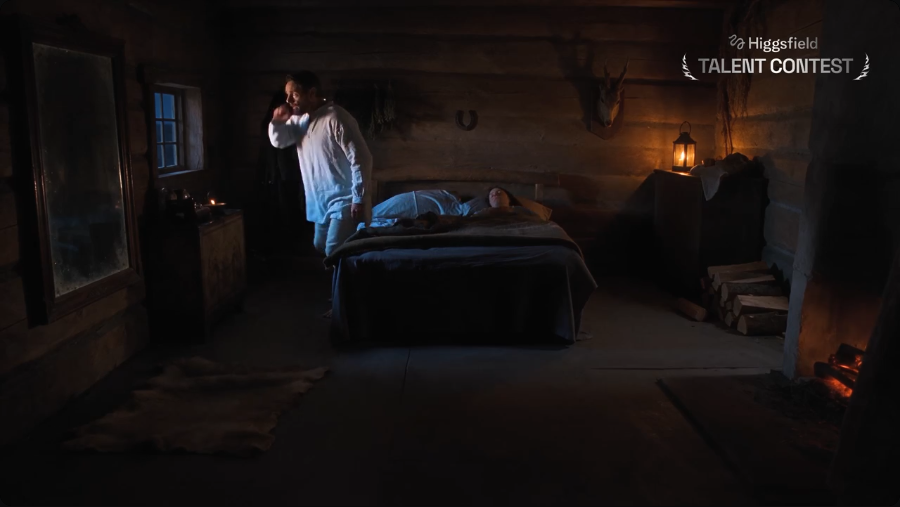
The last stretch is the film's quietest and its most unsettling, because it refuses to raise its voice after the scream. A cracked mirror with a blood splatter at its centre, a horse silhouette in the foreground, blue dusk light through a window. A tearful close-up of the farmer. Then the wide night interior of the log-cabin bedroom: the farmer sits up in bed, Wenna lies asleep beside him under a blanket, a fireplace at the right, a lantern, a mirror at the left, an animal skull and a horseshoe on the wall. The room is full of the small wrong details the film has been collecting — the skull, the shoe, the mirror — and the film simply lets us sit in the room with them.
The closing images are the farmer speaking in close-up, and then Wenna embracing him in bed, both in white nightclothes, a deer head on the wall behind them — and over it all, the mob's chant returning in the audio: "You will be ruined." It is the same chant from the opening confrontation, and its return is the film's frame: the village is not in the room, but its sentence is, and the man who defied it is lying awake with it. The film ends on a blank grey frame, no text, no credits, and the player stops at 4:15. There is no "The End", no card, nothing to close the door — and that blankness, after a chant, is the film's last withholding. We never learn what the branches mean, whether she is truly a witch, whether the farmer will kill her or protect her, or what happens to the villagers. We never see the mob again after the opening. The film's maker, on the page, says he wants the audience to walk out unsure who they would have stood with in that clearing, and uneasy about the answer — and on that count, at least, the film does exactly what it set out to do.
A word for the sound, because here the sound is both the film's engine and its weakest link. The chanting is the real score: "You will be ruined" at the opening and again at the end, a sentence that brackets the whole film, and the screaming in between is prolonged and unintelligible by design. But the spoken dialogue, where it exists, is so distorted that only a handful of lines survive clearly, and the film's most important exchange — a man talking a mob out of a burning — is partly lost to garble. In a film with this much story to carry in four minutes, the sound is the thing that most often gets in its own way.
Best Scene (2:49–2:59)
"The Branches"
The farmer's wide-eyed face, held — and then Wenna, crying and screaming, green branches sprouting from her mouth and from both ears, a lantern glowing behind her. It is the best scene because it is the film's argument made visible: the village may have been right, and being right is the worst possible outcome for the man who saved her. Everything before it — the circle, the farm, the dead jay, the horse in the room — was a slow walk toward this one image, and everything after it is the film living with what the image means. The branches do not explain themselves, and the film is right not to explain them. A scream with leaves growing out of it is the kind of image that does not need a sentence attached.
Final Thoughts
Wenna Must Die is a real folk horror in a rough, un-credited cut — a complete story in a body that is not finished yet, with one unforgettable image and a closing chant that follows you out of the room. Its voices are too distorted, its explanations too few, and its ending too blank — but its dread is patient, its light is beautiful, and its central question is the right one. Verdict: a witch-burning interrupted, a rescue that may have been a mistake, and a scream with branches growing out of it.
★★★½ — A white circle at dusk, a dead jay, and branches where a scream should be
Scene Breakdown
0:00–0:16 — The clearing. Dusk forest clearing, stream at left. A torch-bearing mob stands in a circle around the bound Wenna on a pyre inside a large white ritual circle painted on the ground. A lone man, the farmer, approaches from behind the camera. Wide, static shot. No title card.
~0:16 — The overhead circle. Overhead shot looking straight down on the white ritual circle, the torch man and the bound woman inside it.
~0:16–0:57 — The confrontation. Close-ups: a shouting torch-bearing man, the chanting mob, the farmer aiming an old pistol toward the camera and the mob, and the torch man standing over Wenna, tied to the pyre. Paused at 0:57 on the torch man facing the bound Wenna. No shot is fired, no muzzle flash is seen, no one falls.
~0:57–1:15 — The ride home. Log cabin at sunset; the farmer with a saddled dark horse; a horse drinking at a lake; a rider leaving the village on a dirt road at dusk.
~1:15–1:50 — Farm life. Pastoral farm life in golden light. Wenna at a wooden fence with a basket; cows, sheep and chickens in a farmyard with birch trees and log barns; Wenna smiling with sheep behind her; horse-riding and galloping across fields.
~1:50–2:05 — The dead jay. Silent passage. Over-the-shoulder close-up of Wenna's hands holding a dead jay — blue, black and white wing, brown body — in the grass. No speech in this stretch.
~2:05–2:35 — The quarrel. Wenna leaning on the back of the horse in a golden field, talking to the farmer about the horse. "You spend more time with your horse than me. Do you love it more than me?"
~2:35–2:49 — Indoor distress. Close-ups of the farmer's frightened face in a dark interior.
2:49–2:59 — The branches. Paused at 2:49 on the farmer's wide-eyed face. At 2:59, the branch scream: close-up of Wenna crying and screaming, green leafy branches and ferns sprouting from her mouth and from both ears, a lantern glowing behind her, the farmer's shoulder in the left foreground. This is the climax — not the ending.
~3:00–3:20 — The mirror. A cracked mirror with a blood splatter at its centre, a horse silhouette in the foreground, blue dusk light through a window. Cut to a tearful close-up of the farmer.
~3:20–3:42 — The bedroom. Wide night interior of the log-cabin bedroom: the farmer sits up in bed, Wenna lies asleep beside him under a blanket; fireplace at right, lantern, mirror at left, an animal skull and a horseshoe on the wall.
~3:42–4:10 — The embrace. Close-up of the farmer speaking; Wenna embracing the farmer in bed, both in white nightclothes, a deer head on the wall behind them; the mob chant "You will be ruined" returns in the audio.
4:10–4:15 — Blank grey. A blank grey frame, no text, no credits; the player stops at 4:15.