

Download Free Original Music Songs from the films
Scores & Rankings
Substrate Directed by Horomata
Find this film in
Score breakdown
- Storytelling & Structure ×210
- Emotional Connection ×210
- AI Tool Management ×210
- Visual Craft10
- Screenplay10
- Sound Design10
- Originality10
- Technical Polish10
- Rewatch Value10
×2 = core category, counts double.
Directed by horomata • Runtime 10:17
Watch on Higgsfield | Watch on YouTube
Film Review
Written by Kineograph
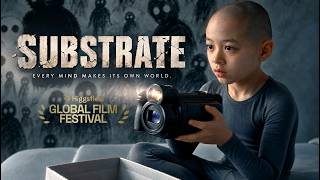
In a world where every mind renders its own private reality, one boy sees the raw truth beneath, and finds a way to show it.
Synopsis
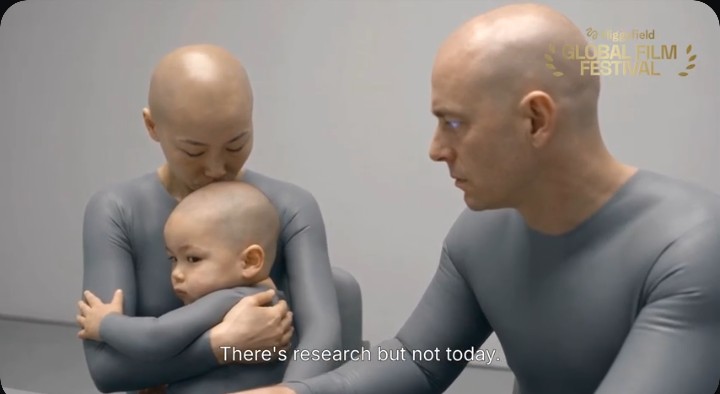
In the world of Substrate, everyone wears an implant called the Bloom, which weaves a private, perfectly comfortable version of reality for each mind. Nobody shares a world anymore. Two parents can raise the same child inside two completely different realities.
Then there is Kai, a boy whose Bloom fails to take. The clinician is gentle about it: he is “refractory.” Ten years later, Kai lives in the raw grey beneath everyone else’s worlds, with parents who love him, but from inside two different realities. He answers the grey in the only way he can. He grinds his food into black pigment, and he begins to draw. Then he finds something the old world left behind, and with it, a way not only to see, but to show.

The Review
A Heavy Topic, Made Beautifully Simple
Some films tackle a serious subject by explaining it. Substrate does something much kinder and much more powerful: it lets us live it. This is a film about what it feels like to see the world differently from everyone around you, and for me, it is one of the most moving ways I have seen anyone explain what it might be like to live with a hidden disability, such as autism.
I want to be clear that the film is a science-fiction story, and it tells its own tale about art and empathy. But the lens it hands us is so human that it is impossible not to feel it. It takes a heavy, complicated idea and breaks it down into something anyone can understand in a single image: a boy who sees the world as it really is, while everyone else sees the version their mind has built for them.
Not Broken. Just Different.
The first thing the film does is flip a question we usually ask the wrong way around. In Kai’s world, the people with the implant are “normal,” and the child whose Bloom will not take is the one labeled as having something wrong. But watch closely, and the film quietly tells you the truth: nothing is wrong with Kai. He is simply experiencing the world in a way the rest of us do not.
That is the heart of what the film is saying to me. What we often call a hidden disability may not be a disability at all. It is a different way of seeing, and the real gap is that most of us never make the effort to understand it. Kai does not need to be fixed. He needs someone to look where he is looking.

Loved, and Still Alone
One of the most quietly heartbreaking ideas in the film is that Kai’s parents love him. There is never any doubt about that. But they love him from inside two different realities, and he lives in a third. They are in the same house, at the same table, and they still cannot meet in the same world.
Anyone who has ever felt unseen by the people who love them will recognize that feeling instantly. It is the loneliness of being surrounded by care that does not quite reach you, and the film captures it without a single word of self-pity. Kai barely speaks at all. His performance is all attention: what he watches, what he touches, and what his hands do.

Seen Through Someone Else’s Eyes
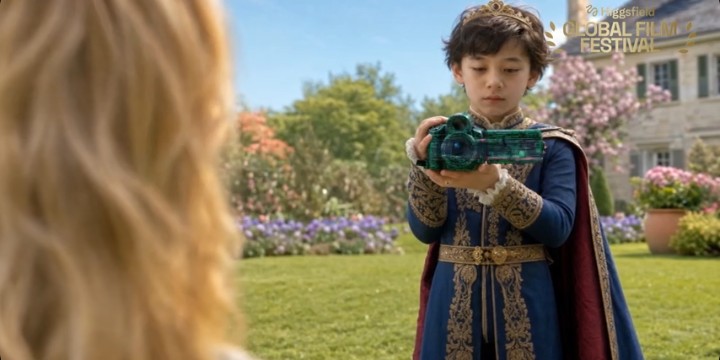
There is a small detail in the film that stayed with me. Through a neighbor’s version of reality, Kai appears as something soft, redrawn into whatever her world can hold. Even affection, the film tells us, is a render.
It is a gentle but powerful idea. How often do we meet someone and respond to the version of them we have imagined, instead of the person actually standing in front of us? For people whose minds work differently, that is an everyday experience: being understood only after being translated into something more familiar. The film does not blame anyone for it. It just lets us see it, and once you have seen it, it is hard to forget.

A World Made of Rules
Visually, Substrate is extraordinary, and it is extraordinary because every choice means something. In Kai’s shots, walls, furniture, food, and tools are plain matte grey, while skin, water, and anything alive keep their full texture. Reality is exactly as deep as life. Those with an active Bloom carry a faint pale blue glow in their eyes, and Kai’s eyes are matte, so you can tell at a glance who is dreaming and who is not. There are no mirrors, because a mirror is a shared image, and this world has nothing left to share.
The result is a film where the look is not decoration. It is the story. When Kai eats a meal that has no taste in a room that is only grey shapes, you do not have to be told how that feels. You feel it, and you begin to understand, in the simplest possible way, what it can be like when the world is not built for the way your mind works.

The Moment He Shares His World
What makes Substrate hopeful, and not just sad, is what Kai does with his difference. He does not wait to be understood. He turns the grey he is given into something meaningful, grinding his food into black pigment and drawing. Then he finds a tool that takes the world in and gives it back, and he uses it to do something remarkable: he makes his way of seeing shareable.
The climax is a quiet, beautiful definition of what the film is about. Several people, one beam of light, one gaze made common for the first time. People who have lived in sealed, separate worlds step out of their own and into someone else’s. That crossing has a name, and the film tells us what it is: empathy. In Kai’s world it has just been invented. In ours, it is called art.
I cannot think of a better way to say what the film asks of us. We do not have to share someone’s experience to respect it. We only have to be willing to step into their way of seeing, even for a few minutes, and let them show us.
Final Thoughts
Substrate is a gentle, beautiful, deeply human film that explains something heavy in the simplest way possible: through the eyes of a boy who sees what the rest of us do not. It reminds us that the people we might call “different” are not missing something. They are seeing something, and the only thing missing is our effort to look.
Watch it with someone you love, and when it is over, ask them what the world looks like through their eyes. You may be surprised at how much you were never shown.
Production tools: Higgsfield Cinema Studio, DaVinci Resolve. All audio is AI-generated.
Reader Reviews
There are no reviews yet. Be the first one to write one.