
Download Free Original Music Songs from the films
Scores & Rankings
Haey Directed by Pickle Kim
Find this film in
Score breakdown
- Storytelling & Structure ×210
- Emotional Connection ×210
- AI Tool Management ×210
- Visual Craft10
- Screenplay10
- Sound Design10
- Originality10
- Technical Polish10
- Rewatch Value10
×2 = core category, counts double.
Film Review
HAEY
On a fog-wrapped lighthouse island, a blind boy and the old man who raised him share their final days together. A quiet, devastating meditation on love, and on how the people we love never fully leave us.
A strong contender for Best Picture of the entire festival.
Synopsis
Haey is the story of Gilwoo, an aging lighthouse keeper, and Haey, the visually impaired boy he found and raised as his own. Together on a remote island surrounded by sea and fog, they live a life built entirely out of sound, touch, and small daily tenderness. The film follows their final days together, and in doing so becomes something larger than its setting: a meditation on love, on companionship, and on the people who stay with us long after they are gone. By its end, the film leaves the audience with a single, unanswered question. Where is Haey now? Haey never tells you. It only shows you that the answer may not be the point.
The Review
Some films tell you a story. Haey hands you a feeling and trusts you to find your way through it. At just under seven minutes, it accomplishes what many features never manage: it makes you feel the full weight of a lifetime of love in a handful of quiet scenes, and it does so without a single wasted frame.
I want to say this plainly, because it matters: not once while watching Haey did I feel like I was watching something made with AI. There was no moment where the illusion cracked, no beat where I was reminded of the tools behind it. The whole time, it felt like real people, carrying real emotions. That is an extraordinary thing to accomplish in a festival built entirely on this technology, and it’s part of why this film stands apart from everything else I’ve reviewed this season. Haey is this festival’s CODA — a small, quiet, unassuming film that sneaks up on you and ends up being the one everyone is still thinking about days later. I sincerely believe this film has a real shot at being named Best Picture of the entire festival.
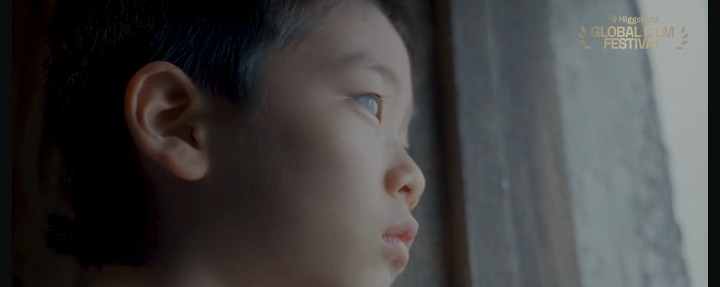
The most remarkable thing Haey does, and the reason this review exists, is refuse to treat Haey’s blindness as a limitation to be pitied or overcome. The film never frames him as a boy who is missing something. Instead, it builds its entire sensory language around what he does have. We feel the wind the way he feels it. We hear the waves the way he hears them. His hand trails along the wooden walls, reading the house the way sighted people read with their eyes. The camera lingers on the things he touches, not the things he cannot see, and in doing so, the film makes a quiet but powerful argument: a full, rich, deeply loved life was never contingent on sight to begin with. Haey’s world is not smaller for being experienced through sound and touch. It is simply different, and the film treats it with total dignity.
And then there is Gilwoo, whose love for this boy is the quiet engine running beneath every scene. He is not a demonstrative man. He scolds the boy for losing a shoe in the surf, he goes about his daily chores without fuss, and yet every gesture he makes carries the weight of someone who has built his entire remaining life around another person’s happiness. The moment he takes the walking stick from the boy’s hand and simply holds his hand instead is one of the most tender pieces of unspoken direction I’ve seen in a film this short. It says, wordlessly, what the whole film is about: I don’t need you to find your own way when I’m still here to walk beside you.
That line, said about a pair of old shoes, is obviously never really about shoes. It’s the film’s thesis stated plainly, and it pays off completely by the final frame. Nothing we love, and no one we love, has to be left behind simply because life moves forward. We carry them. That’s the whole film, distilled into one sentence a grandfather says to a child about footwear.
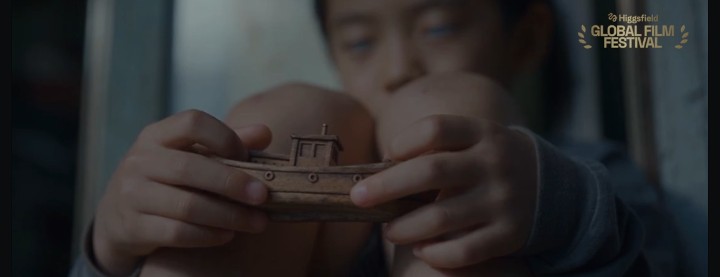
The starlit boat sequence is the film’s one deliberate departure from its otherwise cold, weathered visual language, and it earns that departure completely. It’s gorgeous, dreamlike, and it’s unclear whether we’re watching a memory, a longing, or something that never happened at all, and that ambiguity is exactly the point. It’s also where the film delivers its most devastating reveal: Gilwoo telling the boy that the most precious thing he ever caught was a fish, before the film cuts to Haey as an abandoned infant, crying and tangled in a fishing net on the shore, and Gilwoo lifting him free. It recontextualizes everything that came before it. This was never a story about an old man and a boy who happened to live together. This is the story of a man who found something precious in the most unlikely place and chose, every single day since, to keep it.

I have to talk about the score, because it’s doing so much of the emotional heavy lifting here, and it does it beautifully. The original song that plays as Haey walks through the house, sung in Korean, is hauntingly gorgeous even without understanding a word of it, which is exactly as it should be in a film this attuned to feeling over explanation. Its theme, “we will never be torn apart, we remain as warmth, becoming each other’s lighthouse,” is one of the most quietly beautiful lyrical ideas I’ve come across in any short film this year, and it earns every bit of its placement here. The score doesn’t swell to tell you how to feel. It simply sits underneath everything, the way grief and love both do, present but never overbearing.

The ending ties it all together with remarkable restraint. Gilwoo, ill and failing, climbs the lighthouse stairs one final time as a storm swallows the island whole. Far out at sea, a captain searches blindly through the fog for any sign of light. And then it comes, faint, fading, returning, brightening, fading again. The film never tells us whether that light is the lighthouse, a memory, or something else entirely, and it doesn’t need to. What matters, the film insists, is not who saved whom, or who was lost first. What matters is that for a while, two people became each other’s light. The closing dedication, “for my grandmother who taught me the meaning of true love beyond the limits of sight,” recontextualizes the whole film one final time, and it lands like a quiet gut-punch.
Haey is a small, beautifully restrained film carrying an enormous message: that love doesn’t require sight to be complete, and that the people we love most deeply never really leave us, even when we can no longer see them either. It is gentle, it is devastating, and it is one of the most quietly inspiring short films I’ve reviewed. If the festival is looking for its Best Picture, it should look here first.
Scene-by-Scene Breakdown
The film opens on a small boat tied to a dock, the water choppy beneath it. A quiet, unsettled opening that sets the tone immediately.
A young boy climbs the stairs calling for his grandfather. “Grandpa, I think the sea is angry.” A simple line that quietly establishes both his closeness to Gilwoo and his attunement to the world through sound.

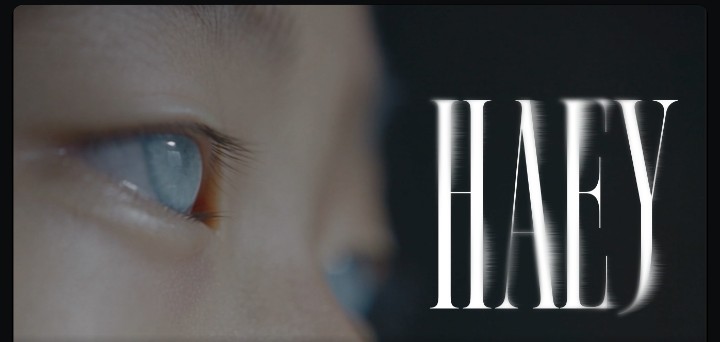
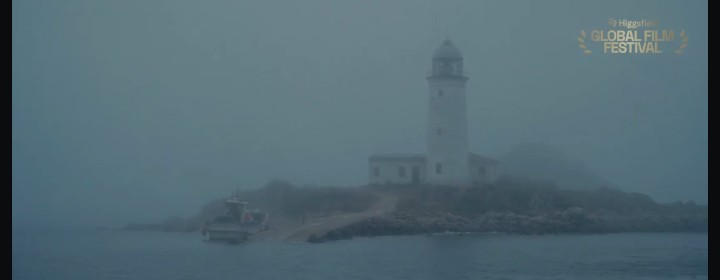
A beautiful shot of the lighthouse wrapped in fog as the title “Haey” appears. Atmospheric and immediately evocative.
Gilwoo warms water on the stove and pours tea as a captain arrives at the lighthouse by boat. A small, domestic moment that grounds the island’s isolation.
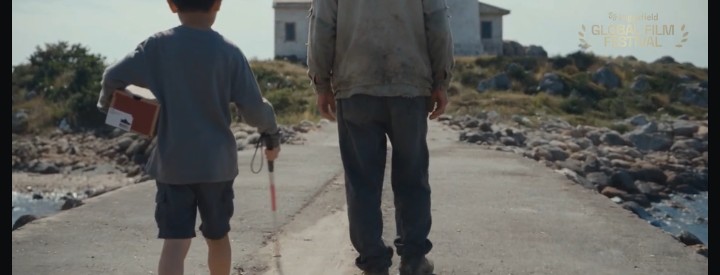
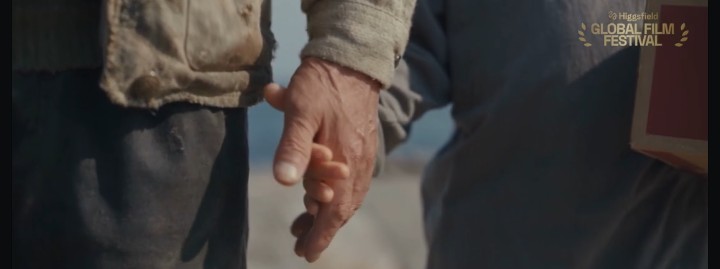
The captain gives the boy a new pair of shoes before departing. Gilwoo and Haey walk back to the lighthouse together, and in the film’s most tender piece of unspoken direction, Gilwoo takes the walking stick from the boy’s hand and simply holds his hand instead.
Haey walks the island alone with his cane, following the paths through the tall grass. A quiet moment of independence and trust in his own senses.
Haey stands on the sand, letting the water touch his feet, his shoes set beside him. Peaceful, unhurried.
One shoe is swept away by the tide. Haey walks on into the evening wearing only one shoe, not yet aware of the loss.
Gilwoo lights the old oil lamp with a match. A small ritual, repeated and familiar.
The original song begins, sung in Korean, hauntingly beautiful even without translation. Haey walks through the house, his hand grazing the wooden walls as he moves — reading his home the way sighted people read with their eyes.

“You don’t have to leave them behind just because you got new ones,” Gilwoo says, about the lost shoe. The film’s thesis, stated plainly through the smallest possible object.
Haey asks his grandfather to help find his shoe. They set out on a boat, the night sky filled with stars, their reflections visible on the water as they talk. Haey asks if Gilwoo has ever caught a big fish. He says yes — it was the most precious thing in the world.
The film’s emotional centerpiece. As Gilwoo finishes telling the boy that the fish he caught was the most precious thing in the world, the film cuts to Haey as an abandoned infant, left near some boxes by a fishing net. The baby cries and becomes tangled in the net; Gilwoo, arriving at the dock, hears him and pulls him free. A devastating, beautifully placed reveal that recontextualizes everything about who these two are to each other.
Gilwoo prepares vegetables as they talk. Haey asks if it’s almost time for school. Gilwoo confirms it’s nearly time for him to go to shore. Haey tells him he wants to stay on the island with him forever.
Haey tells Gilwoo it’s time for him to go — he already knows the way. A small moment of growing independence, bittersweet against everything we now know.
The weather worsens. Gilwoo begins coughing, clearly unwell. At the dock, the captain and his helper discuss needing to retrieve him before his condition worsens.
Gilwoo, coughing and weak, climbs the lighthouse stairs to light the beacon one final time as a storm swallows the island. The captain’s boat loses its radar in the thick fog, unable to see anything. Then, faintly, a light appears — fading, returning, brightening, fading again. The restraint here is remarkable; the film never confirms what the light is, only that it appears exactly when it’s needed most.
The closing dedication: “For my grandmother who taught me the meaning of true love beyond the limits of sight.” A final, deeply personal note that reframes the entire film one last time.
Reader Reviews
There are no reviews yet. Be the first one to write one.