

 Outreal Production
 Creator ID26-11-00-0084


Score breakdown
2 views on Kineograph
Film Review
Written by Kineograph
Juan Sebastián de Villamar and his gang of musical outlaws crash the wedding of Avela del Río to steal her family’s treasure — a golden revolver encrusted with diamonds — but the bride turns out to be the one thing nobody planned for.
This review discusses the ending. If you would rather watch the film first, we recommend you do, and then come back.
¡Ah! ¡El Amor!
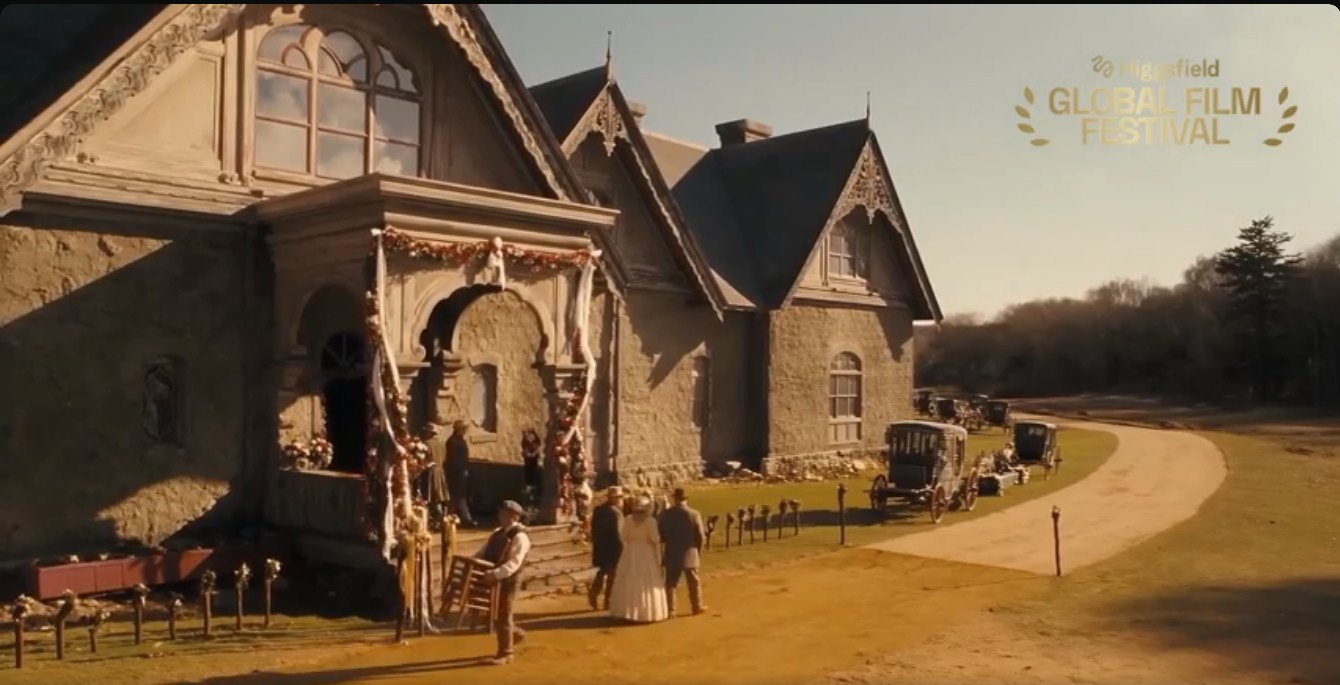
It begins at the wedding itself: a stone house, carriages on the drive, and the bride in white, while our narrator introduces himself with the flourish of a man who has rehearsed it — Juan Sebastián de Villamar, telling us about love, and about Senator Augusto del Río, one of the richest men in the territory. The narration is the film’s engine and its best joke delivery system: everything we learn arrives in Villamar’s voice, pleased with itself, assured, and only loosely related to how events actually turn out.
“So I Brought The Mountain”
The plan is laid out crew by crew, and the introductions are the best writing in the film — every man defined by the gap between his job and his gift. Ficelle the barman will keep the guards drinking all night, until they are far too drunk to guard a thing. Men are planted among the musicians: the blonde one has magic in his hands. One of them is a hopeless lover of women whose true passion was guns — sadly, his talent with a pistol never quite matched his talent for music. And for the heavy work, the line this section is named for: Villamar brought the Mountain, a man the size of his nickname, currently peering out of hiding beside his leader like a boulder trying to be inconspicuous.
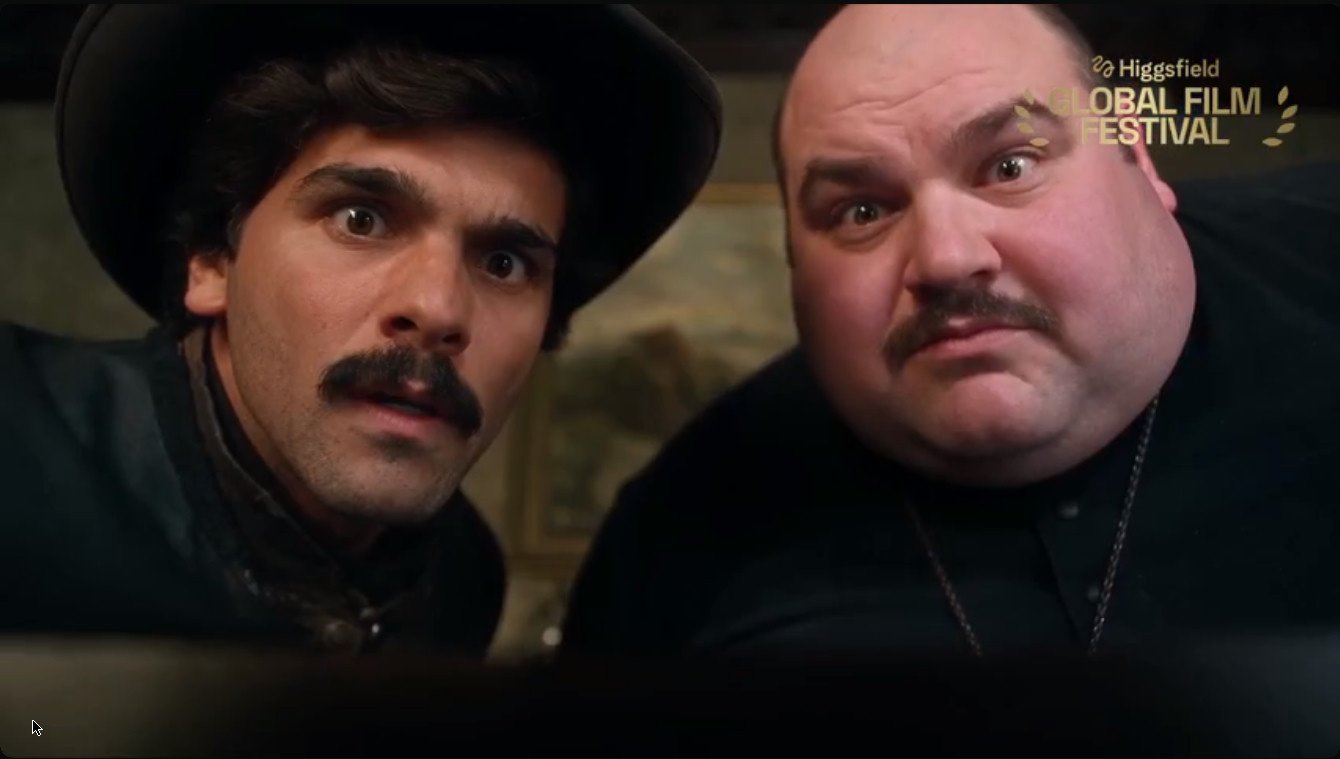
It is economical, confident comedy writing: by the time the gang announces that tonight they play for the newlyweds — and especially for the beautiful bride — we know exactly who these people are, which is to say, exactly how this is going to go wrong.
You Never Stood A Chance
It goes wrong quickly. The plan leaks — someone has gone and told the whole thing — and something essential is lost in the scramble, mislaid at the worst possible moment. Then Senator del Río has them where he wants them, and he is delighted about it: did they really believe men like them could outsmart a del Río? Fools. They never stood a chance against him.
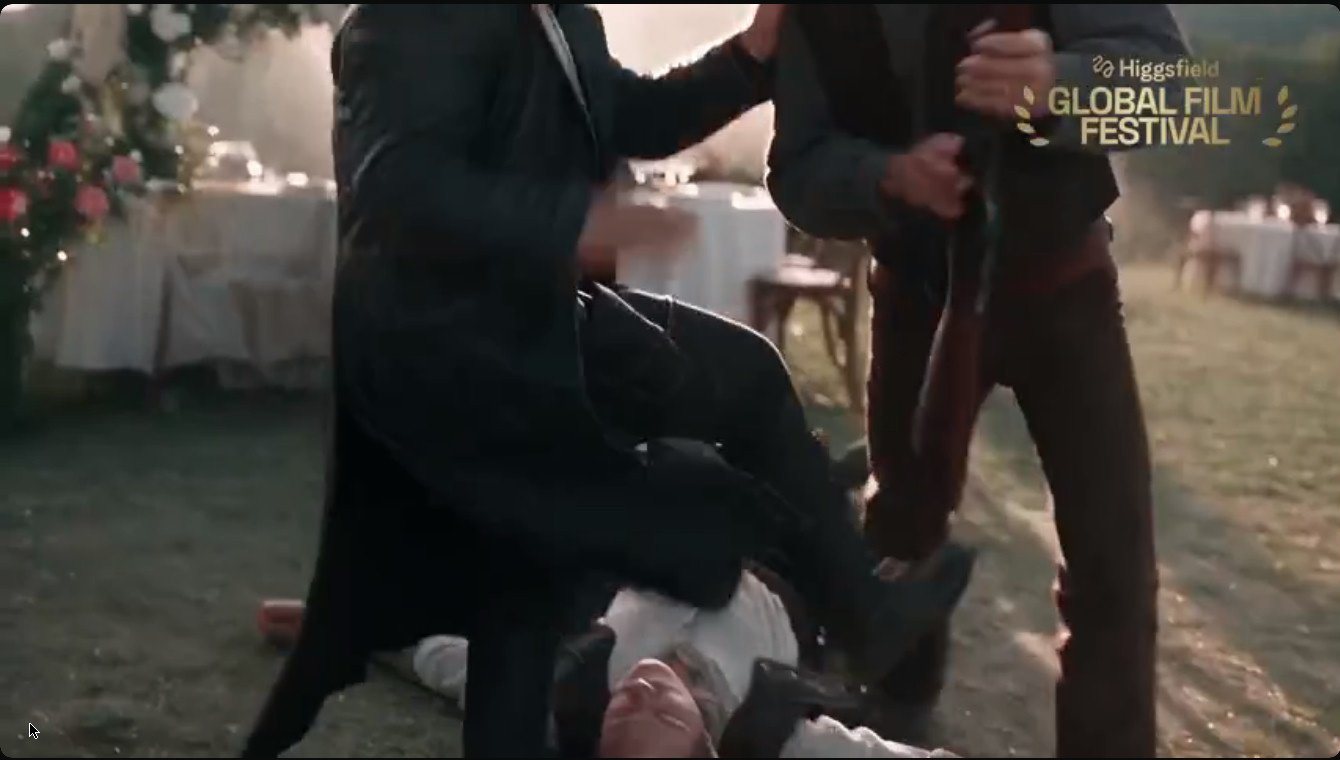
He shows them the prize anyway, because men like del Río cannot help it: the golden revolver, encrusted with diamonds, the family treasure for generations. And the centrepiece of the evening, presented like another item of property: Avela del Río, the bride herself. There is a grapple at a wedding table, hands everywhere, the plan in pieces on the terrace floor — and then, somehow, the gang has the revolver, and it is time to disappear. Count of three. Gone.
Best Scene (7:22–8:20)
The escape, the pony, and the line
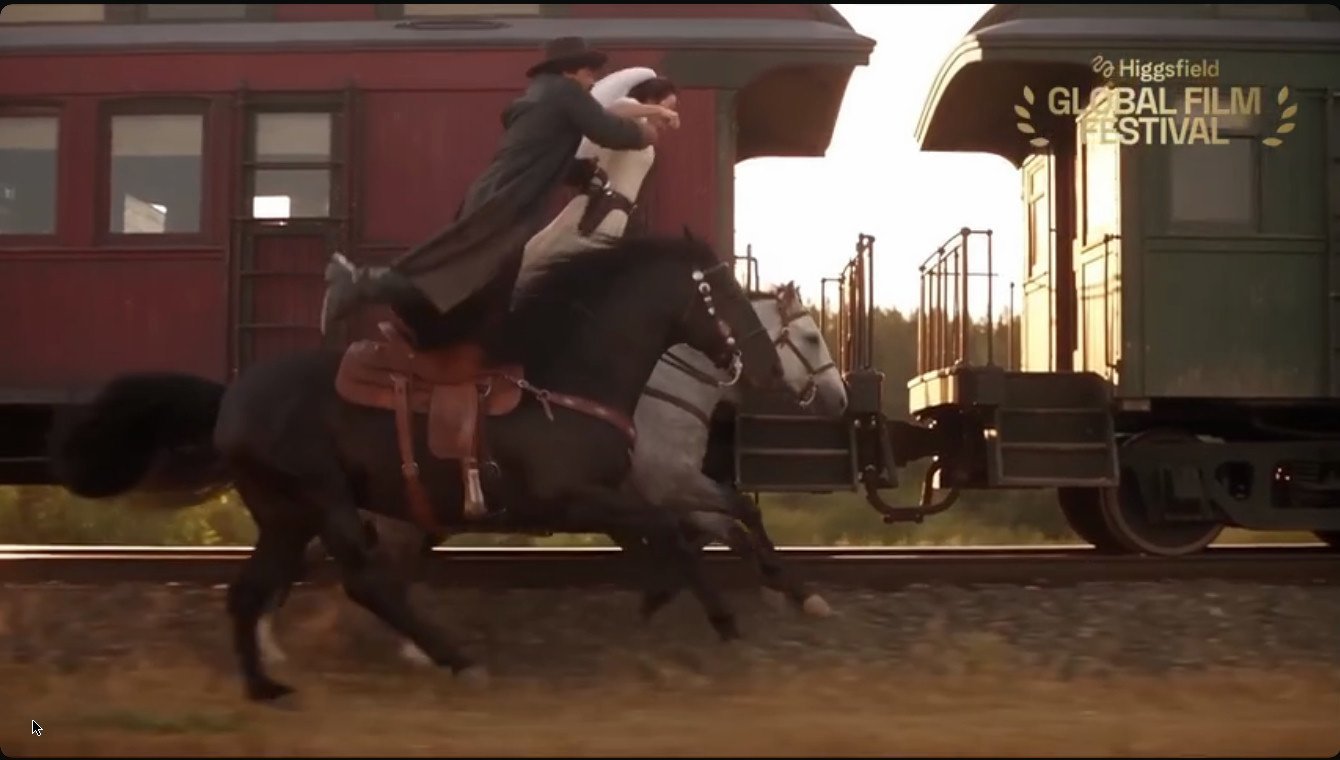
The escape is pure western joy: Villamar on a black horse beside a red train, the bride in white riding in front of him, and the train song rolling over it all — jump that train, baby, don’t look down. And then the film produces its signature image, which I have to describe because words are what it deserves: three of them — the bride, the Mountain, Villamar — squeezed onto one tiny pony, galloping beside the train.
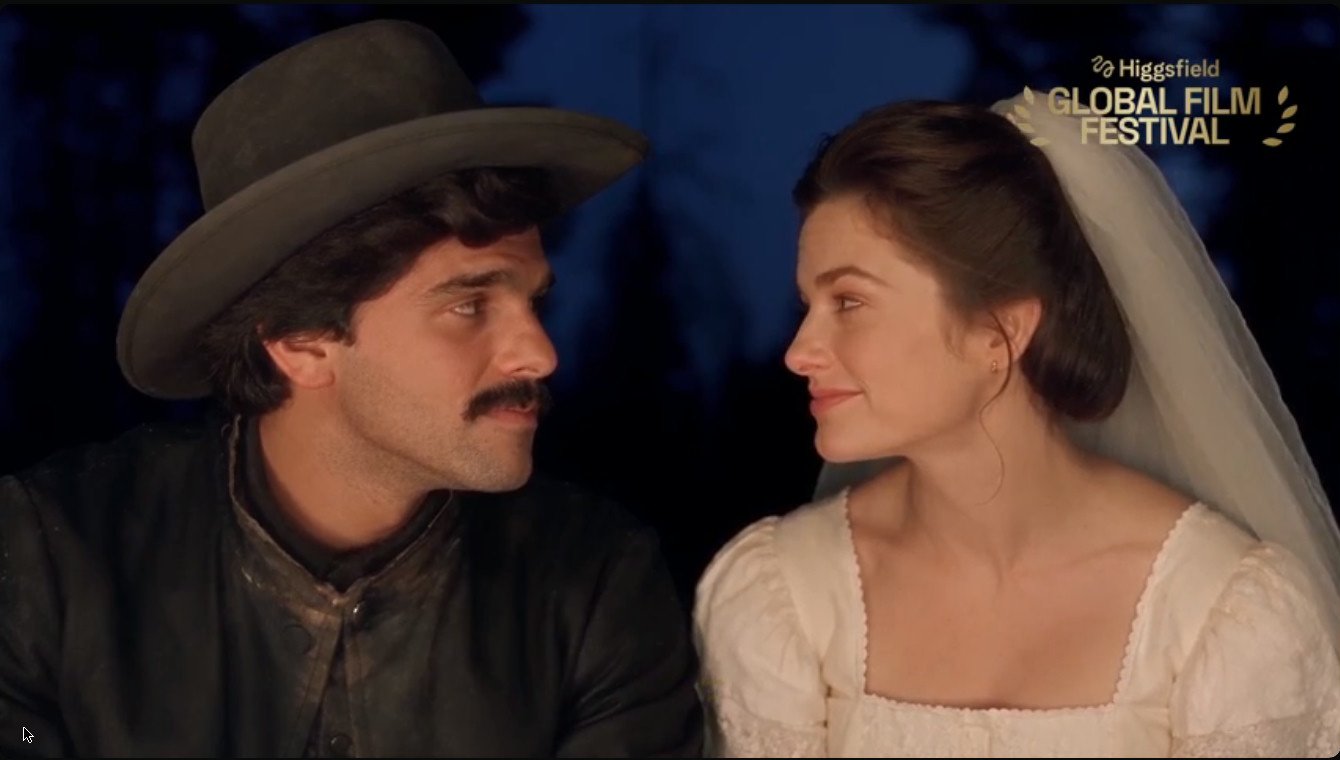
Let me be fair in both directions. As AI craft, it is a scale error, plain and simple: the pony is far too small for its riders, and no amount of charm changes the measurements. But the film plays it completely straight, nobody on screen finds it odd, and as comedy it is the funniest shot in the film — the flawless plan’s final form. Then the song settles, the light goes blue, and the comedy steps aside for one quiet exchange. Avela is asked, in effect, about stealing from her own father. Her answer is the film in one line: “He was never my family. You are.”
Chapter One, And Proud Of It
The ending refuses every tidy option. There is no arrest, no dawn reckoning, no return of the revolver or the jewels; the gang simply rides on, the bride with them, under a starry sky and a title card. The studio is explicit that this is the first chapter in a larger world, and the film wears that openly — the heist resolves, the story doesn’t, and the varmints are left mid-gallop, exactly where a serial western wants them.
On craft, the honest notes are small ones. Faces and moustaches morph slightly between close-ups, hands on guns and reins are simplified, the horses and the train do not always move at speeds that match the ground, and now and then the gallop floats. None of it stops a joke, and at nine minutes the film is over before any of it can accumulate. This is a Brussels studio’s first AI film, made entirely inside Higgsfield’s own tools, and its control of tone — broad comedy outside, one sincere line at the centre — is the thing the next chapter has to protect.
Final Thoughts
Varmints is a heist that steals the wrong thing on purpose: the gang came for the treasure and left with the bride — and the bride is the only one who got exactly what she wanted.
I would recommend it to anyone who likes their westerns affectionate and their comedies quick: nine minutes, a diamond-encrusted revolver, one very small pony, and a heroine who treats being kidnapped as the first good decision of her life. Chapter two has a great deal to live up to — starting with the fact that chapter one got away with everything.
Scene Breakdown
0:00–0:55 — The wedding venue; Villamar introduces himself, and the del Río family’s wealth.
0:55–2:45 — The plan, crew by crew: Ficelle at the bar, the musicians, the lover, the Mountain.
~3:00–4:00 — The plan leaks; something is lost; the gang scrambles.
4:00–5:30 — Del Río’s confrontation; the golden revolver shown; the scuffle at the wedding table.
5:30–6:00 — The gang has the revolver: time to disappear, on the count of three.
6:00–7:20 — The escape: a black horse, a red train, and the bride in white.
7:22–8:20 — Best Scene: the train song, the tiny pony, and the face-to-face at night.
8:50–9:11 — The end title card: a film by Jacob Maizel & Ismaël Sall, produced by Outreal Production.
~7:22 — Three grown outlaws ride squeezed onto one tiny pony beside the train — a genuine scale error that plays as a deliberate sight gag. Both things are true, and it is listed with a smile.
Throughout — Horses and the train move at speeds that do not match the ground passing under them, and the gallop sometimes floats.
Throughout — Faces, moustaches and hats morph slightly in close-up, and the hands on guns and reins are simplified.
Made entirely with Higgsfield AI (Soul, Clips-to-video, Storyboard and the Dialogue feature) by Outreal Production, Brussels, Belgium — the studio’s first AI film. Shortlisted at the Higgsfield Global Film Festival: one of the 126 films retained for the final.
There are no reviews yet. Be the first one to write one.