 KINEO
No One Saw
The Film Score


AI Slop Meter
Mostly clean 7.0/10Find this film in
Festivals and Awards
 Higgsfield Talent Contest
Score Breakdown
| Storytelling | 9.0 |
| Emotional Connection | 9.0 |
| AI Tool Management | 8.0 |
| Visual Craft | 8.0 |
| Writing & Dialogue | 6.0 |
| Soundtrack | 6.0 |
| Originality | 8.0 |
| Polish | 8.0 |
| Rewatch Value | 8.0 |
| Weighted total (/12) | 8.0 |
⚠ Report a problem with this video
Kineograph does not host films on its platform. This video is embedded from the creator’s own account on a platform such as YouTube, TikTok, Instagram, Facebook or Suno. Any ads you see on this video are handled by that platform and the creator. Kineograph does not own this video and does not receive any ad revenue from it. We encourage you to support and follow the creators whose work is showcased on Kineograph. Visit their social media and/or personal websites.
Film Review
This review discusses the ending. If you would rather watch the film first, we recommend you do, and then come back.
Synopsis
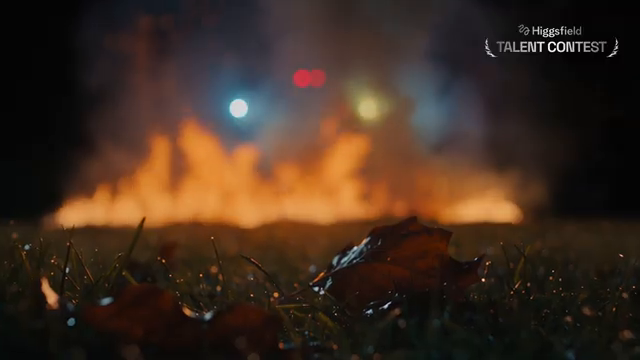
The film opens at night, on a fire: a wet autumn leaf in the foreground, flames blazing behind it, emergency lights washing the dark in blue and red. A firefighter finds a little ceramic gnome lying on his back in the wet leaves — red pointed hat, white beard, blue tunic, a small axe in his hand — and looks down at him. Then a black screen, and a single card: "Three days earlier."
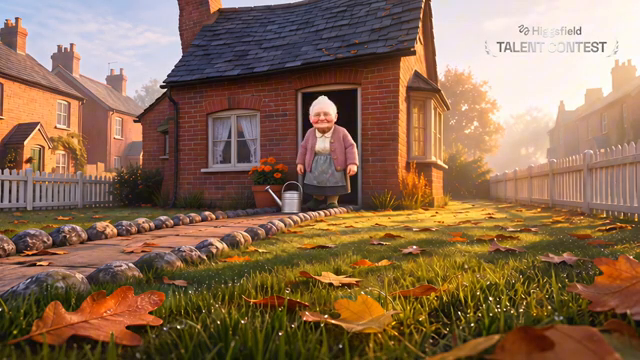
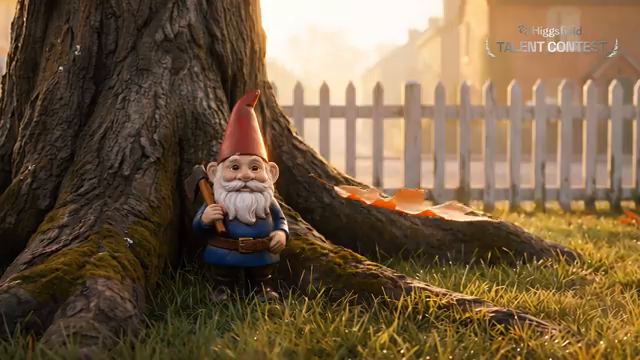
Morning. The gnome stands under the old oak in the front garden of a small red-brick cottage, an orange leaf falling past him. The woman who lives there comes out of her green door — white hair in a bun, pink cardigan, floral apron, a metal watering can in her hand — and walks down the stone path to where he stands. She turns him to face the street, the way she does every morning, and goes back inside. That is the routine, and the film lets us live in it for a while: the sunlit garden, the white picket fence, the leaf piles, the dog that passes behind the fence at night. Every morning she turns him to face the street. Every night he turns back to watch her door. She notices — she is puzzled by it, she keeps finding him turned around — but she does not understand it.
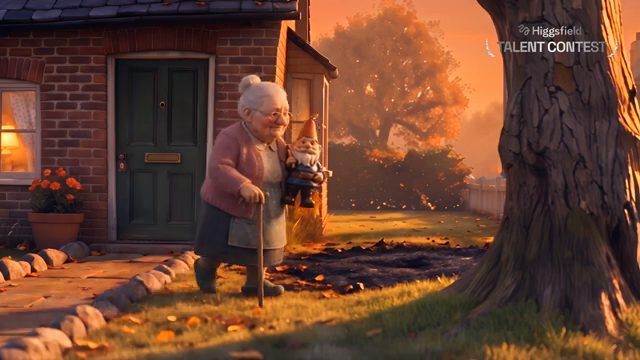
Then one morning she does not come out. The gnome cannot speak, cannot call out, cannot knock. So he does the only thing he can. He raises his arms to the street. He lights a leaf on a stick like a torch, holds the flame up to his own face, and sets the dry leaf pile alight — a signal fire, built from the one thing he has. The pile goes up. The flame fills his glossy ceramic eye. And by the morning after, he is lying face-down in the scorched black earth under the oak, and the woman — alive, hunched over her cane, in the golden light — walks out to the blackened patch, finds him, and picks him up. She stands by her green door, smiling down at the gnome held in her arm, the scorched patch behind her under the oak. The title lands there: no one saw what he did — except, at last, her.
A Fire, Then Three Days Earlier
The cold open is the film's smartest decision, and it is worth saying plainly why. We see the fire first, before we know anything — the leaf, the blaze, the boots of the firefighter standing over a fallen gnome — and only then does the film step back three days and show us the gentle routine that led there. That order changes everything we feel about the quiet middle of the film. Without it, the morning scenes would be pleasant and slight: a woman, a garden, a gnome. With it, every small act of turning is loaded, because we already know where the turning leads. The film never has to tell us the stakes. It shows us the end first, and then makes us wait for it.
The routine itself is filmed with real patience. The cottage is a complete little world — red brick, green door, orange flowers in a pot, stone path, white picket fence, the oak with its autumn leaves — and the film returns to it from enough angles that it stops being a backdrop and becomes a place. The woman's morning walk down the path, watering can in hand, is the film's thesis in miniature: a small, daily, unremarkable act of care, repeated until it becomes the whole story.
There is a risk in a film with no dialogue, which is that the images have to do all the explaining, and No One Saw trusts its images more than most films would dare to. The gnome's turn is the whole plot. He faces the street in the morning because she turns him. He faces her door at night because that is where his attention lives. Nobody says any of this. The film simply shows it happening, day after day, until the pattern is unmistakable — and then it breaks the pattern, and the break is the story.
Turned Around
The middle of the film is a study in small movements. The gnome under the oak in the morning sun, an orange leaf falling past his hat. The gnome at night, a fallen leaf resting on his red hat, the street lamp and the lit windows across the road behind him. A brown dog with a red collar passing behind the fence. And the turn itself, repeated until it becomes a kind of language: her hands on his ceramic shoulders in the morning, turning him outward; his slow turn back toward her door when the dark comes.
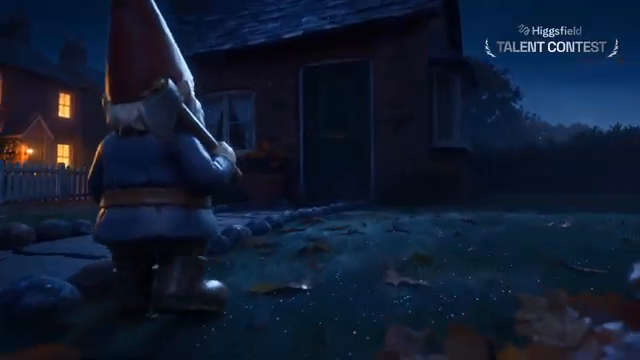
What makes this section work is that the film never makes the woman foolish for not understanding. She is puzzled, not blind — she notices him turned around, day after day, and she keeps correcting it, the way you would correct a thing that keeps ending up in the wrong place. The film lets her be a person with a routine of her own, not a prop in the gnome's story. Her watering can, her cane, her slow walk down the path: these are the details of a life lived alone, and the film respects them enough to linger. That respect is what makes the ending land. When she finally holds him, it is not a stranger's rescue. It is a woman who has been tending a garden, and a gnome who has been tending her, finally seeing each other.
If there is a softness here, it is that the middle asks the viewer to sit with repetition for a while, and the repetition does not deepen so much as accumulate. The night shots are beautiful — the gnome small against the dark cottage, the windows lit across the road — but two or three of them say the same thing. The film knows what it is doing, and the accumulation is the point, but a viewer who wants the story to move will feel the wait. I came to read the wait as the design: devotion, in this film, is not a single grand gesture. It is the same small turn, night after night, until the night it matters.
The Signal Fire
Then the morning she does not come out, and the film changes register entirely. The gnome raises his arms to the street — a small figure, ceramic, powerless, with nothing to signal with except what is already lying around him. He lights a leaf on a stick like a torch. The flame catches his face, and for a moment the whole film narrows to that one image: a garden ornament holding fire up to his own face, doing the only thing he can do.
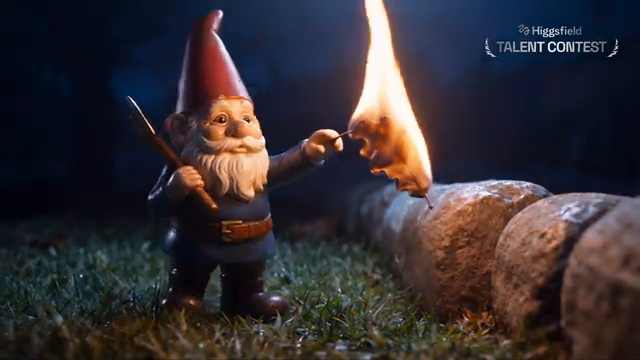
The leaf pile goes up, and the film holds on the blaze, and then on the extreme close-up that is the film's boldest shot: the flame reflected in the gnome's glossy ceramic eye. It is a strange, arresting image — a creature made of glazed clay, catching fire in his own eye — and it is the moment the film stops being gentle. The gnome collapses in the scorched earth, face-down in the blackened ground under the oak, and the film does not soften it. The morning after is a wide shot of a black patch where the garden used to be green, and the gnome lying in it, small and still.
Here I have to be honest about the one place the film leaves me wanting. It does not show what happened inside the house that morning, and it does not stage the rescue itself. We see the signal fire, and we have already seen the firefighter in the opening, and the next morning the woman is alive and walking out to the scorched patch — but the film never shows us the middle of that chain, the moment help reached her door. The viewer puts the pieces together, and the pieces do fit, but the film asks us to do that assembly at the exact moment its story is at its most urgent. It is the one elision in a film that otherwise shows us everything it needs to show, and I felt it. The silence that is the film's great strength — its refusal to explain — is, here, also the place where a single image of the rescue would have closed the circle.
Being Held
What the film does show, and shows beautifully, is the morning after. The woman comes out in the golden light, hunched over her cane, and walks to the scorched patch, and looks down at the gnome lying face-down in the blackened earth. She bends — slowly, the way an old woman bends — and picks him up. And then the film's last image, held until the fade: she stands by her green door, smiling down at the gnome held in her arm, the scorched patch behind her under the oak, the morning light on the brick and the leaves.
This is the scene the whole film has been walking toward, and it works because it is not a rescue spectacle. There is no speech, no tears. She holds him, and smiles, and the film holds on that, and then it fades to black. The title card follows — "No One Saw" — and the title, which could have been a shrug, lands as a statement of fact and then as its own quiet reversal: no one saw what he did, except, at last, her. Being held is the payoff. Not being saved, not being thanked. Being seen, after being turned around and overlooked day after day, by the one person whose seeing matters.
A word for the silence, because the silence is the film. There is no dialogue in No One Saw — none at all — and the film never once reaches for a workaround: no narration, no dialogue, and only a handful of words on screen — a single date card, the title, and the director's name — no explanatory text. The story is told in turns and glances and the position of a small ceramic body in a garden. An original score and sound design are credited in the description, and I have not assessed the score separately here. The gnome's devotion is wordless because he is wordless, and the film honors that by staying wordless with him.
Best Scene (3:28–4:05)
"The Signal Fire"
Night, under the oak. The gnome holds a burning leaf on a stick like a torch beside the huge pile of dry leaves, and the flame lights his face — his red hat, his white beard, his small axe still slung on his back, the fire catching in his eyes. He is a garden ornament holding fire, and the image is at once absurd and completely serious: this is the only signal he has, and he is going to use it. The pile goes up. The flame fills the frame, and then the film cuts to the extreme close-up — the fire reflected in the gnome's glossy ceramic eye, the whole blaze caught in a single glazed bead — and holds it. It is the best scene because it is the film's argument made visible: devotion, when it has no voice and no hands that work the way hands should, looks like this — a small thing setting fire to the only thing it owns, so that someone else might be seen. The collapse that follows, the gnome face-down in the scorched earth, is the price of the signal, and the film does not look away from it.
Final Thoughts
No One Saw is a small film that knows exactly how small it is, and that is why it works. It takes one idea — a gnome who watches a door — and follows it to its end without once raising its voice, and the end it finds is not a rescue but a recognition: being held, being seen, after days of being turned around. Its middle repeats itself, and it leaves the rescue itself for us to assemble — but its images are patient, its structure is sure, and its final frame is the kind that stays with you after the fade. Verdict: a wordless fable about the smallest devotion, and the morning it is finally seen.
★★★★ — A gnome, a door, and a signal fire no one saw
Scene Breakdown
0:00–0:10 — The cold open. Night. The film fades in on a wet autumn leaf in the foreground, a large fire blazing out of focus behind it, blue and red emergency lights washing the dark. A firefighter finds the gnome: top-down, the gnome lies on his back in wet leaves and mud, red pointed hat, white beard, blue tunic, holding a small axe, two large black firefighter boots standing over him. Close-up of the firefighter, moustached, in a dark uniform, looking down.
0:53 — "Three days earlier." Black screen, white serif text. The film steps back.
~0:55–1:05 — Morning, flashback. Close-up of the gnome under the old oak, red hat, white beard, blue tunic, axe at his side, an orange leaf falling. White picket fence, sunlit brick houses.
~1:05–1:40 — The woman comes out. The elderly woman leaves the red-brick cottage — pink cardigan, floral apron, white hair in a bun, smiling, carrying a metal watering can; orange flowers in a pot by the green door. She walks down the stone path toward the gnome. Low-angle shot of her in the doorway.
~1:40–2:15 — The routine. Daytime. The gnome stands under the oak facing the street and the gate, as she has turned him. Leaf piles, stone path, picket fence.
~2:00–2:55 — Night. Close-up of the gnome under the oak, a fallen orange leaf on his red hat. A shot from behind: the gnome, arms raised toward the street, axe on his back, street lamp and lit windows across the road. The gnome under the oak, now turned back to face her house and door. A brown dog with a red collar passes behind the fence.
~3:00–3:30 — The torch. Night. The gnome holds a burning leaf on a stick like a torch beside a huge pile of dry oak leaves; the flame lights his face. His axe is slung on his back.
~3:30–4:05 — The blaze. The dry leaf pile is ablaze. Extreme close-up: flame reflected in the gnome's glossy ceramic eye.
~4:00–4:40 — Morning after. Wide shot: a scorched black patch under the oak, the gnome lying face-down in the blackened earth. The woman, hunched, with glasses, walks with a cane in golden light and looks down at the scorched spot.
~4:40–5:20 — She finds him. She retrieves him. She stands by her green door, smiling down at the gnome, now held in her arm, cane in her hand; the scorched patch is visible behind her under the oak.
~5:20–5:45 — The hold. Final hold on her holding him; fade to black.
5:47 — Title card. Black screen: "No One Saw" / "Directed by: Sherif Azmy."
5:54–6:03 — Promo card. Black screen: "CREATE A FILM LIKE THIS ON" / "CINEMA STUDIO 4." End.