 KINEO
Mission: Misrobbery
The Film Score


AI Slop Meter
Some slop 5.5/10Find this film in
Festivals and Awards
 Higgsfield Talent Contest
Score Breakdown
| Storytelling | 8.0 |
| Emotional Connection | 7.0 |
| AI Tool Management | 7.0 |
| Visual Craft | 8.0 |
| Writing & Dialogue | 6.0 |
| Soundtrack | 6.0 |
| Originality | 8.0 |
| Polish | 7.0 |
| Rewatch Value | 7.0 |
| Weighted total (/12) | 7.2 |
Watch on Higgsfield
⚠ Report a problem with this video
Kineograph does not host films on its platform. This video is embedded from the creator’s own account on a platform such as YouTube, TikTok, Instagram, Facebook or Suno. Any ads you see on this video are handled by that platform and the creator. Kineograph does not own this video and does not receive any ad revenue from it. We encourage you to support and follow the creators whose work is showcased on Kineograph. Visit their social media and/or personal websites.
Film Review
This review discusses the ending. If you would rather watch the film first, we recommend you do, and then come back.
Synopsis
Two masked thieves in a rusty yellow van drive through the night to a moonlit palace. The tall one, Charlie, and the short, round one, Buster, put on their black balaclavas, talk about the watchman asleep by the gate, and try to climb the high palace wall — and collapse in a tangled heap at its foot. Inside, one of them pauses to admire himself in a tall mirror, they crouch over a treasure chest in a room full of books, study a floor plan of the palace, and get hungry enough to steal apples and bananas instead of gold. A black cat rides on Charlie's head through a doorway, unbothered. In the bedroom they creep past a sleeping man by oil-lamp light while Charlie reaches for a small gold statue on the bedside table, and a small half-asleep voice calls after its teddy. They leave with a sack and tell each other the mission is complete and they are rich men now. Then the camera pulls back, and everything changes: the two thieves have walked in on a movie set where a robbery is being filmed — the crew is standing around with a camera on a dolly, a boom and lights — and the real actors show up, and the thieves are caught. A narrator closes with a moral about thieves who thought they could get rich by plundering and ended up a laughing stock. The film ends on a single gold card: "A FILM BY VENKY."
The Van, the Wall and the Gate
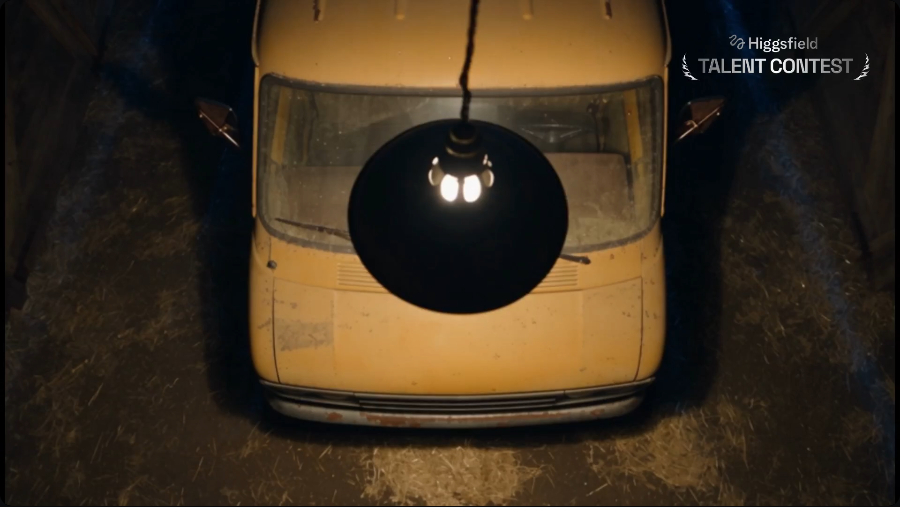
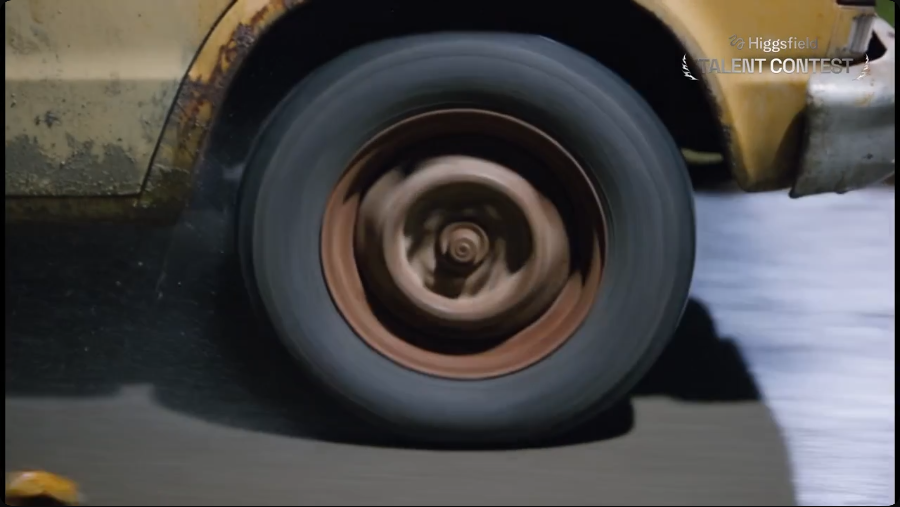
The film opens on its best image and never quite tops it. An overhead shot of the rusty yellow van in a dark garage, a black bulb lamp hanging in the foreground, the van's roof filling the frame — it is a poster of an opening, and it tells you everything about the tone in one frame: night, rust, and two men about to make a mess of something. The pair put on their masks at the back of the van, posing for the camera like men who have seen too many heist films, and then the van is speeding down a misty road, the wheel spinning in close-up, the palace waiting in the dark.
The wall is where the film finds its comedy. One of them has the plan — "Bro, let's climb over that wall and get inside" is the clearest line in the film, and it is delivered with the confidence of a man who has never climbed a wall — and the attempt ends exactly as it should, with a thief flat on his back at the foot of the stone wall, legs in the air, the other one somewhere in the heap beside him. They talk about the watchman asleep by the gate, and about waking him to open it, which is the kind of plan only these two would come up with. The watchman himself is never seen — he exists only in their talk — and the film is right not to show him, because the joke is in the planning, not the guard.
Inside the Palace
Once they are inside, the film slows down and lets the pair be funny in small ways. The mirror scene is the best of them: the two thieves stop at a tall mirror, and one of them stares at himself in his balaclava, his reflection staring back with bulging eyes and a small distorted mouth. The dialogue says little about it, and it needs no dialogue — it is a joke about vanity, and it is the moment the film's Laurel-and-Hardy shape locks into place: the tall one who thinks he is in charge, the short one who keeps nearly ruining everything, both of them delighted with how they look.
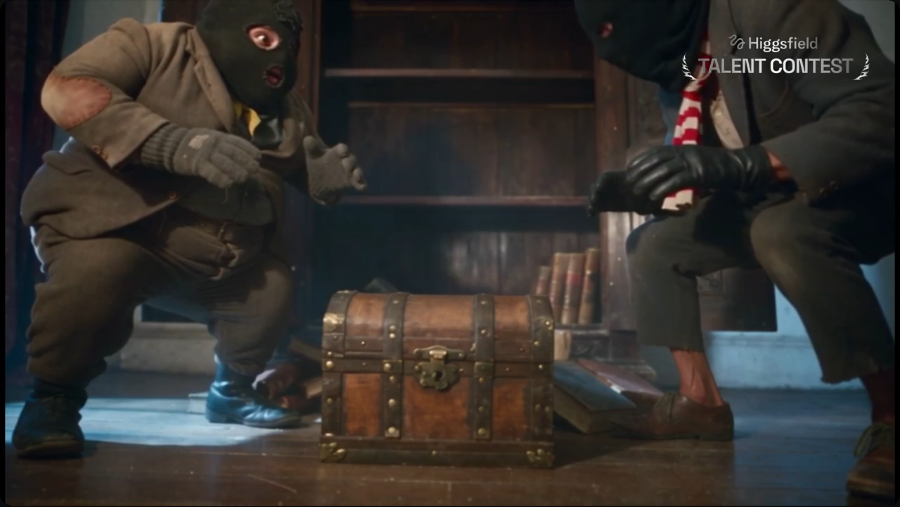
The almirah room is the film's centerpiece of chaos. A tall wooden cupboard full of books, a small treasure chest on a shelf, and the two of them crouched over it while the whole thing wobbles and tips, both of them crying "Oh, no!" as books slide and the chest threatens to go over. The wobble is the joke, and it lands. Then comes the plan: gloved hands pointing at a palace floor plan, its room labels half-legible, the pair studying it like generals. And then hunger, which is the film's most honest joke: the great heist pauses so the thieves can eat apples in a doorway, Buster clutching an armful of apples and bananas to his chest while Charlie bites into one through his balaclava. They came for gold and settled for fruit, and the film knows exactly how funny that is. Somewhere in the middle of all this, a black cat rides on Charlie's head through a doorway, entirely unbothered, as if it owns the palace — a small, perfect piece of nonsense that the film does nothing with and does not need to explain.
The Bedroom and the Sack
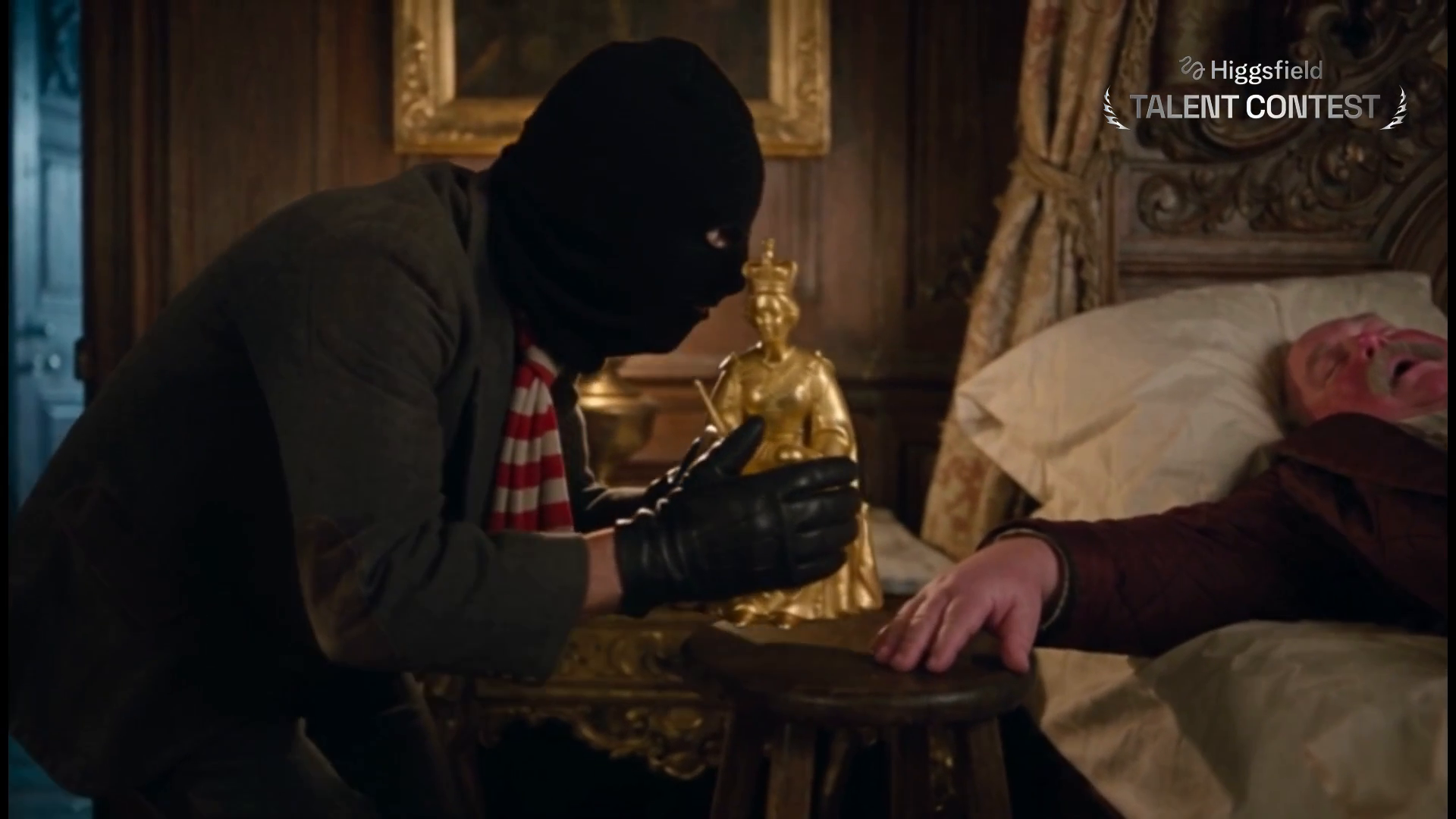
The bedroom is the tensest scene in the film and the one that shows the pair at their most incompetent. They creep past a sleeping man by oil-lamp light — a big mustached man in a dressing gown, snoring with his mouth open — while Charlie reaches for a small gold statue on the bedside table, his gloved fingers closing around it. A small half-asleep voice calls after its teddy, and the two of them freeze. It is the closest the film comes to real suspense, and it works because the film finally stops joking for a moment and lets the quiet do the work: the lamp, the sleeper, the statue, the held breath.
They leave with a sack and tell each other the mission is complete and they are rich men now, and the film lets the boast stand as the payoff — two fools convinced they are rich men, walking out of a palace they never understood. It is the film's joke about incompetence at its purest, and it carries them all the way out the door.
A word for the sound, because the sound is the film's weakest link and its narrator is its strongest. The underscore is a low, tense heist pulse with slapstick thuds underneath, and it does its job. But the thieves' voices are often muffled and slurred, the volume and clarity shift from shot to shot, and with no subtitles several lines cannot be verified exactly — the film loses jokes it has plainly written because the words never quite arrive. The dialogue stays mild apart from a single strong word in the middle stretch, which the transcript caught but I could not verify exactly. The narrator at the end is a different matter: an older male voice, clearer than anything that came before it, and the film visibly steadies the moment he starts speaking. No composer or track is credited anywhere, on the page or in the film.
The Reveal
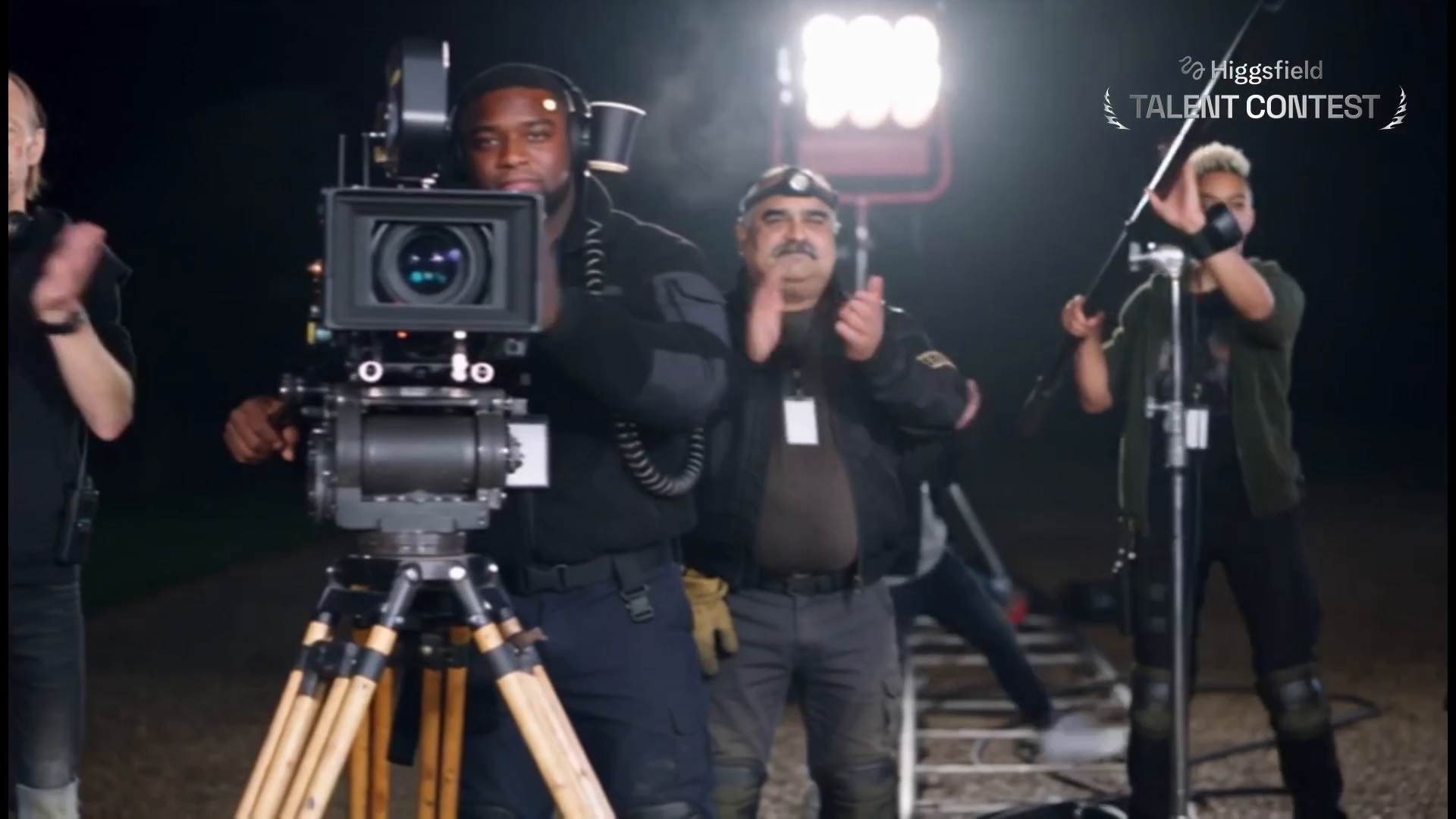
Then the film pulls its trick, and it is a good one. The camera draws back from the palace doorway and the whole thing comes apart in the best way: the palace the thieves have been robbing is a film set, a robbery scene being shot — a camera on its dolly, a boom overhead, lights on either side, and a crew standing around. The two thieves walk out of the palace door into the lights, and the crew, taking them for the actors, praises their performance, comparing them to Charlie Chaplin and Mr. Bean. One of the crew asks, in effect, that if these two are the actors, who are all these other people — and then the real actors show up, and the two thieves are caught. The two men take off their balaclavas at last: ordinary faces, red clown cheeks, holding their masks in their hands and grinning at the lights.
The wide shot that follows is the film's best frame: the whole crew in front of the palace facade, and in the middle of them the sleeping man from the bedroom, now in his dressing gown and very much awake, applauding with everyone else. He was an actor in the film they had walked into, all along. The narrator closes with a moral — that they thought they could get rich by plundering, and ended up a laughing stock, with fate deciding who gets caught and who does not — and it lands because the film has just shown us the mechanism of that fate: not luck, not the law, but a film set and the real actors walking in. The end card is a single line in gold serif capitals on black: "A FILM BY VENKY." No cast, no crew, no music credit, nothing after it.
Best Scene (4:35–5:05)
"The Reveal"
The camera pulls back from the palace door and the set appears: the camera on its dolly in the foreground, the operator behind it, the boom swinging overhead, the lights blazing on either side, and the crew standing around applauding. The two thieves come out of the doorway into the light, and the film holds on the crew's faces — the camera operator, the boom operator, the woman with the pocket watch — all of them watching the two men the way an audience watches a good turn. Then the real actors show up, and the two men are caught. Then the wide shot: the whole company in front of the palace facade, the mustached sleeper applauding in his dressing gown at the center of it, the two thieves still in costume in the doorway behind him. The two men pull off their balaclavas at last, red-cheeked and grinning, holding their masks like hats. It is the best scene because it reframes everything that came before it in a single pull-back — the wall, the mirror, the almirah, the bedroom, the sack — and turns a heist into a blunder onto a film set. The thieves were never going to get rich. They were going to walk in on a robbery being filmed, and get caught by the real actors, and the film knew it all along.
Final Thoughts
Mission: Misrobbery is a small, warm film about two fools who are better at getting caught than they are at getting rich, and it is at its best when it stops pretending otherwise. Its middle sags a little around the plan and the hunger, and its dialogue is too often lost in the mumble. But its images are patient, its physical comedy is honest, its cat is unbothered, and its ending — two thieves walking in on a movie set where a robbery is being filmed, and getting caught when the real actors show up — is the kind of twist that makes the whole five minutes feel like it was going somewhere after all. Verdict: a slapstick heist that knows its thieves are fools, and saves its best joke — that they robbed the wrong place, a film set — for the moment it matters most.
★★★½ — A rusty yellow van, a wobbling almirah, and two thieves caught on a film set
Scene Breakdown
0:00–0:10 — The garage. Overhead shot of the rusty yellow van, a hanging black bulb lamp in the foreground.
~0:10–0:25 — Mask-on. Both thieves in black knitted balaclavas and black gloves at the rear of the van, posing for the camera.
~0:25–0:50 — The drive. The van speeds past, the wheel spinning in close-up; then the van driving away at night beside the stone palace wall.
~1:00–1:15 — The wall. Talk of climbing the wall and of the watchman asleep by the gate; the climb collapses, one thief flat on his back at the foot of the wall, legs in the air.
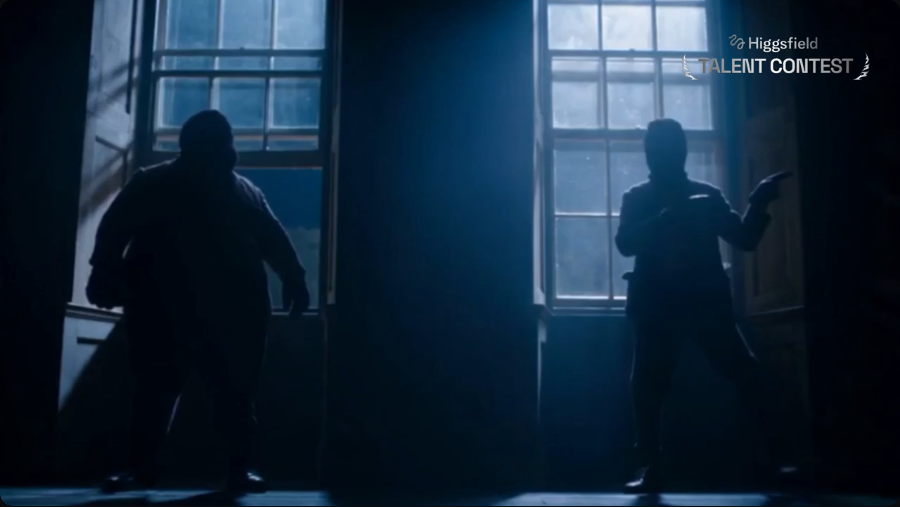
~1:30 — Inside. The two masked thieves as silhouettes by the tall palace windows.
~1:50 — The mirror. The two thieves stop at a tall mirror; one of them stares at himself in his balaclava.
~2:10 — The door. A gloved hand on an ornate door handle.
~2:30–2:50 — The almirah. Both thieves crouched over the treasure chest in the book-lined room; the almirah wobbles, books slide, both cry "Oh, no!"; a close-up of Charlie talking.
~3:00 — The plan. A rolled blueprint tube in a corridor; gloved hands point at the palace floor plan, its room labels half-legible.
~3:20 — The cat. A black cat rides on Charlie's head as he stands in a doorway, unbothered.
~3:30 — Hunger. The pair eat apples in a doorway; Buster clutches an armful of apples and bananas.
~3:50–4:10 — The bedroom. The thieves creep past the sleeping man by oil-lamp light; Charlie reaches for the small gold statue on the bedside table; a small half-asleep voice calls after its teddy; the sleeper alone, mouth open, snoring.
~4:20–4:30 — The escape. The pair hoist the sack between them in the grand hall; then silhouettes in the lit palace doorway, walking out; they tell each other the mission is complete and they are rich men now.
~4:35–5:05 — The reveal. The camera pulls back to the film set: camera on its dolly, boom, lights, crew applauding; the wide shot in front of the palace facade, the sleeper applauding in his dressing gown; the two men unmasked, red-cheeked, holding their balaclavas; the praise comparing them to Chaplin and Mr. Bean; the question of who the actors are; then the real actors show up, and the two thieves are caught; the narrator's moral.
5:05–5:16 — End card. A single card in gold serif capitals on black: "A FILM BY VENKY." Nothing follows it.