

 Maheshinder Singh
 Creator ID26-11-02-0021Creator ID26-11-02-0020

Score breakdown
24.1K views
Film Review
Written by Kineograph
Can the future change the past?
This review discusses the ending. If you would rather watch the film first, we recommend you do, and then come back.
Why This Film Stayed With Me
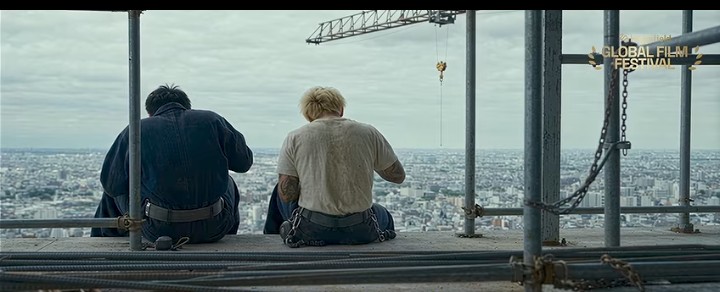
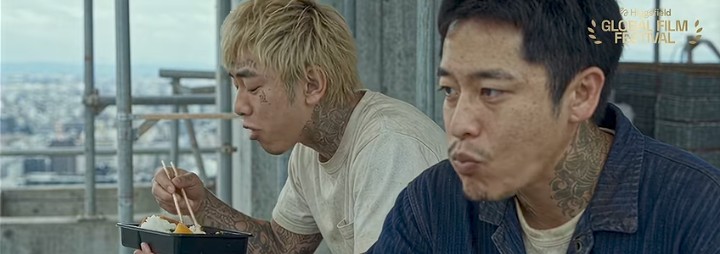
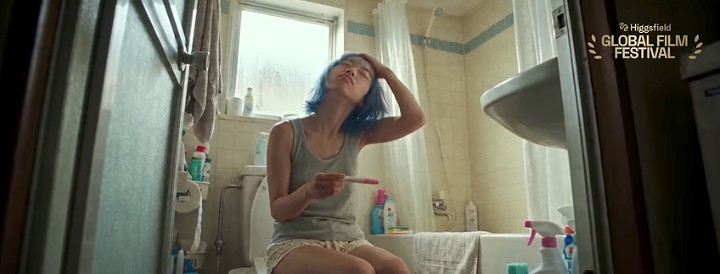
I could not look away from Inside Joke. It opens so simply — two guys sitting on the edge of a high-rise construction site in Tokyo, legs dangling over the city, eating lunch from a bento box and teasing each other about love — and then, at 0:32, it changes everything. The girlfriend finds out she is pregnant.
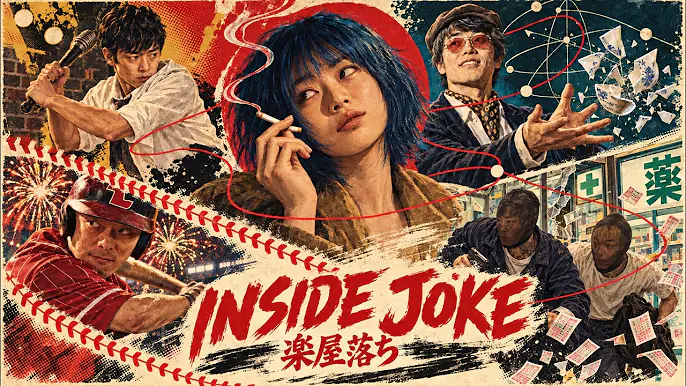
That moment matters so much, because it is not just a plot point. It is the choice that follows them through every life after it. The same man, in four versions of himself: a stand-up comedian searching for “the one,” a physicist teaching quantum entanglement and retrocausality, a baseball player facing the final pitch of a championship game, and a gangster in a neon-lit criminal underworld with his childhood friend. The same woman keeps finding him in each life, in a different look each time — dark-haired on a date, blue-haired in the robbery, brown-coated in the alley, a student in the lecture hall. Different lives. Different choices. Same connection.
That is what stayed with me. The film never stops to explain the multiverse to you. It just lets you live in it, life after life, until the jokes, the timing, and the choices start to line up — and you realise they were connected all along.
You Do Not Even Know You Are In The Multiverse
This is the film’s most impressive trick, and it is why it reminded me of Everything Everywhere All at Once. There is no big announcement, no portal, no flashing sign that says “now we are in another universe.”
One minute you are on a construction site in daylight, the blond tattooed man in a dirty white T-shirt with a safety harness, holding a bento box of karaage, rice, pickles and greens, while his dark-haired friend teases him: “You’ve never been in love…” The next minute a hand wipes the words “INSIDE JOKE” in chalk from a physics blackboard, and you are in a lecture hall. Then you are in a comedy club, laughing at a joke about turning 36 and his mum asking when he is going to settle down. Then you are in a baseball stadium in the bottom of the ninth. Then you are in a car in the rain at night, then in a convenience store robbery, then in a wet alley, and the joking suddenly stops.
It feels natural while you are watching it, and only afterwards do you see how cleverly it was put together. That is compelling storytelling. I was pulled in before I had time to work out how it was doing it.
The Joke That Keeps Coming Back
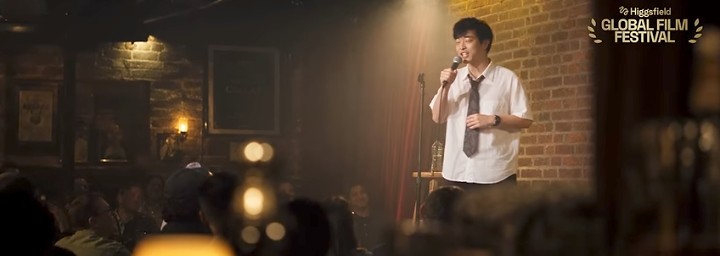
I loved how the same joke keeps returning, in a different form each time, until it stops being just a joke.
It starts with “settle down.” On stage he tells it as a birthday story: he turned 36, he called home, and his mum did not even say “happy birthday, son.” The first thing she asked was, “When are you going to settle down?” He hates that phrase. Nobody has ever made the word settle sound sexy. You do not walk into a restaurant and say “I’ll settle for the Wagyu.” You wanted the Wagyu, and then they tell you it is $380, and suddenly the Caesar salad has a great personality.
Later the joke grows up. Finding the one, he says, is basically a lottery. You buy a ticket, you grab a coin, you get hope. At least the lottery prints the odds on the back. Love is a scam, he says — seven billion people on Earth, and he is supposed to find the one?
And then the film answers its own joke. Finding your soulmate, he says, is the ultimate hack, because every terrible decision you have ever made becomes romantic retroactively. Why did you leave a stable relationship and move into a studio apartment with a DJ named Blade? Soulmate. You cannot argue with that one. It is bulletproof.
I laughed at that line, and then I thought about it for a long time afterwards. That is the inside joke of the title, I think — a small, funny line that quietly tells you the connection is real.
The Physics Is The Romance
I did not expect a physics lecture to be the most romantic part of a film, but here it is.
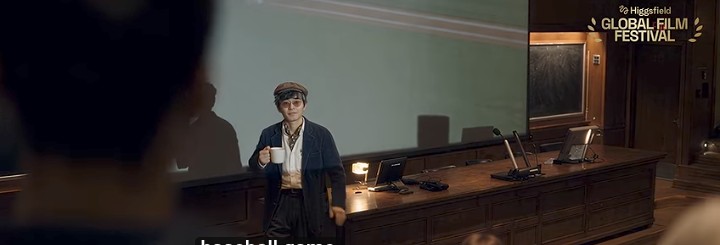
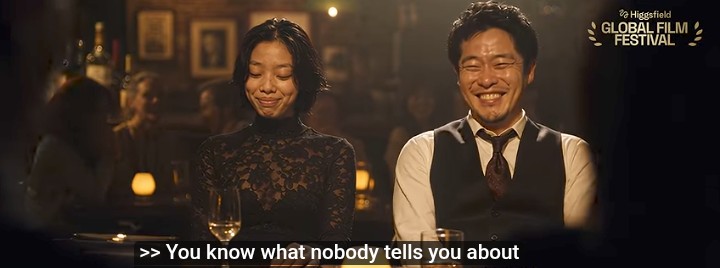
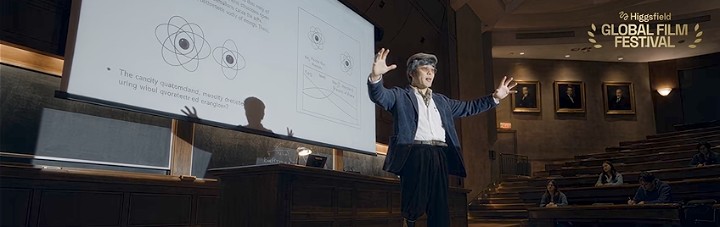
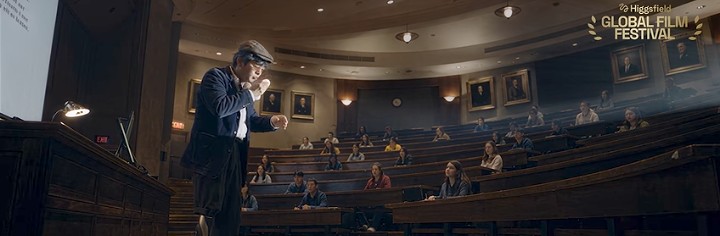
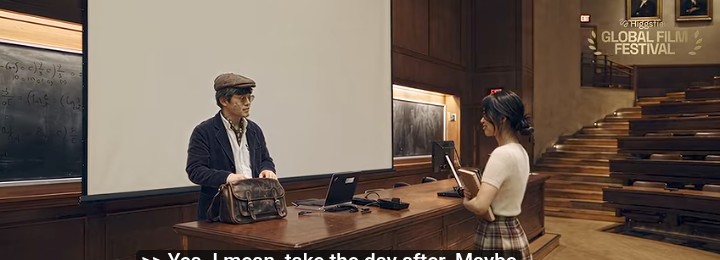
The professor — the same dark-haired man, in a white short-sleeve shirt on stage and in dark trousers in the lecture hall, walking down the aisle with a blade-style prosthetic left leg, past tiered rows of students and framed portraits on the walls — explains entanglement so simply: two particles meet, they interact, they fall in love. They get entangled. Move them billions of light-years apart, measure one, and the other answers instantly, like it already knows. His student, Yuri, asks the obvious question — would that not break special relativity? Einstein did not like it either, he says. He called it spooky action at a distance. But what if the action is not across distance? What if it is travelling backwards through time?
That is the whole film, in one lecture. The man and the woman are those two particles. Separated across lives, they still answer each other instantly.
Later, after class, he puts it even more gently. He does not say the future can change the past. He says influence. Change would mean yesterday was one thing and tomorrow makes it another. Influence means maybe we do not know what yesterday really is until tomorrow rolls around. Take a first date, he says. The day after, maybe it was just coffee. Ten years later, maybe it was the most important afternoon of your life. Or the beginning of a toxic relationship. Exactly. Same coffee.
I loved that. It is such a human way to explain retrocausality, and it makes the science feel like something we have all lived.
What One Universe Does To Another
This is the part I kept thinking about after the film ended, and it is the heart of it for me. The lives are not separate. What one version does in one universe affects another version in another universe.
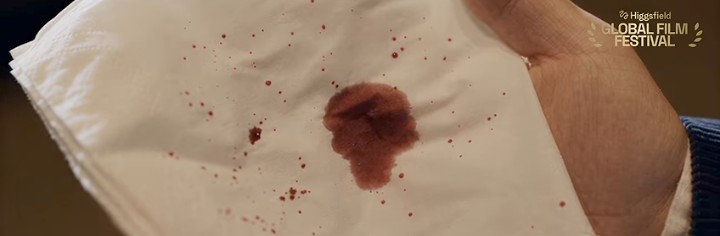
In one life, the guy smokes, and it does not seem to affect him at all. He is in the car in the rain, smoking, laughing, joking, carrying on. In another life, the professor seems to have cancer and is coughing up blood. After class, his student follows him and asks, “Hey, Professor, wait up. Are you okay?” He coughs, he is shaken, he keeps walking, and you can see something is wrong with his body.
That cannot be a coincidence in a film this carefully put together. The smoke in one universe becomes the cough in another. The reckless life leaves a mark on the careful life. The body carries the consequences across lives, even when the man himself does not know why he is hurting.
That is entanglement made physical. Two particles, two lives, one wound. Measure one, and the other answers instantly — sometimes with a cough, sometimes with blood, sometimes with a scar you cannot explain. I found that deeply moving, and deeply frightening, because it means none of our choices stay in just one life.
The Gangster Life Is Where It Gets Dark
I was not ready for how dark the gangster life gets, and that is what makes the comedy and the romance hit harder.
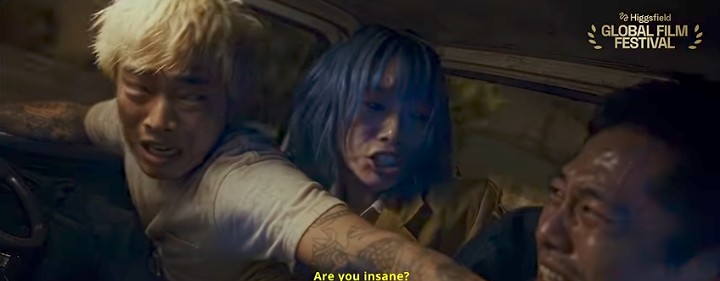
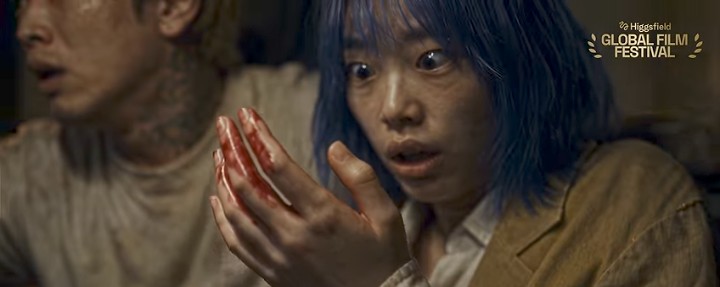
At night, in the rain, the blond tattooed man is driving, his dark-haired friend is smoking beside him, and they are talking about little league — the same childhood the baseball commentary keeps coming back to. Then a convenience-store robbery, shouted in Japanese, “Give me the cigarettes!” And in the middle of it, the blue-haired woman in the tan jacket and big black headphones. She is not a stranger. She is his girlfriend, and she is crying, face to face with him: “You didn’t pick up my calls…”
He is holding a small pink pregnancy test. “How accurate are these things?” Her hand is bandaged. His tattooed hand is gripping something in a struggle. It is messy, frightening, and painfully real. That pregnancy, first found out at 0:32, is still there in the store with them, in every look between them.
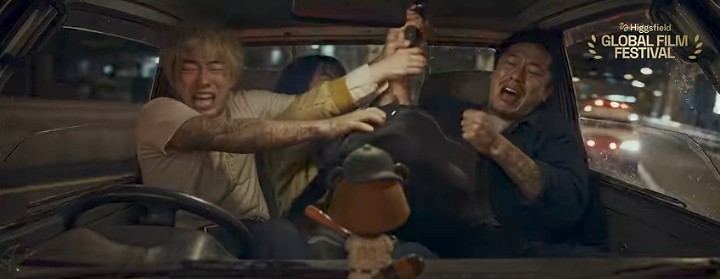
Best Scene (9:24–10:01)
The car, the police, and the shooting
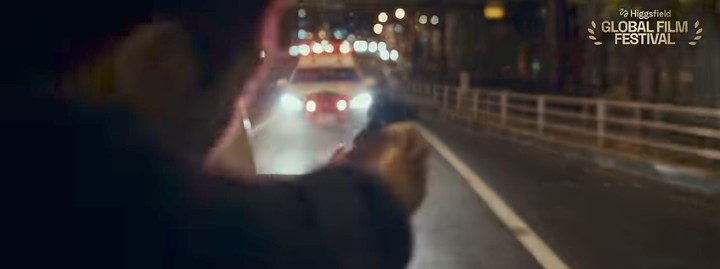
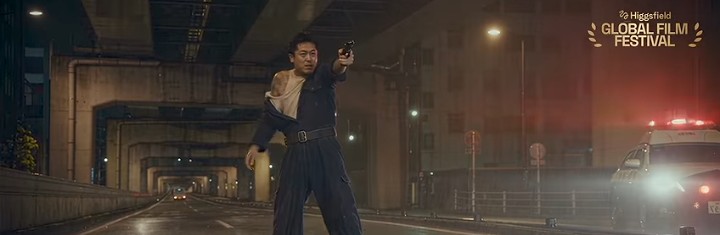
Inside the car, at night, three of them are squeezed in together — the blond driver smoking, the blue-haired woman in the middle with her head bowed, the dark-haired man on the right counting a fan of Japanese yen banknotes. “Seven.” A small toy figure sits on the dashboard. Then the argument turns physical, “Then give me that bag!” and one of them starts shooting at the police.
I stopped breathing for those thirty-seven seconds. It is incredibly well choreographed — the tight space of the car, the rain, the shouting, the woman caught between them, the sudden gunfire, and then a man lying face-down on a wet road under an underpass, one shoe off, beside a black bag, as a white van pulls away. Keeping the movement this clean and this tense inside a car, at night, in the rain, is incredibly hard, and the film pulls it off. Hands down, this is the Best Scene.
Second Best Scene (7:50–9:00)
The entanglement lecture
Two particles meet, they interact, and they fall in love. They get entangled. Move them billions of light-years apart, and measure one, and the other answers instantly, like it already knows. Yuri asks about special relativity, and the professor answers with Einstein’s own discomfort — spooky action at a distance — and then with the film’s boldest idea: what if the action is travelling backwards through time?
I loved this scene because it is so quiet and so clear. No action, no shouting, just a teacher, a student, and an idea that explains the whole film. It is the scene I keep coming back to.
The Night Scene That Stops The Joking
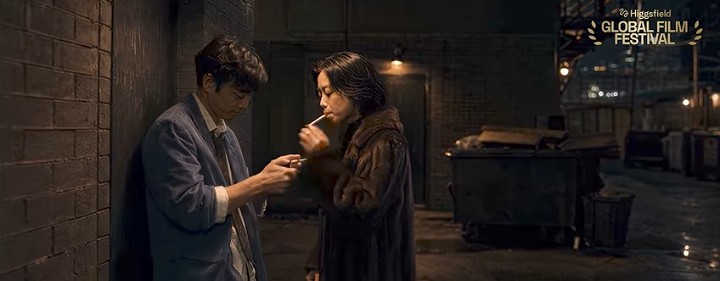
For me, the most moving part is the night reunion in the wet alley. A single hanging lamp, a dumpster, cobblestones. He is in a denim jacket, holding a cigarette. She is in a brown coat.
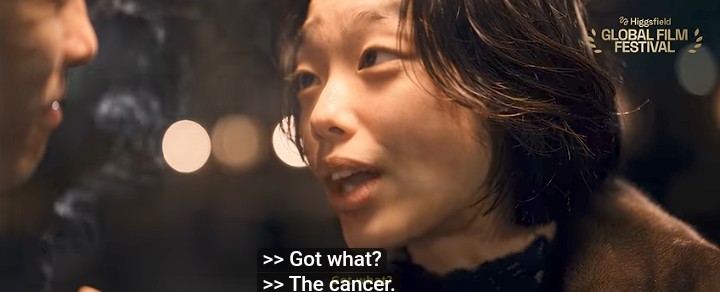
“Can I steal one?” “You know we should quit, too.” “It’s too late. I’ve already got it.” “Got what?” “The cancer.” Then, “Jesus Christ, stop playing with me. Almost had you there.”
“This is why I can never take you seriously. You’re always joking. Even when something actually matters.” “I was a fool. What can I say?” “You hurt me now.” “I know. And I’m sorry.”
“They say time heals all wounds, but love leaves a scar. It was nice seeing you again.”
That apology, after a lifetime of joking, is the heart of the film for me. It is the decision they cannot take back, and the love that leaves a scar anyway.
Baseball, Timing, And Switching Sides
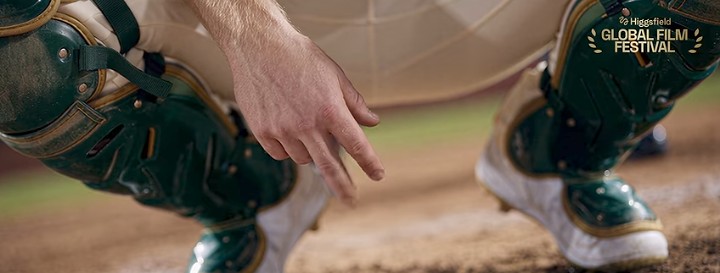
The baseball life is where the film’s idea of timing becomes something you can feel in your chest. Bottom of the ninth, two outs, one strike. Everything comes down to this at bat. A pitch fouled back. A pitch right at his head. Two men who have been playing against each other since they were kids, and now Hiroshi is switching sides.
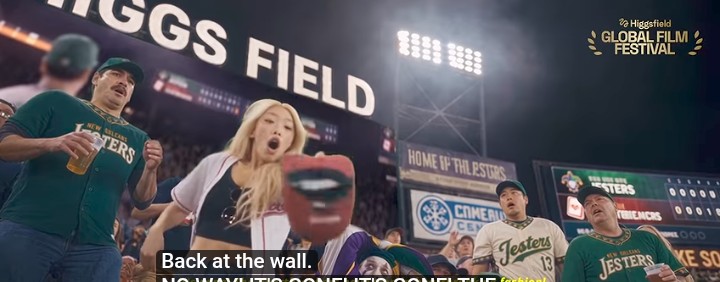
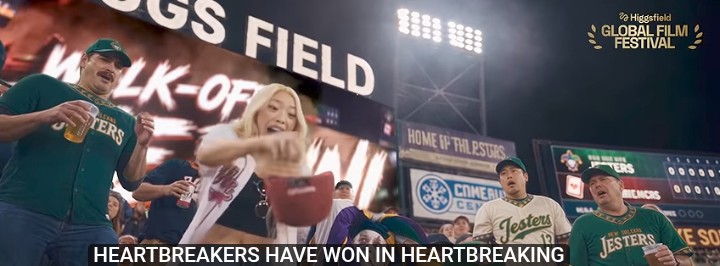
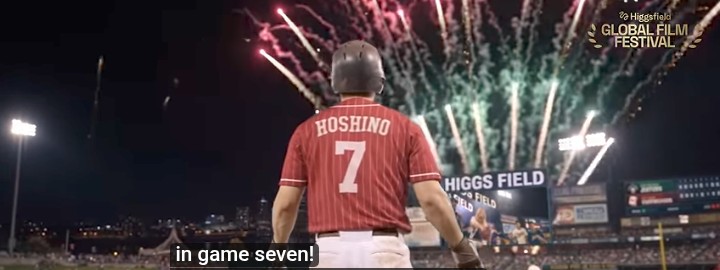
Then the ending of that game, in Game 7, down to the final strike — a high drive, deep to right field, a walk-off home run, and the Heartbreakers are champions. “You can play this game back a thousand times and never write it better than that.”
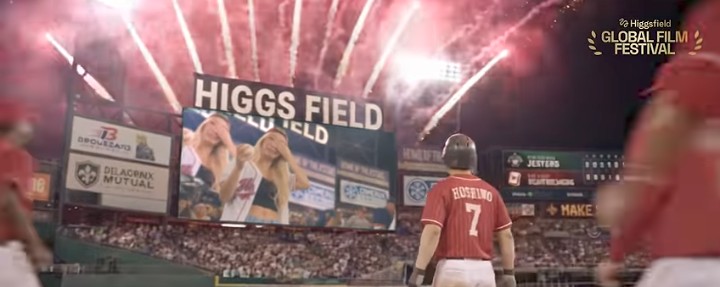
And then, as he runs after the home run, at 14:53, he sees her. She is on the stadium screen, holding the ball that she caught with her hat. The same couple, finding themselves again, in the middle of a crowd, in the middle of a championship. That image is beautiful, and it is the film in one shot: they keep finding each other, no matter the life, no matter the game.
It is the same question as the rest of the film, just in a stadium: what if one moment, one pitch, one choice, changes what everything before it meant?
The Ending Brings It All Back To “Settle Down”
I will not spoil every beat of the ending here, because you should watch it first, but I will say this: it returns to the car at night, and to his mother.
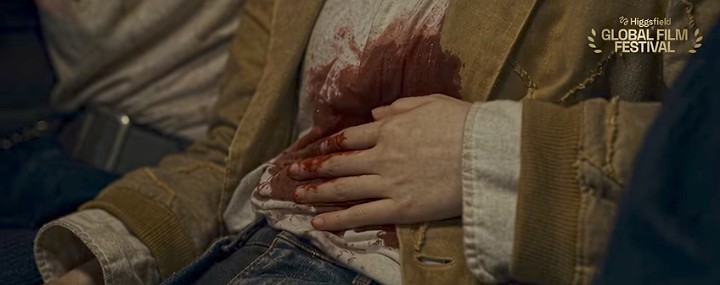
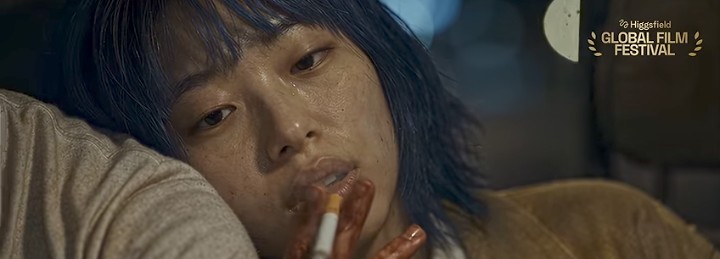
The blue-haired woman is slumped against his shoulder in the car, injured, blood at her mouth and on her tan jacket, her eyes half-closed. She is crying, saying she wants to sleep now. And in that quiet conversation, in Japanese, they talk about his mother calling the other day, and about settling down — the same line from the opening lunch and the comedy set, now with no joke left in it. His answer, as the film frames it, is that he has already settled down.
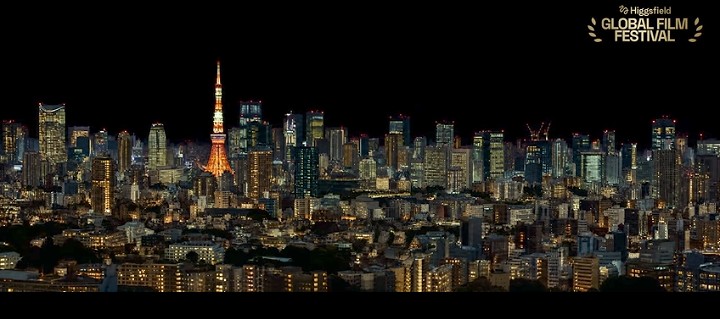
The film does not show her dying on screen, and I do not want to say more than it shows. What it does show is the Tokyo skyline at night, Tokyo Tower lit orange, echoing the daylight skyline from the opening — the same city, the same two people, now at the end of the night.
Final Thoughts
Inside Joke is a film about the person you keep meeting, no matter the life — and it makes you feel that meeting before it explains it.
It is funny, romantic, clever, and quietly heartbreaking, all at once. The comedy makes you laugh, the physics makes you think, the gangster life makes you gasp, and the night scene makes you feel the cost of all those jokes. The home run scene is beautiful, the car scene is brilliantly choreographed, and the lecture is the scene I will remember longest. I would recommend it to anyone who loved Everything Everywhere All at Once, and to anyone who has ever wondered whether a small choice — a phone call, a first date, a coffee, a pregnancy — only becomes the most important moment of your life years later. Watch it first, then come back and tell me what you think it meant. I have a feeling we will all see something different in it.
Scene Breakdown
0:00–0:32 — Construction site, Tokyo, daylight. Two men sit on the edge of a high-rise site, legs dangling over the city, rebar and a crane behind them. The blond man, tattooed, in a dirty white T-shirt, holds a bento box with karaage, rice, pickles and greens. The dark-haired man teases him: “You’ve never been in love…” The blond man takes a phone call, annoyed, “Shut up.”
0:32–0:55 — The girlfriend finds out she is pregnant. This is a key turning point, and it follows them through every life after it. A hand wipes “INSIDE JOKE” in chalk from a physics blackboard, leading into the professor life.
0:55–2:00 — Lecture hall and comedy club, intercut. The professor lectures on time and entropy. The comedian, in a white short-sleeve shirt and loosened tie against a brick wall, says: “I turned 36 yesterday.” He called home and his mum asked, “When are you going to settle down?” The Wagyu is $380, so suddenly the Caesar salad has a great personality. “I’m just trying to get to first base, but sooner or later I’ll hit one out the park.” A date is intercut: a dark-haired woman in a black lace top smiles across a candlelit table at him.
1:59–2:28 — Baseball stadium, night, bottom of the ninth. Nunez steals second, the tying run. Kurokawa does not look happy. They have been playing against each other since they were kids. Hiroshi is switching sides.
2:28–3:35 — Lecture hall. What is time? The equations do not care which direction you run them. Film a baseball game and play it in reverse. Entropy, the arrow of time, and the universe preferring the one where he loses his deposit. “What if we could remember tomorrow? What if we could change the past? Nah.” He walks with a blade-style prosthetic left leg.
3:35–5:44 — Gangster life. Inside a car at night, rain on the windows. The blond man drives, the dark-haired man rides shotgun smoking. “You… Ever think about little league?” Then a convenience-store robbery, in Japanese: “Give me the cigarettes!” The blue-haired woman in a tan jacket and big black headphones is caught in it. Face to face, crying, she says: “You didn’t pick up my calls…” He holds a small pink pregnancy test: “How accurate are these things?” A struggle over something in the store, her bandaged hand, his tattooed hand gripping it.
5:44–6:55 — Comedy club. Finding the one is basically a lottery. Seven. A hot dog? Love is a scam, seven billion people. He gives up, and a woman heckles him kindly: “Maybe she’ll find you.” He has never had a heckler be nice to him before.
6:55–7:50 — Baseball, bottom of the ninth, two outs, one strike. Fouled back. One strike from winning the championship. A pitch right at his head, and the batter does not like it.
7:50–9:00 — Lecture hall. Two particles meet, interact, fall in love, get entangled. Measure one and the other answers instantly. Yuri asks about special relativity. What if the action is travelling backwards through time?
9:00–9:24 — Back in the getaway car, night. Three people: the blond driver smoking, the blue-haired woman in the middle with her head bowed, the dark-haired man counting a fan of Japanese yen. “Seven.” The argument turns physical: “Then give me that bag!”
9:24–10:01 — Best Scene. Inside the car, one of them starts shooting at the police. Incredibly well choreographed, in the tight space of the car, at night, in the rain. A man lies face-down on a wet road under an underpass, one shoe off, beside a black bag, as a white van pulls away.
10:22–11:41 — Comedy club. Finding your soulmate is the ultimate hack, because every terrible decision becomes romantic retroactively. Leaving a stable relationship for a DJ named Blade? Soulmate. Why are we going to the end of the world? Wherever we are going, here’s hoping they have cheaper Wagyu. Good night.
11:49–14:23 — Night reunion. “What’s so funny? Nothing. Just life.” Can I steal one? Then, in a wet cobblestone alley under a single hanging lamp, he in a denim jacket with a cigarette, she in a brown coat: “You never did listen to me.” “It’s too late. I’ve already got it. The cancer.” Almost had you there. You’re always joking, even when something actually matters. “I was a fool.” “You hurt me now.” “I know. And I’m sorry.” Time heals all wounds, but love leaves a scar. It was nice seeing you again.
14:23–14:53 — Baseball, Game 7. High drive, deep to right field, it’s gone. A walk-off home run. The Heartbreakers have won. The Jesters will have to swallow their pride. Pandemonium.
14:53–15:16 — As he runs after the home run, he sees the girl on the stadium screen. She is holding the ball that she caught with her hat. The same couple, finding themselves again.
15:10–16:30 — After the lecture. You don’t really believe the future can change the past, do you? Influence, not change. A first date. Maybe it was just coffee. Ten years later, maybe it was the most important afternoon of your life. Same coffee. A female student follows the professor toward the EXIT door: “Hey, Professor. Wait up. I have so many more questions. Are you okay?”
16:30–18:04 — Final scene, in the car at night. The blond man, hand to his face, distressed. The blue-haired woman slumped against his shoulder, injured, blood at her mouth and on her tan jacket, eyes half-closed. She is crying: “I want to sleep now.” They talk, in Japanese, about his mother calling the other day and about settling down. The exact Japanese wording is not legible on screen, and the film does not show her dying. Wide night shot of the Tokyo skyline, Tokyo Tower lit orange. Gold serif “Inside Joke” on black, then a camera-style menu grid. No cast or crew roll is shown.
There are no reviews yet. Be the first one to write one.