 KINEO
Godlike
The Film Score

AI Slop Meter
Some slop 5.0/10Find this film in
Festivals and Awards
 Higgsfield Talent Contest
Score Breakdown
| Storytelling | 5.0 |
| Emotional Connection | 7.0 |
| AI Tool Management | 7.0 |
| Visual Craft | 9.0 |
| Writing & Dialogue | 5.0 |
| Soundtrack | 9.0 |
| Originality | 8.0 |
| Polish | 7.0 |
| Rewatch Value | 8.0 |
| Weighted total (/12) | 7.0 |
⚠ Report a problem with this video
Kineograph does not host films on its platform. This video is embedded from the creator’s own account on a platform such as YouTube, TikTok, Instagram, Facebook or Suno. Any ads you see on this video are handled by that platform and the creator. Kineograph does not own this video and does not receive any ad revenue from it. We encourage you to support and follow the creators whose work is showcased on Kineograph. Visit their social media and/or personal websites.
Film Review
This review discusses the ending. If you would rather watch the film first, we recommend you do, and then come back.
Synopsis
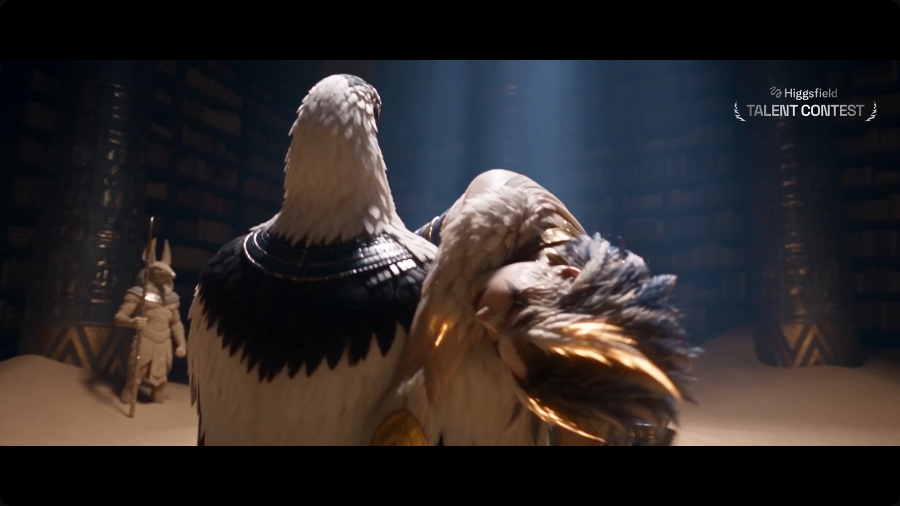
A column of light stands in a snowy crater — the thing that can make fallen gods into gods again. The contenders are introduced in turn: a grey-haired, scarred king on horseback carrying a torch through a dark forest; a young god with a gold headband and golden eyes, red vest, against a sea of clouds; a fur-clad warrior with a round shield walking toward the light between stone ruins. The race begins — a low chase over water through a lantern-lit canyon, the young god wrestling a horned beast in the clouds, a ruined city on the Nile ahead. Then war: an ibis-headed god reads a glowing book over a reclining feathered woman, a jackal-headed figure at the side, battle in snow and dust, the young god leaping with a spear over wolf-headed warriors. The last narrative image is the young god reaching his hand toward the light, two glowing figures behind him in the snow. Then music only, and the image fades to black. The premise is the director's own: "Damaged gods race for the light that can make them gods again. Only one can take it." In this cut, none of them does — and the film is honest about that from the start.
Beautiful Like a Game You Want to Play
The look of this film is its argument. It is full CGI in a AAA game-cinematic style, and it earns the comparison: the worlds are the film's best idea after the premise itself — cliffs of sand above a sleeping Nile, a burning fort, a buried library, a sea of clouds — and each god owns one colour, the way a game's roster would. Silver for the king, gold and lapis for the falcon, ember orange for the thunderer, lacquer red for the monkey. One rule ties them together: the light is the only pure white in the whole film, and the camera never lets you forget it. That discipline is what makes the film feel like Final Fantasy rather than a demo reel: the palette is controlled, the light is sacred, and every shot is composed around it.
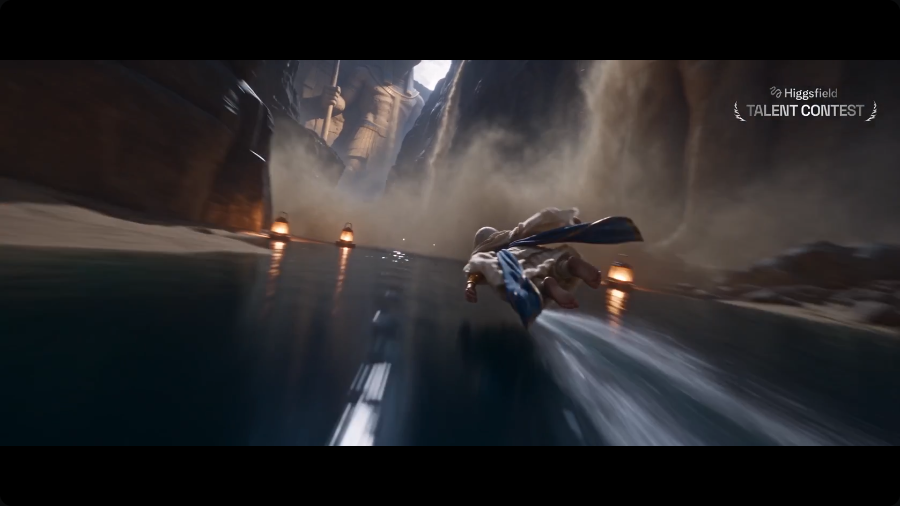
The chase is the film's best stretch, and it is genuinely thrilling: skimming the water of a canyon at speed, lanterns streaking past, a ruined city ahead, the young god with his staff among the runners. For about a minute, Godlike is exactly as exciting as it wants to be, and it shows what the finished version of this idea could be — a race you can feel in your stomach. The war material in the last act has scale, too — gods in snow and dust, the ibis-headed god with his book, the jackal watching. What it does not have is sequence: the shots arrive as a montage of intensities rather than a battle with a shape. But the images are so strong that the montage carries itself.
The Music Carries It
The song is the film's spine, and it is great. A driving English-sung track with a male vocal over an epic orchestral and rock score runs through almost the whole three minutes, and it does what the film's images do: it makes three minutes feel bigger than three minutes. The music is the reason the chase lands and the reason the ending lands — when the speech stops in the final stretch and there is music only, the film does not go quiet, it goes wide. The sung lyrics themselves dissolve into nonsense for long stretches, and in a film with no spoken dialogue the song is the only storytelling voice there is — but here the voice is carrying mood, not narrative, and the mood is exactly right. The film knows what its song is for.
A Trailer, Not a Film — and That's the Point
Here is the honest note, and it is the only one that matters: no one takes the light. No winner is shown, no race is decided, and the film ends where a feature's first act would. The page's own act timings run to 3:30 while the uploaded cut runs 3:13, as if the plan and the film parted company near the end. Judged as a short film, it does not complete its own premise. But judged as what it actually is — a trailer for a game that does not exist, a three-minute promise — it is amazing, and the promise is the point. A race that no one wins is not a story, it is a setup; and this setup is so beautiful, and its music so good, that the setup alone is worth watching. I want more. I want the rest of the race, the rest of the war, and the moment someone finally takes the light.
Best Scene (0:36–1:33)
"The Race"
The second act — above all the low run over the water at about 0:45, lanterns blurring past, the ruined city ahead. It is the one stretch where the film's ambition and its execution meet, and it shows what the finished version of this idea could be: a race you can feel in your stomach.
Final Thoughts
There is a real film buried in Godlike — the premise is clean, the race is thrilling, and the mythology mash-up has genuine poster energy. But what is on screen already is not a failed film; it is a beautiful trailer, and it knows it. The light is the only pure white in the whole film, the music never lets go, and three minutes is not enough. Verdict: a spectacular first act in search of its second and third — beautiful, thrilling, and over too soon. I want the rest of it.
★★★½ — Gods at full sprint, and a finish line worth waiting for
Scene Breakdown
0:00–0:36 — Act 1: the light. A grey-haired, scarred king on horseback carrying a torch through a dark forest at night; a young god with a gold headband and golden eyes against a sea of clouds; a stone arch, a snowy crater holding a column of light.
0:36–1:33 — Act 2: the race. The chase over water through a canyon at ≈0:45, lanterns streaking past; the young god wrestling a horned beast in the clouds; a fur-clad warrior with a round shield walking toward the light between stone ruins; a ruined temple and city by water at night, the white light beam falling into it.
1:33–3:13 — Act 3: the war. The buried library — the ibis-headed god reads a glowing book over a reclining feathered woman, scrolls floating, a jackal-headed figure at the side; war in snow and dust, the young god leaping with a spear over wolf-headed warriors, a burning forest behind them; the older god in a snowy night forest, glowing energy in his hand; the young god reaching for the light, two glowing figures behind him in the snow. Music only in the final stretch; the image fades to black. No winner is shown.