 KINEO
Beast
The Film Score

AI Slop Meter
Clean 9.0/10Find this film in
Festivals and Awards
 Higgsfield Talent Contest
Score Breakdown
| Storytelling | 10.0 |
| Emotional Connection | 10.0 |
| AI Tool Management | 10.0 |
| Visual Craft | 10.0 |
| Writing & Dialogue | 10.0 |
| Soundtrack | 10.0 |
| Originality | 9.0 |
| Polish | 10.0 |
| Rewatch Value | 10.0 |
| Weighted total (/12) | 9.9 |
Watch on YouTubeWatch on Higgsfield
⚠ Report a problem with this video
Kineograph does not host films on its platform. This video is embedded from the creator’s own account on a platform such as YouTube, TikTok, Instagram, Facebook or Suno. Any ads you see on this video are handled by that platform and the creator. Kineograph does not own this video and does not receive any ad revenue from it. We encourage you to support and follow the creators whose work is showcased on Kineograph. Visit their social media and/or personal websites.
Film Review
This review discusses the ending. If you would rather watch the film first, we recommend you do, and then come back.
Synopsis
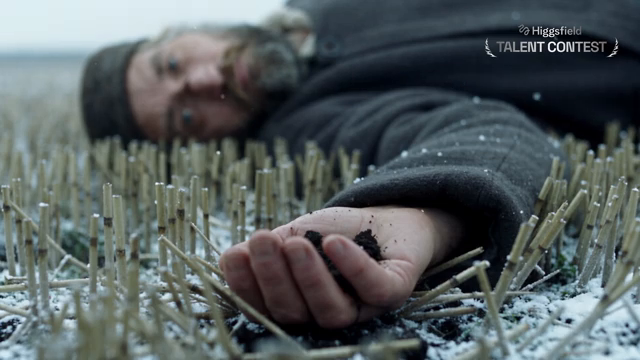
Winter, in a northern land of spruce forest and frozen rivers. A man lies still in a snowy stubble field, his hand clutching the soil, a black horse standing nearby and a house burning in the distance. Invaders have fallen on a river farm: the buildings burn beside the water. In memory, the farm is still alive — a woman with a long braid kneels washing at a misty riverbank, a young boy standing beside her, looking across the river toward the forest. And through it all runs the first song, a warning: "Deep in the forest." "Offer your life, give up your name." "It will take your voice, it will take your face, and a beast of the forest will rise in your place." A blond boy rides out alone on a black horse, to the dark pool where the river springs, and kneels to sing his vow to the spirit — he lays down his name and his kind, and asks for a fury older than iron. What answers him is a wolf the size of a horse, gray-furred and scar-faced, and the snow begins to turn red. The wolf hunts, the wolf falls, and the film ends where no revenge story usually ends: in a golden wheat field in summer, a man leading his black horse home.
The Warning
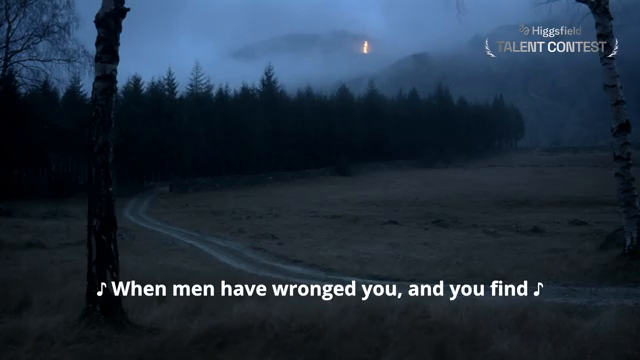
The film opens the way a ballad opens: on the loss, before the man. No title card, no introduction — just a man lying in the snow, a black horse standing nearby, a house burning in the distance. It is a first image that tells you the whole shape of the story in one frame, and the film trusts you to read it. Then the first song begins, a warning about the forest spirit, and the village burns: houses ablaze beside the river, smoke, snow. The raid is shown in wide, cold frames — a road at dusk, a fire on a distant hill — and the film never hurries the destruction into spectacle. It lets the burning sit there, the way grief sits.
The memory that follows is the film's quietest passage, and the one that makes the revenge matter. A woman with a long braid kneels washing at a misty riverbank; a young boy stands beside her, looking across the river toward the forest. Nothing is explained. Nobody says who she is or what the boy is remembering. But the image does the work: this is what was lost, a whole life by a river, and the boy's ride afterward is not a quest but a debt being collected. The rider passes through the burning village on his black horse, the hooded young man singing in the foreground, and the film holds on the details that make the cold real — an extreme close-up of his blue eye, frost on his lashes, firelight behind. Then a giant gray wolf in close-up, and the song's last warning: "you are a child of the forest until the end."
The Vow
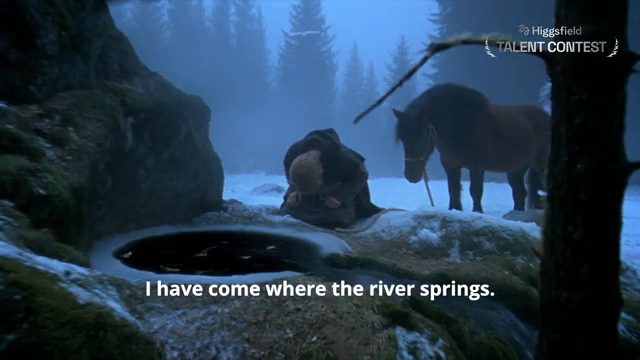
The heart of the film is the vow at the spring, and in this final cut it is sung, which is exactly right. The boy rides into the misty forest with his black horse, and kneels by a black forest spring, the horse tethered nearby, a white owl watching from a rock. He does not beg; he negotiates, in song: "I have come where the river springs. I lay down my name, men have cast me from their kind. So I cast their kind from my bones." The singing carries the scene better than speech ever could — this is a ballad's bargain, and ballads are sung. "A shadow has fallen across this land, and my hands are too small to lift its weight. Give me a rage that never sleeps. Give me a fury older than their iron. Remake me as a beast of the deep woods, and I will haunt them every last one."
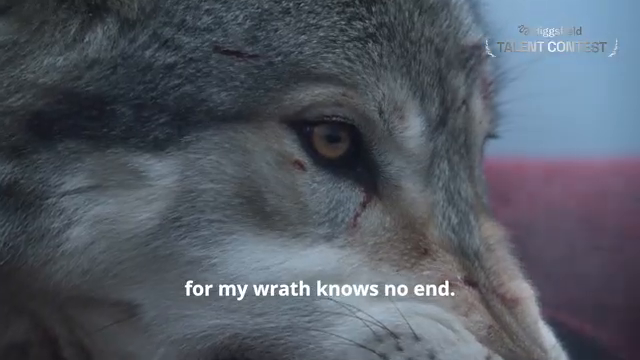
As the vow ends, the film cuts to the boy lying arms outstretched on bright blue snow, looking up at a sky full of falling flakes — laying down his name made visible, a small figure surrendering himself to the cold. And then the bargain is answered without a word of explanation and without a single frame of transformation: a giant gray wolf, scarred muzzle and amber eye, standing over a fallen man in a red cloak in the snow. It is the film's boldest decision, and the right one: the spirit never appears, because the wolf is the spirit's answer. "and tell their children's children of the beast that walks this land." "for my wrath knows no end."
The killing, when it comes, is quiet. The wolf's jaws close on a fallen man's throat — one shot, distant, no gore — and the film moves on. "My jaws will close upon their throats, heavy with every sorrow they carved into my people." For a revenge story, Beast is remarkably uninterested in revenge as spectacle; the violence is weather, not entertainment.
The Price
Then the film shows what the bargain costs. Dead armored soldiers lie in bloodied snow, one in a chainmail helmet with his hand outstretched. And the beast falls: a wounded wolf, arrows in its flank, lying at a river's edge with its head resting on the ice, eyes closed, blood on the snow beneath it. It is a long, still image, and the film lets it breathe. "The white fields will drink the blood of those who sought to own them." "And when I fall, the earth will gather me unbroken and bear me home to the waiting arms of my own."
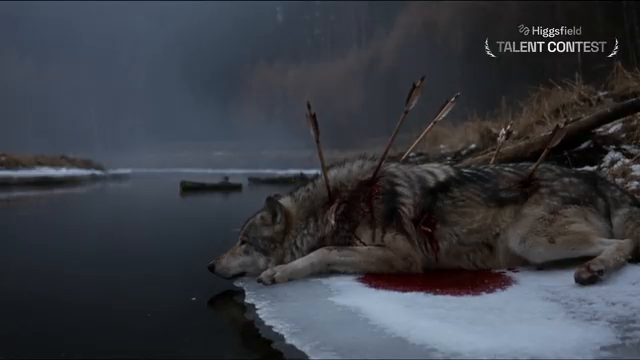
An inverted shot of a woman in a green cloak among falling pink petals follows — the film's strangest image, and its most tender — and then an aerial view of a black winding river through snowy fields, petals drifting on the water, a small boat on the current. The river passage is the film at its most patient, and it earns the patience: there is no single image circled for two minutes, and every shot in the passage is the beast's fall or the journey home. The fall is given its full weight — the wounded wolf at the water's edge, the petals on the river — and the film never rushes past the price the bargain exacted. The song carries it: "Ho-o-o, little ones, come home." "The grass is silver with the morning." "The gate is open, I am waiting."
Home
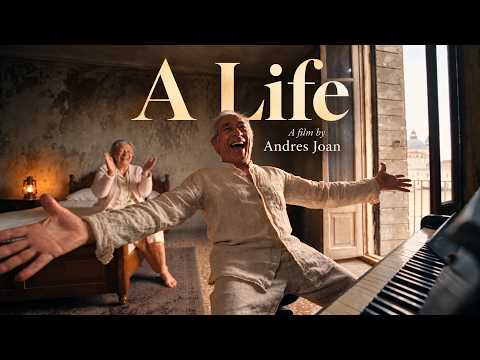
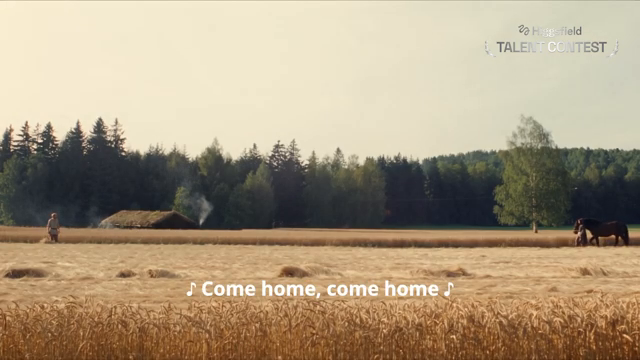
And then the film does the thing revenge stories almost never do: it comes home. The man's face in close-up, eyes closed, faintly smiling, at peace. Then a golden wheat field, a thatched hut, the man walking — and finally, in a hood, leading his black horse through the tall wheat in summer, green trees behind him. Home, at peace. The story ends here, at about 6:22, and the film earns the summer precisely because it never explains it: memory, afterlife, the horse coming home — the film does not say, and this time its silence feels like a choice rather than a gap, because the song has already told us the earth would bear him home. The closing cards follow — "BEAST", then "A Film by Andres Joan" — and after them a short Higgsfield promo, which is platform material, not part of the film.
Best Scene (3:05–4:20)
"The Vow"
The boy kneels at the black spring pool, his black horse tethered beside him, and sings his bargain to the spirit: his name, his kind, laid down; a rage that never sleeps and a fury older than iron asked for in return. The film cuts from his small figure to the boy lying on bright blue snow, looking up, and then to the wolf — gray fur, scarred muzzle, amber eye — with the line "for my wrath knows no end." It is the best scene because it is the film's whole argument made visible at once: the price named in song, the body surrendered to the snow, and the answer standing over a fallen man in a red cloak. Everything before it is the road to the spring, and everything after it is the price being paid.
Final Thoughts
Beast understands something many longer films miss: a fable does not need its magic explained, it needs its price made clear. The song tells us the price in the first minutes — voice, face, place among men — and the river and the wheat field pay it in images that stay with you: a wounded wolf at the water's edge, a woman in a green cloak among pink petals, a man leading his horse home through summer wheat. The storytelling is sure at every turn, the score carries the film without ever telling you how to feel, and the editing holds each image exactly as long as it needs — the fall given its full weight, the homecoming given its quiet. This final cut is the film the work copy was reaching toward — finished, credited, and ending on homecoming instead of fire. Verdict: the best film of the year — the storytelling, the score, the editing, everything is beautiful. Watch it for the vow and the wolf, and for an ending that chooses home over vengeance.
★★★★★ — The best film of the year: a boy's bargain, a wolf's answer, and a road home through the wheat
Scene Breakdown
0:00–0:15 — The field. No opening title card. The film opens directly on a man lying still in a snowy stubble field, his hand clutching dark soil; a black horse stands nearby; a house burns in the distance. (Frame-verified at 0:02.)
0:15–0:35 — The horse and the road. The black horse alone in the field; then a misty forest road. The first song begins: a warning about the forest spirit.
0:35–1:10 — The village burns. A village by a river burns: houses ablaze, smoke, snow. (The frame at 0:50 shows a road at dusk with a fire burning on a distant hill.)
1:10–1:35 — The riverbank memory. A woman with a long braid kneels washing at a misty riverbank; a young boy stands beside her, looking across the river toward the forest.
1:35–2:05 — The ride. A rider on a black horse passes through the burning village; the hooded young man lies and sings in the foreground, then is seen in profile singing against fire.
2:05–2:35 — The eye and the wolf. Extreme close-up of the man's blue eye, frost on his lashes; a giant gray wolf in close-up.
2:35–3:05 — The journey to the spring. The man and his black horse on a misty forest path; the horse tethered near the spring. (Frame-verified: the man and horse walking into the forest at 2:40; the horse alone in the mist at 2:50.)
~3:05 — The offering. The man kneels by a black forest spring pool, a white owl on a rock, his black horse tethered nearby; the vow begins. (Frame-verified at 3:05.)
~3:40 — Laying down his name. The man lies arms outstretched on bright blue snow and ice, looking up, snowflakes on his face. (Frame-verified at 3:40.)
3:35–4:05 — Transformation and vengeance. A giant gray wolf, arrows in its flank and blood on it, stands over and drags a fallen man in a red cloak in the snow, then snarls in the snowy village street amid fire.
~4:01–4:02 — The telling. Burned-in lyric: "and tell their children's children of the beast that walks this land." (Frame-verified at 4:00.)
~4:20 — The Beast. The wolf in close-up: gray fur, scarred muzzle, amber eye. Burned-in lyric: "for my wrath knows no end." (Frame-verified at 4:20.)
4:05–4:35 — Aftermath. Dead armored soldiers lie in bloodied snow, one in a chainmail helmet with an outstretched hand.
4:35–5:05 — The beast falls. A wounded wolf close-up, eyes closed, breath steaming, head resting on ice at a river's edge, blood on the snow; an inverted shot of a woman in a green cloak among falling pink petals. (Frame-verified at 5:00.)
5:05–5:35 — The river home. Aerial view of a black winding river through snowy fields, pink petals drifting; a small boat and figure on the water.
5:35–6:05 — At peace. The man's face in close-up, eyes closed, faintly smiling; then a golden wheat field, a thatched hut, the man walking.
6:05–6:22 — Homecoming. The man, in a hood, leads his black horse through the golden wheat field in summer, green trees behind. The story ends here. (Frame-verified at 6:15.)
~6:23–6:29 — "BEAST". Black screen, huge silver capital letters: "BEAST". The title appears only here, at the end.
~6:30–6:39 — "A Film by Andres Joan". Black screen, small white serif text. The whole in-film credit sequence is these two cards.
6:40–6:50 — Promo tail. A Higgsfield Cinema Studio promo: "CREATE A FILM / CINEMA STUDIO" and a fast montage of unrelated clips. Platform material, not story. The video ends at 6:50.