
 Atomic West
Score breakdown
475 views
Film Review
This review discusses the ending. If you would rather watch the film first, we recommend you do, and then come back.
The Trap At Cajamarca
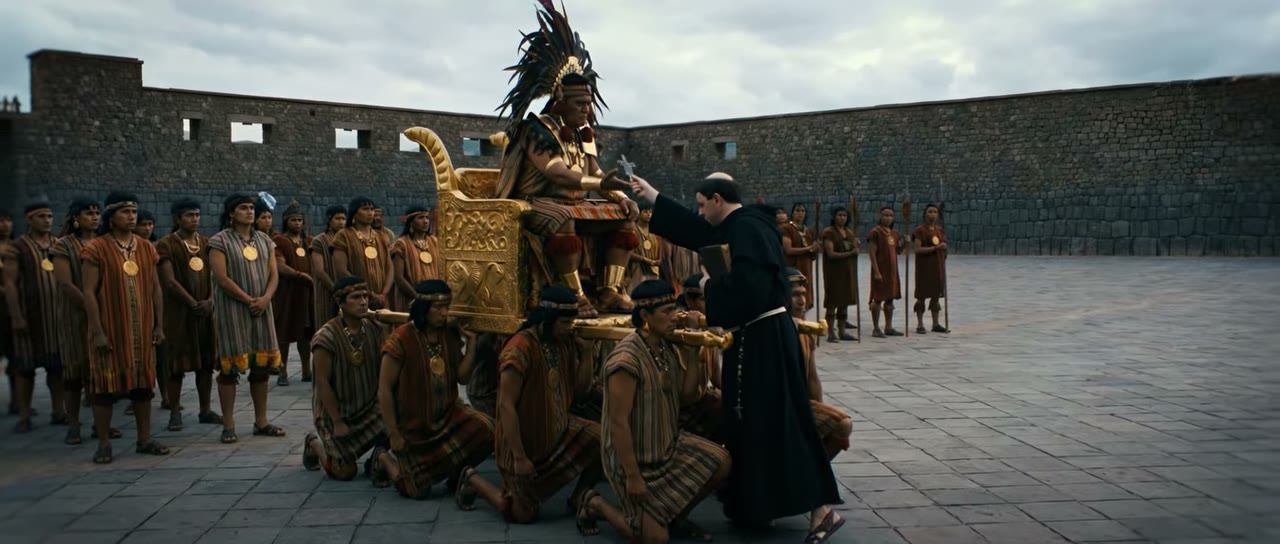
The film never speaks its own facts: the date, the famous odds of 168 men against an empire, even the emperor’s name exist only in the video’s description. On screen he is simply “Highness”. What the film gives us instead is tension, well built. Conquistadors hide among the stone buildings of the plaza while their commander steadies a subordinate named Francisco: “If I hear a single horse before the signal, I’ll have your head… Do not let your nerves betray you, Francisco. Remember God is our shield.” The procession enters — feather headdresses, gold ornaments, the emperor on his gold litter — and a friar walks out alone to meet him, crucifix raised. (History records a Bible or breviary in that moment; the film gives him a cross. It is the film’s clearest departure from the record, and worth knowing.)
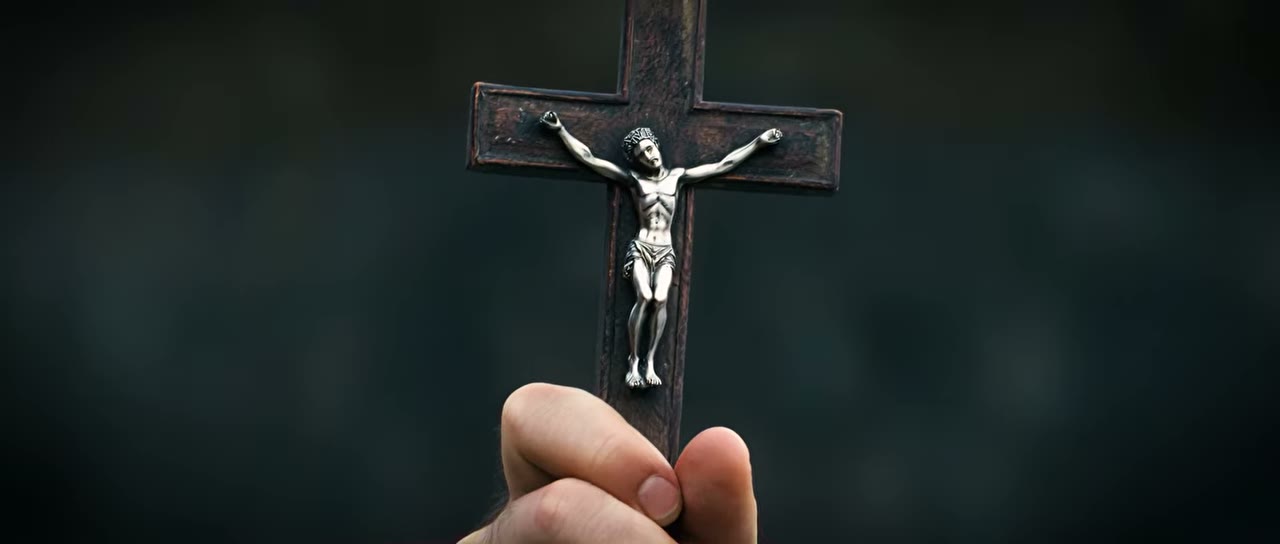
The ambush, when it erupts, is the film’s weakest stretch: cannon and cavalry in fast, smeared cutting, crowds that blend and shift between frames, and shouted orders that garble into nonsense. The seizure itself, though, is quietly chilling — a Spaniard reassuring the captured emperor with the most honest line in the film: “Don’t be afraid, Highness. You are worth far too much to die just yet.” Not mercy. Pricing.
“Would You Trade Heaven For Gold?”
Midway, the film cuts away to Spain — two peasants by a wattle fence, talking about a young man eaten by ambition. “Ambition. Glory. Gold. Do as you like, but remember that in the end we all die.” And then the question the whole film hangs on: “Would you trade heaven for gold?” It is a simple device and it works, because the ending pays it off. In a night scene by a stone wall, the friar presses Francisco with the question that has been keeping him at prayer: what is the soul of this mission? Francisco defends it — guns and swords to pull a continent from the devil, blood as the price of grace — and then, quietly, the two men arrive at the truth together. “Who do we serve? We serve the kingdom of heaven.” “It feels more like we serve the Spanish crown, my friend.” “On this earth, they are the same thing.” The film then holds on an antique map of the continent they have just priced, and ends. No triumph. No condemnation speech either — the film trusts its dialogue, and it is right to.
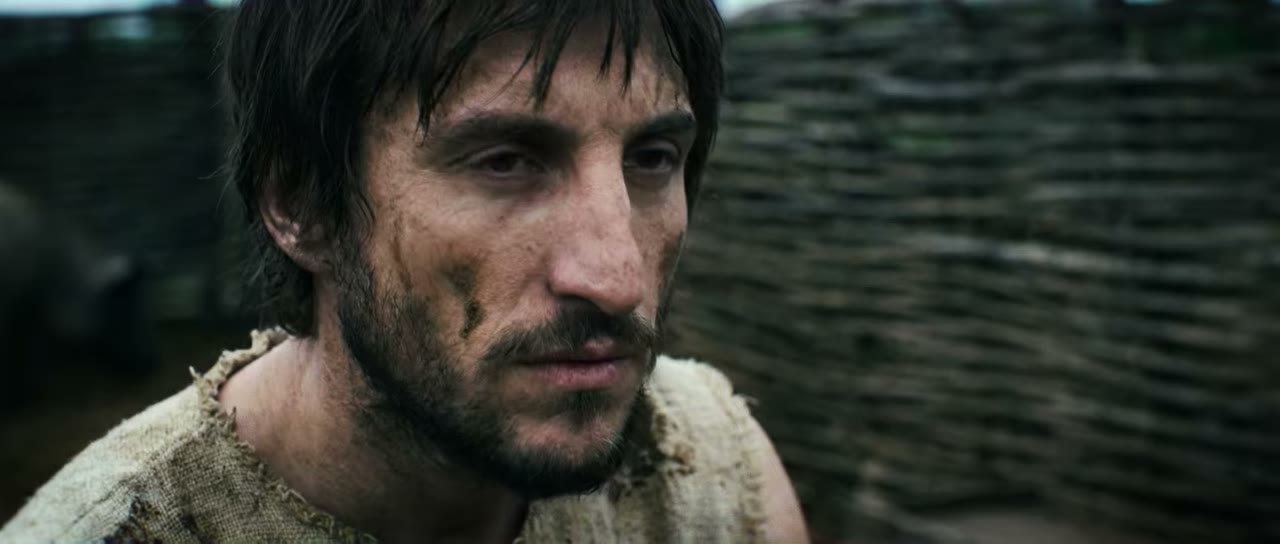
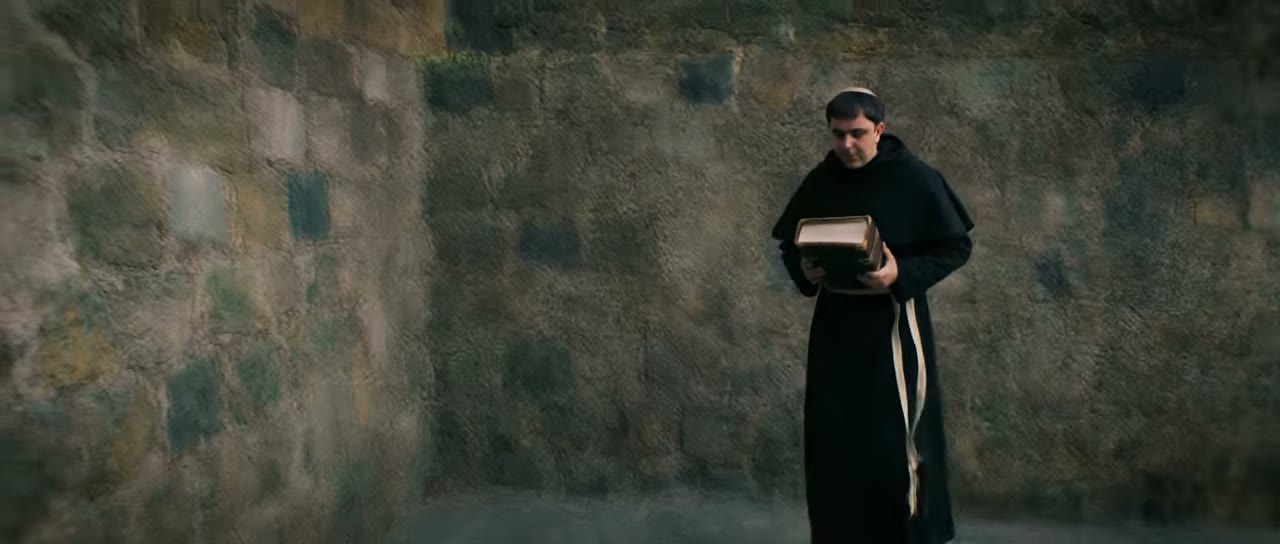
The flaws are real and should not be waved away. Just after the heaven-for-gold question, the audio collapses entirely — fifteen to twenty seconds of unintelligible looping gibberish where a line should be. Later, the friar’s key question stutters on the word “soul” four times. Faces warp in close-up, the battle crowd morphs, and the beautiful closing map’s labels are pseudo-script squiggles when you look closely. A more polished film would score higher in several categories. But polish is not the only virtue, and this one is aiming at something harder than polish.
Best Scene (~2:00)
The friar before the litter
One unarmed friar, a raised crucifix, and an emperor on a gold litter surrounded by his court — with hidden soldiers waiting in the stone buildings around the plaza. The wide shot holds them all in one clean, legible composition, and you feel the trap close before a single weapon moves. It is also one of the least artifacted frames in the film: the moment, and the image, the whole piece is remembered by.
Final Thoughts
Spanish Conquistadors Kidnap Incan Emperor is a flawed film with an honest heart — a massacre examined by the men who committed it, asking what it cost their souls. Its technique lets it down in the middle; its writing rescues it at the end. Atomic West are clearly interested in history as moral drama rather than spectacle, and on this evidence, that is exactly where their strength lies.
Scene Breakdown
0:00–1:20 — The ambush is set. The title card states the thesis; conquistadors take their positions in the plaza as the Inca procession enters the gate.
1:20–3:05 — The confrontation and the trap. The friar presents the crucifix to the emperor on his litter; the signal is given and the plaza erupts.
3:05–4:05 — Interlude: Spain. Two peasants talk ambition beside a fence, and one asks the other: “Would you trade heaven for gold?”
4:05–5:05 — The capture. The emperor held between two conquistadors among the fallen: worth far too much to die just yet.
5:05–6:38 — The soul of the mission. The friar and Francisco debate God and the crown by night, and the film closes on the map of the continent.
~3:49–4:07 — The film’s worst seam: after “Would you trade heaven for gold?”, the voice dissolves into unintelligible looping gibberish for some fifteen to twenty seconds. Even the platform’s own transcript gives up on the passage.
~5:07–5:25 — A stutter loop repeats the word “soul” four times inside the friar’s most important question — a defect the transcript does not show, sitting in the film’s best scene’s doorway.
~2:15 — Shouted lines garble as the ambush begins — ungrammatical fragments and at least one burst of mixed Spanish-English nonsense where an order should be.
~2:15–3:00 — The battle crowd will not hold still: Inca figures blend and change shape between cuts, and weapons and limbs smear in the fast motion.
~0:45, ~2:45 — Close-up faces warp — the commander’s mouth and teeth distort as he speaks, and the shouting face at the signal stretches and gaps. Lip-sync is loose throughout, worst in close-up.
5:30–6:38 — The closing antique map is handsome from a distance; its labels are illegible pseudo-script on inspection.
There are no reviews yet. Be the first one to write one.