
Download Free Original Music Songs from the films
Scores & Rankings
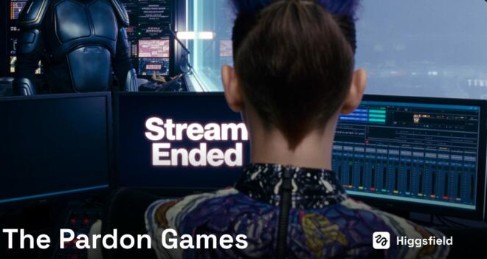
The Pardon Games Directed by Disruptorcreatorc
Find this film in
Score breakdown
- Storytelling & Structure ×22
- Emotional Connection ×21
- AI Tool Management ×27
- Visual Craft2
- Screenplay1
- Sound Design3
- Originality2
- Technical Polish5
- Rewatch Value1
×2 = core category, counts double.
Film Review
Prisoners serving life sentences fight dangerous beasts for a shot at freedom, broadcast for entertainment by the show’s host, Mrs. Beastly. One wrongfully convicted man decides to stop playing by the arena’s rules.
Content Note
This film contains graphic, sustained violence. The review below addresses that directly, including why it affected my ability to enjoy the film.
Synopsis
The Pardon Games imagines a gameshow where prisoners serving life sentences can win their freedom by surviving the arena — a weapon from a pile, a dangerous beast on the other side of the gate, and a television audience watching it all unfold under the showmanship of host Mrs. Beastly. At the center is Juan Vick, an ex-military engineer framed for a crime he didn’t commit, who enters the arena not just to survive, but to find out who is really responsible for putting him there.
The Review
The premise behind The Pardon Games sits comfortably in familiar territory — the forced-combat, televised-spectacle lineage of Death Race, The Hunger Games, and Squid Game. That’s not a criticism in itself; it’s a well-worn genre for a reason, and there’s clearly thought behind the setup here. A wrongfully convicted veteran, a host whose showmanship masks something crueler underneath, a central question the brief poses directly — who is the bad guy here — these are the right ingredients for a tense, morally charged survival thriller.
Where I have to be honest, though, is in how the film chooses to deliver on that premise. This is the first film in this festival I came close to stopping partway through, and it wasn’t because the story lost me. It was the violence itself — graphic, sustained, and lingered on in a way that felt less like it was serving the story and more like it was demonstrating what the underlying technology is capable of rendering. There’s a difference between violence that makes a story land harder and violence that exists because the tools can produce it convincingly, and for long stretches of The Pardon Games, I felt myself watching the latter rather than the former.
That’s a genuinely difficult needle to thread, and I want to be fair about where the line actually sits. Squid Game and The Hunger Games are both violent, and both use that violence pointedly, to indict the system staging the spectacle rather than to revel in the spectacle itself. The camera in those works tends to pull back at the moment of impact, or cuts away, trusting the audience to feel the horror without needing to see every detail of it. The Pardon Games, by comparison, often stays locked on the moment of impact itself, and the longer it lingers there, the more the film’s satirical premise, a society entertained by caged human suffering, starts to feel uncomfortably close to what the film is actually doing to its own audience.
What Works
None of this is a knock on the craft or the ambition. The arena setpieces, especially the extended sequence between Juan and the circus elephant, show real care in staging and choreography. The elephant’s arc, from attacking Juan, to his truce attempt, to the animal ultimately carrying him toward the control room before being brought down by tranquilizer darts, is genuinely the strongest material in the film. It’s the one place where the violence gives way to something more interesting: a moment of unexpected mutual recognition between a prisoner and a creature that’s just as exploited by the system as he is. That beat suggests the film is capable of the nuance its premise promises, and I wish more of the runtime leaned into that register instead of away from it.
The back half, with Juan disarming the guards, overriding the arena’s systems, and releasing every caged animal at once, has real momentum and a satisfying sense of the tables finally turning. The closing standoff between Juan and Mrs. Beastly, resolved in a single slow-motion gunshot, is a bold, confident way to end a five-and-a-half-minute film, and it leaves the ambiguity the brief sets up, who is really the villain here, hanging in exactly the right place.
Where It Loses Me
But I have to be honest about the net effect. By the time the film reaches its strongest ideas, the elephant’s mercy, the moral question at its core, I had already spent several minutes recoiling rather than leaning in, and that affected how much I could invest in what came after. A film doesn’t need to sanitize its violence to be effective; some of the best entries in this genre are brutal. But brutality works best when the camera trusts the audience’s imagination as much as it trusts its own rendering capability. Here, it often felt like the opposite: a demonstration of what sensitive, violent content this technology can produce, with the story occasionally struggling to keep pace with that demonstration rather than leading it.
The Pardon Games has a genuinely compelling premise and at least one outstanding sequence in the elephant’s arc, but its commitment to graphic, lingering violence works against its own best instincts. There’s a sharper, more unsettling film in here, one that trusts restraint as much as it trusts spectacle, and I’d be glad to see that version of it.
Key Moments
Juan Vick enters the arena. The gameshow’s rules and spectacle are established, along with Mrs. Beastly’s role as host.
Juan’s extended encounter with the circus elephant. He attempts to climb the arena’s wall of swords and is knocked down. A truce attempt, offering the sword to the elephant, pays off: the elephant spares him, returns the weapon, and carries him on its back. The strongest material in the film, and the clearest moment of genuine emotional nuance.
Tranquilizer darts bring the elephant down mid-ride. Juan signals it to launch him toward the control room, crashing through the glass into Mrs. Beastly’s chamber.
Mrs. Beastly orders her guards to detain Juan and exits to deal with the tranquilized elephant herself. Juan disarms the two guards in a quick, decisive exchange, using a stun rod against the sword one of them is holding.
Juan hacks the control room system, triggering an emergency release of every caged animal. Chaos breaks out across the arena as guards are overwhelmed.
Juan sees Mrs. Beastly approaching the downed elephant with a gun, about to execute it. He struggles to free the sword stuck in a table, spots a guard’s dropped firearm instead, and raises it. The film cuts to a wide shot of the stadium as a single gunshot rings out, and ends there, leaving the outcome, and the question of who the real villain was, deliberately unresolved.
Reader Reviews
There are no reviews yet. Be the first one to write one.