
Download Free Original Music Songs from the films
Scores & Rankings
The Transmission Directed by LSophie Domez
Find this film in
Score breakdown
- Storytelling & Structure ×29
- Emotional Connection ×27
- AI Tool Management ×210
- Visual Craft10
- Screenplay8
- Sound Design10
- Originality10
- Technical Polish10
- Rewatch Value10
×2 = core category, counts double.
THE TRANSMISSION
Directed by LSophieDomez • Runtime approx. 3:44
Watch on Higgsfield | Watch on YouTube | Substack | Instagram: @domez_org
Film Review
Written by Kineograph
Monumental, sensory sci-fi portraits in black and gold, where perception becomes a quiet cinematic revelation. Made on a phone, with just 10 credits.

Synopsis
The Transmission was born under constraint. It is an entry in the Higgsfield Global Film Festival, built entirely on mobile, with limited credits and limited resources. The filmmaker describes those limits as creative fuel, forcing her vision to compress into what she calls pure signal.
It is also the first glimpse of something much larger: The Chronicles of Domez, a planned 19-novel saga in a genre the creator calls Sensory Science Thriller Fiction. LSophieDomez is a solo female founder, and she describes DOMEZ as audiohaptic research for Deaf and Blind access. The film is a cinematic fragment of that world: ten neural portraits, one sensory universe.
The Review
Ten Credits
I want to begin with the most remarkable fact about this film, because it changes how everything else should be seen. The director made The Transmission with only 10 credits.
Ten. Most of us would never even think a film could be made with so little. We would look at the number and decide it was not worth starting. She did not. She looked at what was available to her, she saw a canvas, and she made something that holds its own in a festival full of films built with far more. That deserves applause, and it deserves it loudly. It is genuinely astonishing what she was able to do with almost nothing.
It is also an invitation. The film shows us that what matters most is the mind behind the work, not the size of the budget. If a film this striking can be made with 10 credits, on a phone, then the tools most of us already have are enough to begin. She has shown it can be done, and she has done it with genius.

A Painting Come to Life
Watching The Transmission feels like watching a painting come to life. It reminded me of walking through an art gallery, moving slowly from room to room and experiencing each exhibition. Each of the film’s portraits is its own piece on the wall: a figure suspended in a single, perfectly composed frame, with something living moving inside it.
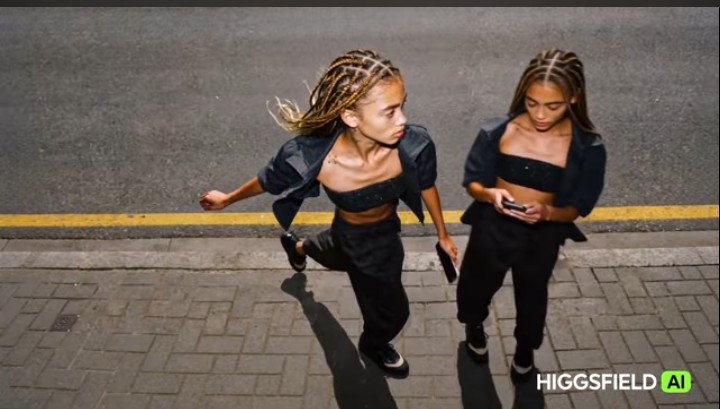
And that is the film’s clever trick. Many of its subjects are frozen in motion, caught mid-step on a street or stuck in one spot while still moving, flickering as if the light is being switched on and off around them. A woman with long braids stands frozen on a sidewalk while another version of her walks into the frame and photographs her. A man moves in slow motion without leaving his place, with blurs drifting around him. The effect is hypnotic, and it makes the whole film feel like a series of living portraits.

The Ripple
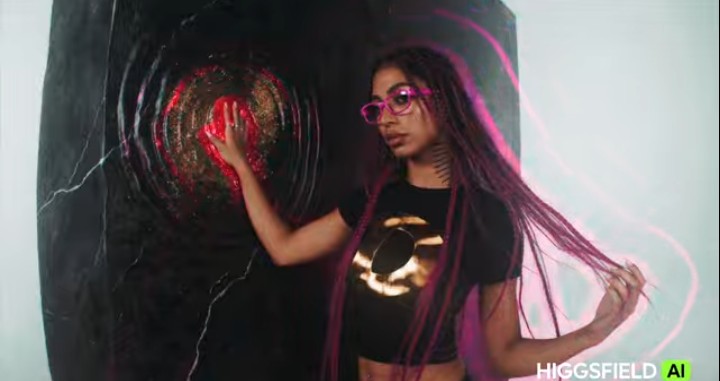
The most beautiful image in the film is the ripple. In one portrait, a woman rests her hand on a golden block, and from her hand a shadow wave flows outward in every direction, until the block looks like a pink painting that is alive. In another, her palm is pressed against a tall slab of rock, and the wave moves across it as she holds her braids, with pink light moving around her hand and hair like an audio wave moving with the music.
It is hard to do justice to this in words. And it fits what the film is about. The closing text speaks of a sensory universe: seeing light, hearing a pulse, touching a hand. The ripples make sound and touch visible, and given that the creator describes her work as audiohaptic research for Deaf and Blind access, that feels intentional to me. It is a way of letting us see what a pulse or a touch might feel like. That is my own reading, but it is a lovely one.
Black, Gold, and Bubble Light
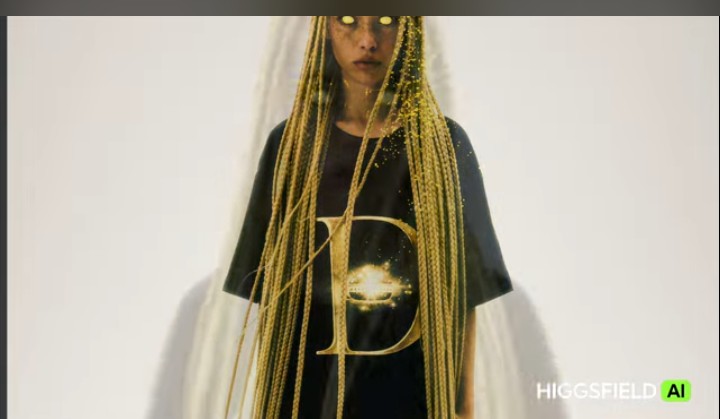
The visual language is confident and consistent. The film opens and closes on a black marble wall with gold veins, and between those frames it moves through whites, purples, pinks, and a soft, bubble-like glow that flickers in and out around its subjects. The fashion is memorable, from oversized tees to futuristic padded outfits, long braids in purple, gold, and white, and a recurring letter D on clothing that ties the portraits together as one world. One woman has her eyes replaced by gold light. Another has a metallic arm and a robotic part of her face. Every look feels deliberate.
The sound design matches it. The music is dreamy, like a doorway to another dimension, and it shifts to something metallic near the end. Between the music are strange, tactile sounds, like objects moving and dropping, that make the world feel physical. Even a simple shot becomes interesting when you can hear it.


The Ending
The film closes by returning to where it began, the black marble wall with strips of gold. The music stops suddenly, and a short message appears in gold letters before the film ends on the same two images it started with. It is a clean, confident frame, and it gives the film the feeling of a complete exhibition: you walk in, you see ten portraits, and you leave carrying something.
Final Thoughts
The Transmission is proof that creativity, not resources, is what makes art. It is a beautiful, strange, and original film that turns a very small number of credits into a living gallery, and it comes from a filmmaker who clearly has a large vision and the discipline to compress it into a few minutes.
I applaud her, and I thank her for showing the rest of us what is possible. If you are ever tempted to say you do not have enough to make something, watch this first.
Scene Breakdown
0:00–0:12 — A black marble wall with gold strips flickers. A slim woman with long braids stands frozen on the sidewalk. Another version of her walks in from the upper left, photographs her frozen self with a phone, and walks out. Dreamy music, like a doorway to another world.
0:13–0:32 — A man in a hoodie with the letter D, black pants, and blue-and-black glasses is stuck in place but in slow motion. Blurs appear around him, someone walks by in the background, and he looks into the camera.
0:33–0:39 — The same man against a white background, with blurs appearing around him.
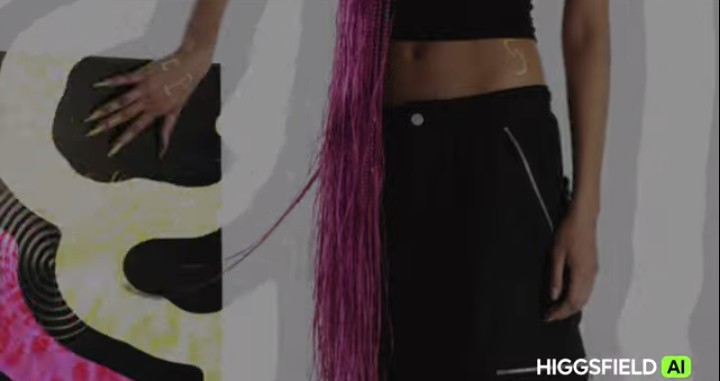
0:40–0:53 — The woman from the opening, now with purple braids long past her waist, rests her hand on a golden block. She has long nails and a letter I on her shirt. She flickers like a light turning off and on, while the background stays still.
0:54–1:11 — The same composition from the waist down. The golden block becomes a pink painting, and a shadow wave flows from her hand in every direction.
1:12–1:18 — A shot like the opening, with a bubble-colored glow flickering around her.
1:19–1:49 — Purple braids and pink glasses. Her left hand holds her braids and her right hand is on a tall block of rock, where a ripple spreads across the surface. Pink light moves around the wave and around her hair like an audio wave moving with the music.
1:50–2:06 — A man with long straight purple hair in a black D hoodie stands in front of white Greek-style pillars. He is stretched inward and outward with the music, and the background moves for a moment too.
2:07–2:15 — An angled close-up from above of a man in a black D shirt with medium purple hair, frozen mid-walk and flickering.
2:16–2:31 — A woman with white braids in a futuristic padded outfit with a D at its center. The surroundings stretch around her, left and then right. A robotic eye appears at her right, and her left arm looks metallic.
2:33–2:42 — The same woman frozen on the street in a black top with a D, with a robotic part forming half of her glasses and a metallic left arm. She holds a phone. The sound is full of things moving and dropping.
2:43–2:54 — Four people frozen mid-walk down the street: a girl with long straight hair, a blonde girl with long braids, and two men in black D hoodies. A ripple emerges from the center girl.
2:55–3:16 — A woman with long gold braids whose eyes are replaced by gold light, in an oversized gold-D tee. The shadow zooms in and out toward us as she stays in place.
3:17–3:32 — The opening image returns, but the sound becomes metallic. She stands in the center, and we see many of her at once, like looking inside a kaleidoscope of symmetrical spaces and color.
3:33–3:44 — The black marble wall with gold strips returns, and the music stops. A message in gold letters closes the film, ending with the line “10 neural portraits, one sensory universe.”
Reader Reviews
There are no reviews yet. Be the first one to write one.