
ORÌKÍ

Score breakdown
62.9K views
Single Review
Written by Kineograph
An oríkí is a praise poem — and this one praises Orí, the inner head that guides and guards a life, over the sound of atabaques and a whole city drumming.
The Song
It builds like a ceremony. For forty seconds the percussion gathers — the lyric sheet names its atabaque players one by one, rum, rumpi and lê — before the first sung lines arrive: “Vou tocar tambor pra você sacudir” (“I’ll play the drum to make you shake”). Yoruba runs through the Portuguese from the start, and at about a minute the chant locks in: “Orí que me fala / Orí que me guia / Orí que me guarda / Orí que me salva / Orí que me diz / Orí que me leva” — speaks to me, guides me, guards me, saves me, tells me, carries me — answered by cries of “Orìkí!” The verses turn practical, almost legal: ask permission before you enter or leave; don’t touch the leaf without licence; nothing about this road was easy or accidental. Then, near the end, the music steps back for a spoken litany — if you don’t know what an obí is, or an orobô, or a quartinha of water, or a plate of ebó for Oxalá, or an acaçá, then I owe you no explanation. It is a boundary drawn with a smile, and it lands like a drum hit.
The Film
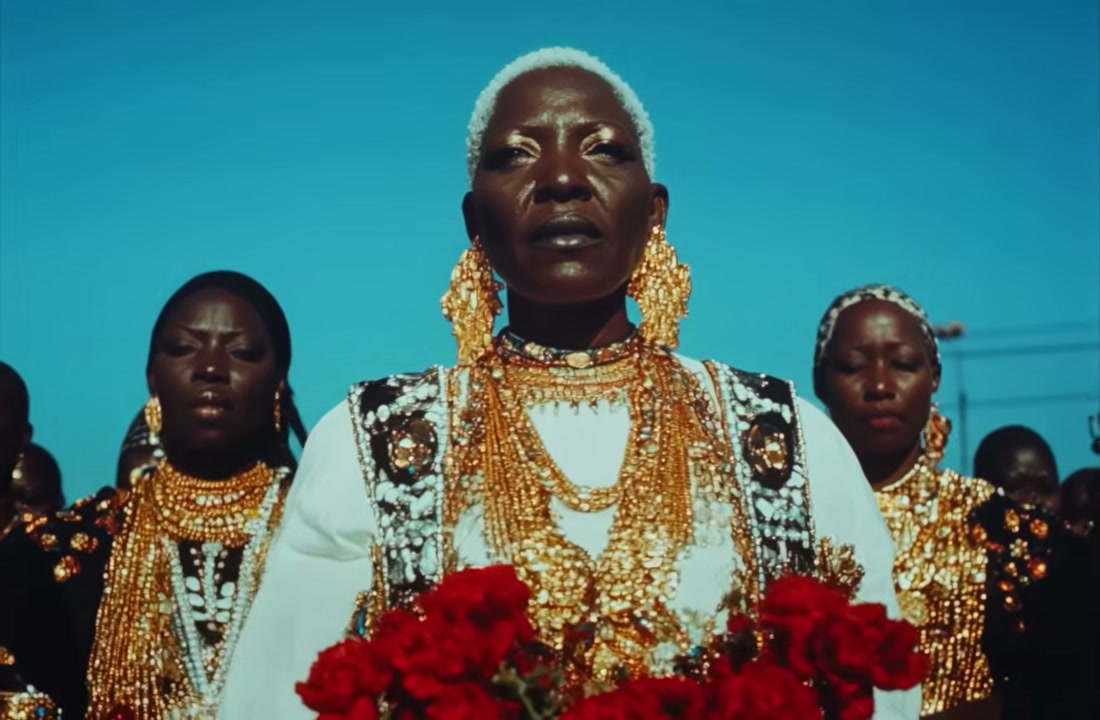
A celebration filmed where it lives. Hands on an atabaque; hands casting pieces on red earth; an elder in white and gold with red roses, gold at her ears and throat; women drummers in bright dress marching; masked caretas crowding the lens, mouths open in the masks’ mouths; a boy in a white lace cap turning toward a street procession; rooftops and colonial streets; a lone figure in pale blue, wearing a tall spiralled hat, bowing by the sea. The direction (Luma Nascimento and Zamba, with a full technical sheet — colour, lettering, edit, executive production by MUVIU Studio) treats every face as worth a portrait. The final movement gathers everyone: one figure in white on a hill, a multitude below, the sun going down over all of it while the credits roll.
Best Moment (3:10)
One figure, one multitude, one sunset
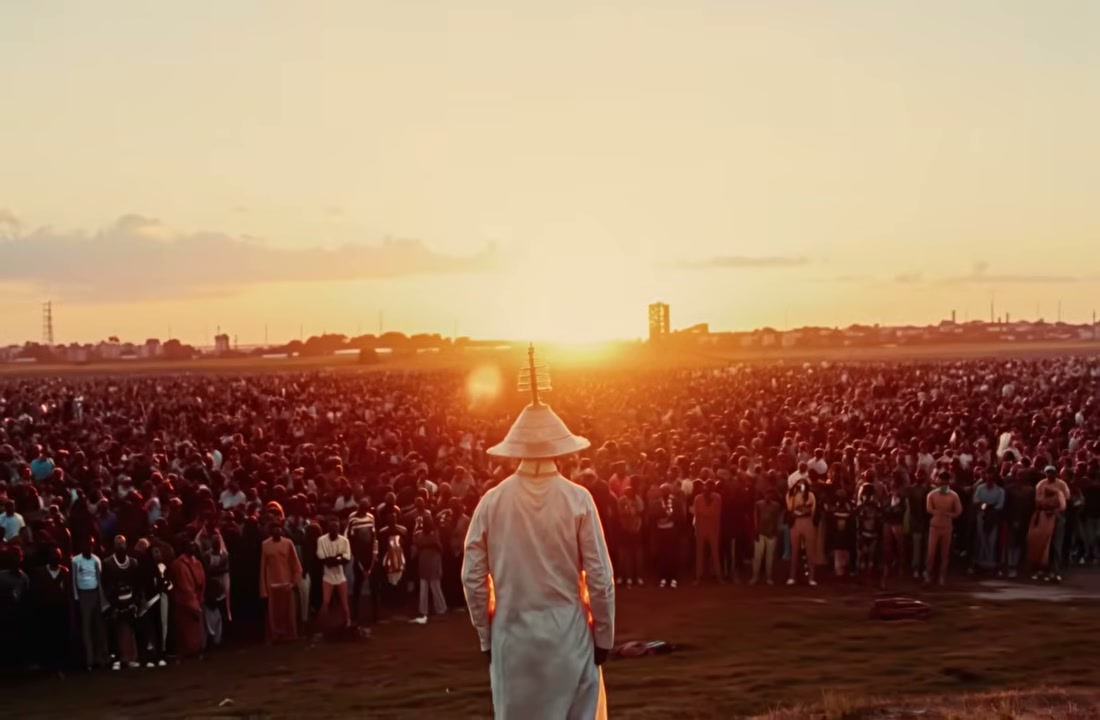
From about 2:55 the film stops cutting and simply stands there: a lone figure in white with a tall tiered hat on a hill, facing a crowd that fills the frame to the horizon, the sun setting behind them both. After three minutes of drumming and procession, the stillness is enormous — the praise-chant’s subject made visible: one head, held up, in front of everyone it came from.
Where It Strains
Barely, and mostly at the edges: the widest sunset shots soften the crowd into texture, and a viewer with no Portuguese meets a lyric they can feel more easily than follow — though the printed lyric in the description, Yoruba and all, is there for anyone who wants it. Neither amounts to much against what the piece achieves.
Final Thoughts
A praise-chant with a city for a choir — devotional, percussive and completely itself, and the finest film in this batch.
Play it loud; stay for the sunset.
Scene Breakdown
0:00–0:39 — The percussion builds: a banana yard at dawn, hands on the atabaque, hands casting pieces on red earth.
~0:35 — The elder in white and gold, red roses in her arms.
~0:39 — The first sung lines arrive over the drums.
1:00–1:25 — The chant: “Orí que me fala, me guia, me guarda…” answered by “Orìkí!”
1:25–1:53 — The verse of permissions: “Agô pra entrar, agô pra sair” — ask before you enter or leave.
1:53–2:21 — “Toca tambor, aguerê, alujá” — processions, women drummers, the streets full.
~2:10 — The figure in pale blue bows by the sea, tall spiralled hat against the sky.
2:21–2:33 — The chant returns; masked caretas crowd the lens (~2:45).
2:35–2:52 — The spoken litany — obí, orobô, quartinha, ebó, acaçá — delivered to camera.
2:55–3:33 — The sunset finale: one figure in white before the multitude, credits rolling.
Video: the joins are genuinely hard to find. The technical sheet credits an AI artist, so generated imagery is woven through the film, but the processions, portraits and drumming read as seamless photography. The most obviously generated-looking passages are the lone figure in the tiered hat against sky and sea (~2:10) and the vast sunset crowd shots (2:55–3:33), where the multitude softens into texture and the light turns painterly. No warped hands, no garbled signage, no melting faces anywhere we looked.
Audio: none — a human-played, human-sung record, cleanly mixed.
Single by Afrocidade, directed by Luma Nascimento and Bruno Zambelli (Zamba). Lyrics and credits are from the video’s own description; short quoted lines are translated literally from that printed lyric. Everything else is from our own listening and viewing.
There are no reviews yet. Be the first one to write one.