
Twisted Crown
 Studio Tora Lab
Score breakdown
Read Review
1.7K views
Series Review
A farmer’s son has one day to stop being a farmer forever: win the Black Hills Tournament, be chosen by a Sacred Stone, and walk out of the village that has already decided what he is worth.

The Farmboy
Thoren Wolfbane’s problem is his surname. His father disgraced the family — the village calls them traitors, calls Thoren “the son of the farmer always causing troubles” — and the old man has spent years beating the disgrace out of his son one training session at a time. “You will be a farmer all your life” is the threat; the Sacred Stones are the escape. Win at Black Hills, be chosen as a Stone’s bearer, and a farmboy becomes a Protector. Thoren’s own dream is simpler and sadder: he just wants to leave, to see the world, to live “a life worthy of the name” instead of one spent in his father’s shadow. Episode 1 tells this in the grammar of classic anime — a legend for a cold open (a great warrior who defeated a king and a goblin), a brutal last lesson, a meadow, a dog, and a boy swearing an oath to himself under a huge sky.
The Night Before
Episode 2, “Farmboy”, is all eve-of-tournament: the crowds pouring in (“everyone has gathered aiming for the Stones”), the tavern, and the triangle at the story’s centre. Arabriel, Thoren’s friend, fights under the opposite weight — a family legacy he is expected to carry — and has quietly loved Elala, the tavern-keeper’s daughter, since childhood; she, just as quietly, watches them both. The two friends make the promise the whole season will test: if the draw puts them against each other, they fight for real. It is a slow episode, deliberately — the calm is the point — and it ends with the boys looking up at Black Hills itself.

The Summons and the Fire
Episode 3 widens the world in a single scene: a one-eyed commander, Legorius, rides into the farm after nearly twenty years, removes his skull-faced helmet, and delivers the King’s summons — after the match, Thoren and his father will present themselves at court. The father calls the King a snake and goes anyway. Then the tournament’s first true duel stops being a contest: Thoren’s opponent, a red-haired knight, grins — “this is where you see who I really am” — and wakes a roaring spirit of fire in the middle of the wheat. Legorius shuts it down (“This is neither the time nor the place, young Thoren”), but the message is clear: the Stones are already moving, and not everyone at Black Hills is playing by the rules.
The Breaking Point
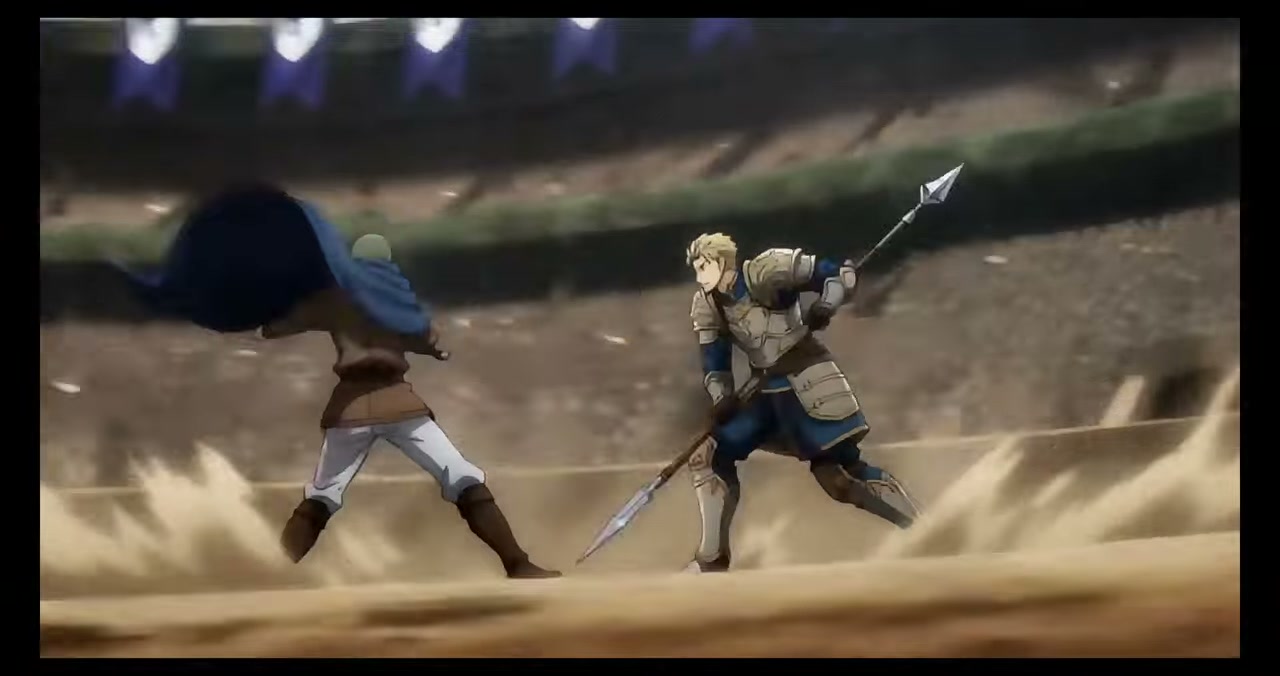
Episode 4 is the longest and the most eventful, though it spends its opening stretch retelling the story so far through the characters’ memories. In the arena, the ceremony gives the series its crown jewel of continuity: this is the very ground where the legendary Rhaela won her Stone, and today’s winner becomes the new Protector, bearer of the Sacred White Stone. Arabriel wins his bout against Klaus — and is accused, in front of everyone, of making Klaus’s younger brother, a tournament favourite, disappear. He denies it on his house’s honour and swears to find the real culprit. And Thoren? Thoren is late — delayed by Episode 3’s duel — while the officials move to disqualify him, Arabriel begs for five more minutes, a visiting lord mocks Black Hills and the “traitor” Wolfbanes, and the episode cuts to its “to be continued” card on the exact frame our hero finally arrives, sword on shoulder, apologising. It is a shameless cliffhanger, and it works completely.
The Craft — and the Languages
The anime craft is warm and confident: golden wheat, long sunsets, expressive faces, and a recurring opening song that gives the series a proper identity. Designs hold across all four episodes, and the fire awakening in Episode 3 is a genuine showpiece. Viewers should know what they are pressing play on, though: Episode 1 is the official Italian dub — Ivo De Palma voices Thoren, with the ALCHILL team — while Episodes 2 to 4 switch to Japanese voices; English subtitles are burned into every episode, so nothing is lost, but the switch is noticeable. Episode 1 also carries a dedication card, “in loving memory of Giuseppe Frisina”, which says much about the small, personal scale of this studio. However you watch it, Twisted Crown is a two-language production, and Kineograph lists it as such.
Final Thoughts
Come for the tournament; stay for the conspiracy. Twisted Crown is patient, heartfelt, old-school anime storytelling that trusts its audience to wait for the payoffs — and then stacks three of them into one episode. With Rhaela already on the site, Studio Tora Lab’s corner of Eldaria is becoming one of the most interesting worlds in AI series. Roll on Episode 5.
Scene Breakdown
Episode 1 — “L’Inizio della Leggenda” (7:40). 0:00–1:25 — The legend of the great warrior, told as a tale. 1:25–3:55 — The last lesson: Thoren’s father, the stakes, and “you will be a farmer all your life”. 3:55–5:20 — Thoren’s oath in the meadow — freedom, the world, and out of his father’s shadow. 5:20–7:40 — The village on festival eve, the lordling’s mockery, and the road to Black Hills: “let the games begin” — closing on the Italian dub credits and the episode’s dedication card.
Episode 2 — “Farmboy” (9:33). 0:00–2:45 — The night before: the crowds, the Stones, and two friends taking stock. 2:45–5:30 — The tavern: Elala, her father’s teasing, and Arabriel’s long-kept secret. 5:30–7:50 — The bully’s insult — “traitor” — and Thoren’s answer: tomorrow he takes a Stone and leaves. 7:50–9:33 — The promise (if we fight, we fight for real), a mother’s warning that the Stones kill the weak, and the arrival at Black Hills.
Episode 3 — “What They’re Hiding” (11:04). 0:00–1:50 — The father’s confession: “I was too hard on him” — everything was to protect the boy. 1:50–5:00 — Legorius at the farm: twenty years, an old friendship, and the King’s summons. 5:00–7:30 — Tournament morning; Elala searches the crowd for a Thoren who has not come. 7:30–11:04 — The duel in the wheat: a seriously strong opponent, a grin, a waking wall of fire — and a commander’s intervention.
Episode 4 — “The Breaking Point” (14:52). 0:00–4:30 — The story so far, retold in flashback as the arena fills. 4:30–7:30 — The ceremony: the Sacred White Stone, the new Protector, and the ground where Rhaela won her Stone. 7:30–9:30 — Arabriel beats Klaus — and stands accused of a disappearance. 9:30–12:30 — Arabriel stalls his own celebration; Klaus concedes with respect, and asks why he held back. 12:30–14:52 — “Next up: Thoren Wolfbane.” He hasn’t appeared. Five more minutes are begged, the Wolfbanes are mocked — and at the last possible second, he arrives. To be continued.
Visitor Reviews
There are no reviews yet. Be the first one to write one.