

 Bible Stories – Movies
Score breakdown
10.5M views
Film Review
This review discusses the ending. If you would rather watch the film first, we recommend you do, and then come back.
A Prince Who Doesn’t Belong Anywhere
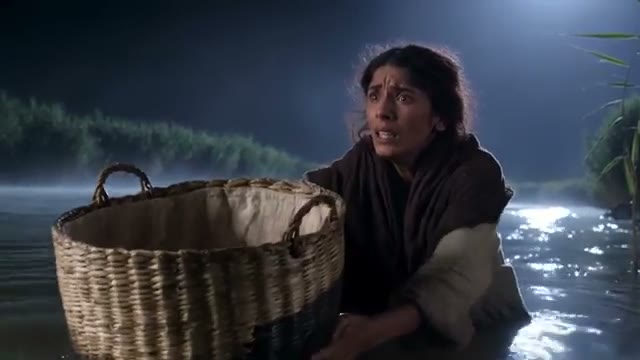
I think the film’s real subject is not the plagues at all, it is belonging, and it says so in its best early line, when a Hebrew tells Moses, “You are not one of us. You belong to the palace.” That stings because it is true in both directions: the palace does not own him either. The opening is handled with real care — the decree, the mother hiding her baby with her daughter Maryam, the basket in the reeds at night — and the princess finding the child is played as mercy, not spectacle: “This one will live.” I believed the bargain that follows, the mother paid to nurse her own son, and the line “When he grows, he will be mine” hanging over the whole childhood.
What I admired is how the film lets the contradiction sit in Moses rather than explaining it away. His tutor drills him — “A prince does not bow” — and the palace gives him everything, a name, fine clothes, training, respect, while the narrator keeps insisting something is waking in him. The dreams of a small house, the voice he says he hears, Pharaoh telling him “You were born to command, not to feel” — it is all a bit on the nose, and the narration does a lot of the work the scenes could have done, but the tension itself is real and I felt it. By the time he walks into the construction site and stops a whip, I understood why he could not stay a prince and why he could not become a Hebrew either. He kills the overseer, and the film does not dress it up as heroism; the man he saves is terrified of him, and that fear is the honest part.
Order, and the God Who Breaks It
Pharaoh is the film’s second-best idea, and I mean that as praise. He is not a ranting villain; he is a man who has made a religion out of control, and his lines are the sharpest in the script. “Order is everything. Without order, there is revolt.” Then, when Moses first demands freedom: “It is not weakness. It is order.” I thought that was a genuinely good piece of writing, because it makes the conflict about two kinds of order — Pharaoh’s, and the one Moses keeps stumbling into. The film is at its most interesting when those two ideas are in the same room, and at its least interesting when it leaves the room to show another plague.
That is my main complaint about the middle stretch. The signs arrive — the staff, the poisoned water, the frogs, the dust rising, “This is the finger of God” — and each one is staged well enough on its own, but they are cut together so quickly that they stop landing as events and start landing as a list. Pharaoh bargains, relents, takes it back; Moses warns, waits, returns. The pattern is the point, I know, but the film does not vary the pattern enough, and the livestock and the hail and the locusts blur in my memory in a way the basket and the bush do not. What saves the stretch is the small human cost it keeps cutting back to: the laborers under the no-straw quota, shouting “I can’t,” and blaming Moses — “You did this. Now it’s impossible” — and Moses praying, “Lord, why did you allow this? I came to speak, and they suffered more.” That prayer is the film being honest about its own story, and I respected it for that.
The Night the Doors Were Marked
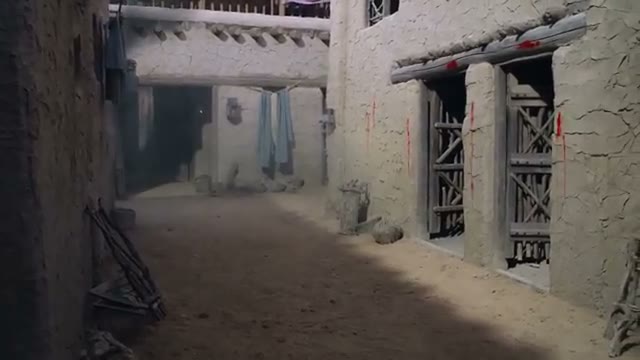
The Passover is where this film finally stops performing and starts feeling, and it is the stretch I would show anyone who asked me what it does well. The instructions are given plainly — a lamb without blemish, blood on the doorposts and on the lintel, unleavened bread, bitter herbs, sandals on and belt fastened — and then the film goes quiet. A mother tells her child, “Stay with me. Stay inside,” and the street outside is empty, the doors marked in red, the whole city holding its breath. I found that image, the empty mud-brick street at 51:28, more frightening than any of the plagues, because it is about people waiting for something they cannot see. When Moses is asked, “And what happens if the door is not marked?” and answers, “Death enters,” it lands because the film has finally trusted silence to do the work.
The Sea, and the Sentence That Follows
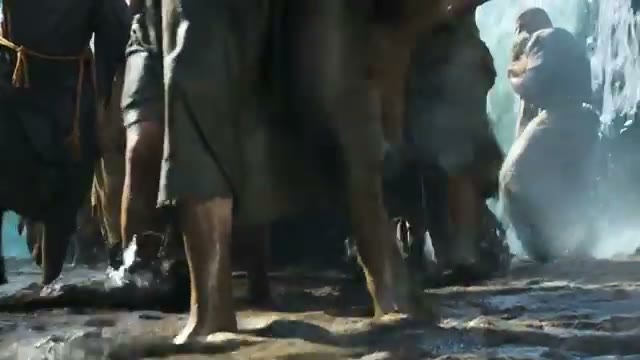
The exodus itself is brisk — Pharaoh breaking, “Rise up, get out from among my people,” then changing his mind, the chariots, the crowd at the shore shouting that Moses brought them out to die — and Moses answering, “Do not be afraid! Stand firm! You will see the Lord’s salvation!” The crossing is staged as a rush through a wall of water, and it works as a release after all that waiting, even if the faces in the crowd soften and blur as they run. Then the film does something I did not expect and rather liked: it refuses a triumph. “I will sing to the Lord,” and then, “Is it over? No. It has begun.” I thought that was the right ending for a film that knows the Red Sea is a beginning, not a conclusion — though I also wished, just a little, that it had earned that line with five more minutes of what comes after, instead of stopping on it.
Best Scene (25:30–27:10)
The burning bush
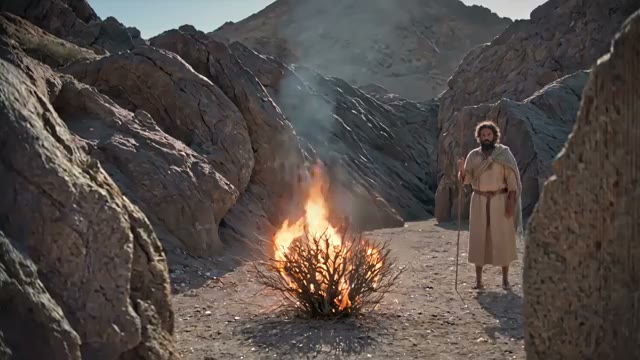
It is the best scene because it is the only one where Moses argues, and loses, and is changed by losing. God tells him to take off his sandals, that the ground is holy, that he has seen the affliction of his people and heard their cry, and Moses answers with every excuse a frightened man has — he is a fugitive, he is nobody, he freezes, he is slow of tongue — and each one is met, not with comfort, but with a promise and a sign: the staff thrown down, the hand in the cloak, “I am who I am. Tell them I am has sent me to you,” and “Send someone else” answered by “Your brother Aaron will come. He will speak for you, but you will go.” The close-up that carries it is at ≈25:45 — Moses weathered and gray-streaked, staff in hand — and he answers “Here I am” at ≈25:57; at 26:01 the film is on the wide shot of the bush burning in the rocky ravine as “Take off your sandals… holy ground” begins. That wide shot is the film’s most striking image, but the close-up is the scene: a man who wanted to stay buried in the desert realizing he will not be allowed to.
Final Thoughts
I came away thinking this is a better film about Moses than it is about Pharaoh’s fury — the fury is loud and repetitive, the man is quiet and complicated, and the film is best whenever it remembers which of those it is really about. It is not a great film, but it is an honest and often moving one, and the Passover night alone justifies the watch. The empire calls itself order; the film’s answer is a man who finally stops running.
Scene Breakdown
0:00–1:30 — Opening narration. The Hebrews suffer under Egypt; laborers are driven on, and the narrator says the tighter the empire grips, the more it reveals its fear.
1:30–3:30 — The decree. Pharaoh’s decree: too many births in Goshen, so every Hebrew boy born will be thrown into the river and the girls will live; soldiers search houses while a mother hides her baby with her daughter Maryam, then sets the basket in the reeds at night (3:31).
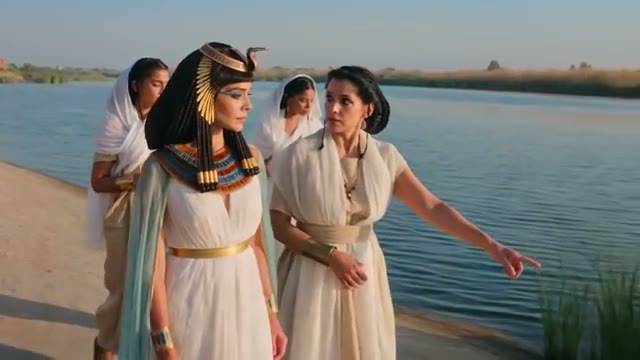
3:30–5:45 — The basket found. The princess finds the basket at the river (4:01): “This one will live”; Maryam offers a Hebrew woman to nurse him, his mother is paid to care for him, and the princess says, “When he grows, he will be mine.”
5:45–7:45 — Raised a prince. A “YEARS LATER…” card (6:15) marks the jump: Moses is raised as an Egyptian prince, drilled in posture and reading, and told his name means he was drawn out of the waters.
7:45–9:45 — Something waking. Moses as an adult: war training, Pharaoh’s “Egypt doesn’t ask. Egypt’s ruthless logic takes,” dreams of a small house and a voice calling him, and the narrator says the presence of the Hebrews has awakened something in him (9:02).
9:45–12:00 — The killing. The construction site: Moses watches Hebrews worked hard, stops an overseer beating a man and kills him; the man he saves tells him to run, Hebrews reject him the next day — “You are not one of us. You belong to the palace” — and Pharaoh orders his arrest as guards move through the palace (11:01).
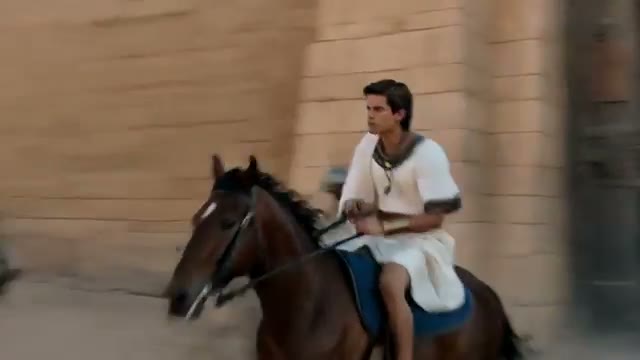
12:00–18:30 — Flight. Moses runs from Egypt, crosses the desert on foot and then on horseback (18:02), the narrator saying everything the palace put on him is falling away and asking, “Who am I?”
18:30–20:45 — The well. The well in Midian: Moses finds Jethro’s daughters at the well (20:02) and defends them from shepherds who claim the water, fighting them off.
20:45–23:00 — Jethro’s house. Jethro takes him in: “Here, the one who protects, eats”; Moses says he grew up in the palace but is not of the palace, and begins to unlearn the palace’s ways, learning to listen to the wind, the night and his own heart as a shepherd.
23:00–25:30 — A new life. Moses marries Zipporah, who treats him like a man, not a prince; their son is named Gershom, “because I am a stranger in a foreign land”; a visitor brings news from Egypt — more cries, more servitude, the people suffering (25:01).
25:30–28:00 — The burning bush. Moses goes closer to see why the bush does not burn, is told the ground is holy, hears “I am the God of your father, the God of Abraham, the God of Isaac, and the God of Jacob,” objects that he is a fugitive and slow of tongue, is given the signs of the staff and the hand, and is told Aaron will speak for him.
28:00–30:30 — The return. Moses tells Zipporah what he heard — “I didn’t see. I heard” — Jethro sends him in peace, and Aaron meets him on the road, saying he heard something telling him to come; the staff he carries back is no longer just wood but a sentence (29:02).
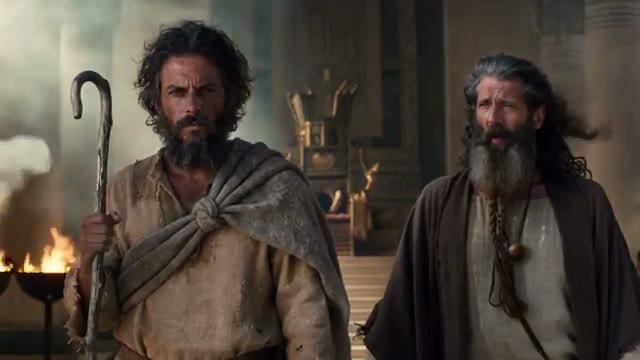
30:30–32:45 — The first audience. “Thus says the Lord the God of Israel. Let my people go”; Pharaoh asks who the Lord is that he should listen, refuses, and then decrees no straw but the same brick quota — “It is not weakness. It is order”; at 32:34 the film cuts from the audience — the great palace doors, Moses leaving — and the laborers’ straw-gathering is on screen by 32:48.
32:45–35:30 — The quota. The quota crushes the laborers: “Where is the quota? I can’t. I can’t”; they blame Moses, he prays, “Lord, why did you allow this?”, and God promises Pharaoh will let them go, not by kindness, but by force; the signs begin (35:14).
35:30–38:30 — The plagues begin. Poisoned water and frogs in the streets, Pharaoh begging Moses to pray them away — “When? Tomorrow. So you will know there is no other” — dust rising, “This is the finger of God,” and Goshen set apart, untouched (38:18).
38:30–41:00 — Bargaining. Pharaoh bargains and relents and takes it back: sacrifice here, then three days, then “pray for me”; the livestock dies everywhere but in Goshen, and Pharaoh says, “I will not yield,” as Moses leaves the palace between guards (40:59).
41:00–44:00 — Hail. Moses warns, “Now hail will come. Hail Egypt has never seen. Whoever hides will live” (42:02); the storm tears through the palace courtyard, and Pharaoh confesses, “I have sinned, pray to the Lord,” and Moses stops it.
44:00–46:30 — Locusts. The land is stripped, “there is no more food”; Pharaoh offers to let only the men go, Moses refuses — “Our children, our elders… No one stays” — and Pharaoh threatens him and sends him out.
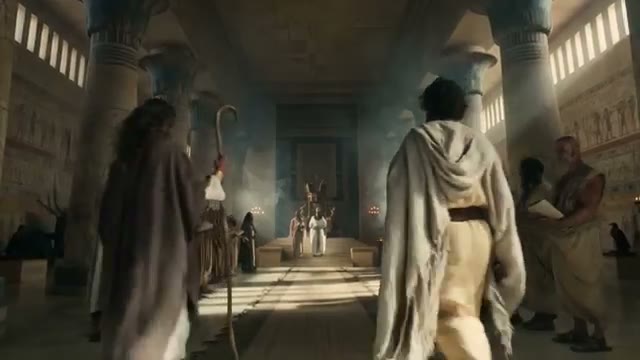
46:30–48:45 — Darkness. Darkness that can be felt for three days, while the light stays on in Goshen; Pharaoh summons Moses once more in the great hall (47:02) — take the children, leave the herds — Moses refuses, and Pharaoh banishes him: “The day you see me, you will die,” and Moses answers he will never see his face again.
48:45–51:30 — Passover. Choose a lamb without blemish, blood on the doorposts and the lintel, eat in haste with belt fastened and sandals on; “If the door is not marked, death enters” (48:48); the night passes, a mother holds her child inside, and the marked street stands empty in the morning (51:28).
51:30–54:30 — The exodus. Pharaoh, broken, says, “Rise up, get out from among my people… and bless me also”; the Hebrews leave carrying everything they can, then Pharaoh changes his mind, sends the best chariots, and the people are trapped at the sea, shouting that Moses brought them out to die (54:24).
54:30–56:48 — The crossing. “Do not be afraid! Stand firm! You will see the Lord’s salvation!”; the people rush through the parted water (55:01), “I will sing to the Lord,” and the film ends on the shore with, “Is it over? No. It has begun.”
≈11:01 — Three palace guards/officers in the corridor share near-identical faces, hairstyles and features.
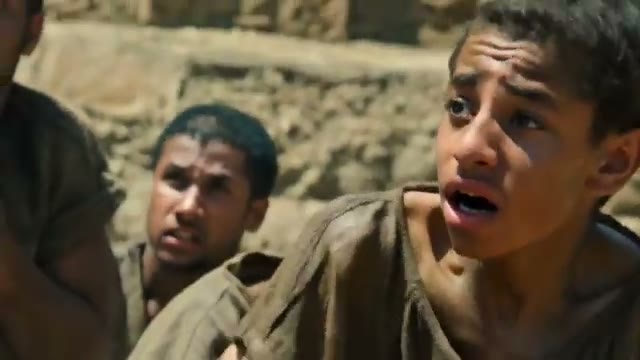
≈33:02 — The foreground laborer’s face is waxy and soft, with uneven eyes, while the man behind him is blurred out.
≈47:00 — Pharaoh’s throne close-up reads slightly waxy.
≈47:02 — In the wide palace hall, the courtiers lining the sides have faces that soften into indistinct smudges, and Moses and Aaron are shot from behind with their faces hidden.
≈54:24 — In the wide shot of the crowd at the sea, the faces in the crowd soften and blur; many figures have indistinct features.
≈55:01 — In the crossing, the figures moving through the water have faces that blur in motion — the child in the foreground has a smeared face — and the wall of water is a smooth turquoise blur with no texture.
Throughout the plague passages (≈35:30–46:30) — dialogue is often delivered with the speaker’s face turned away, in profile, or off-camera, which hides lip-sync but also keeps the film from ever quite committing to a face in its loudest scenes.
There are no reviews yet. Be the first one to write one.