
 Mrbarda
 Creator ID26-11-01-0261

Score breakdown
39 views
Film Review
This review discusses the ending. If you would rather watch the film first, we recommend you do, and then come back.
Synopsis
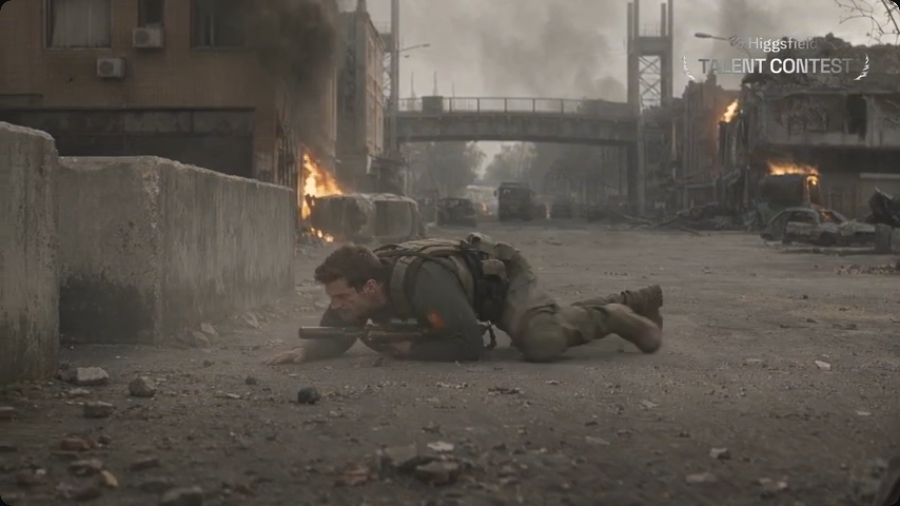
Combat, in a ruined street: two soldiers behind concrete, a burning car, one of them wounded and clutching his arm. “Hang in there. It’s almost over.” Cut to the real world — a young man on a couch, headset on, pizza boxes on the table, telling his friend he has a job interview in the morning. “Come on, 10 more minutes.” “You said that an hour ago.” He logs off. And in the game world, the war simply… stops mattering. The two soldiers walk home past burnt-out vehicles, find there is no food, share what there is — a tin of soup at a bare table — and settle for the night, the wounded one on the couch, the other keeping watch in a chair. “I’m going to get you out of here.” Then, from outside their world: “Pick up where we left off?” The player is back. “Yeah. Hopefully I don’t get shot again.” “Try staying behind cover.” The film ends where it began, which is the point. The project page is explicit that this one is completed and submitted; the soldiers are named Adam and Ben in the production files, though the film itself never names them.
The Life Between Levels
The film’s best decision is what it refuses to do. There is no wink at the camera, no game-interface jokes past the premise itself — the log-off is played as a shift change in a war that never ends, and the soldiers’ off-duty life is given the full dignity of a drama: hunger, a bandaged arm, flashbacks mentioned over soup. “Flashbacks again?” “Yeah, lately. I don’t know what’s wrong with me.” It is a war film’s conversation, happening to men who are, technically, software.
That conversation deserves naming plainly: it is about post-traumatic stress — PTSD. The film never uses the term, and it does not need to — it shows the shape of it. One soldier cannot stop reliving the battle; the other organises the whole night around it — food first, the couch for the wounded man, himself awake in the chair keeping watch, because standing down is the one order neither of them can follow. No joke is made of any of it, and no cure is offered by morning — only care, given in soup and sleep and presence. For a film built on a video-game premise, that is an unusually honest piece of writing about what soldiers bring home.
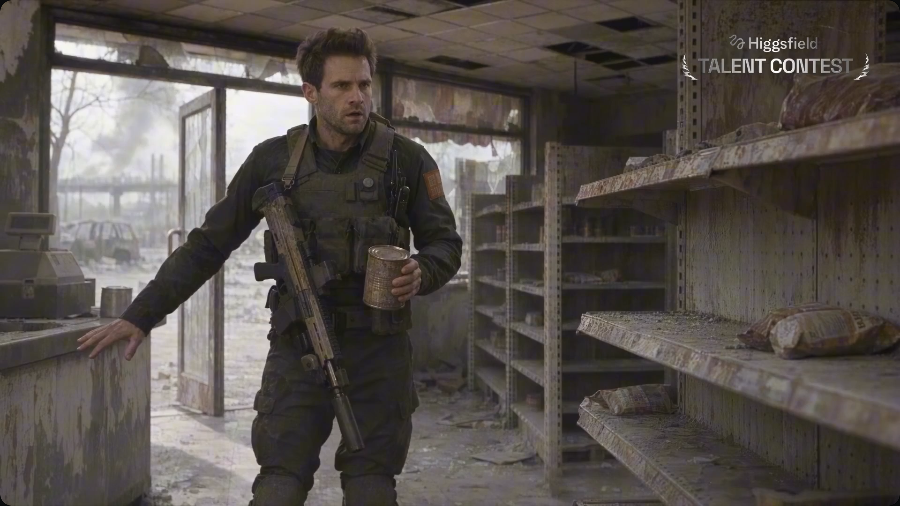
The middle of the film is domestic in the best way. The walk home past the burnt bus, the ruined kitchen, the soup — “That’s dinner. You’re welcome.” — and the couch negotiation (“Sorry, you’re stuck with the chair. When I get hurt, I’m taking the couch.” “Don’t get used to it.”) build a friendship out of small generosities. When the promise comes — “I’m going to get you out of here” — it has been earned by tins of soup, not speeches.
The Loop Closes
The ending is the idea completed. The player’s return is not a twist; it is a sentence. Everything the two men built in their one evening of personhood — the meal, the rest, the promise — is still true, and none of it can protect them, because at dawn someone presses Continue. The last exchange sounds almost light, and lands as tragedy: “Hopefully I don’t get shot again” is said the way soldiers say such things — evenly, as if it were nothing — by a man whose flashbacks we have just spent the evening with. It is not a joke, and the film does not treat it as one.
Best Scene (2:35–3:10)
“That’s Dinner”
The soup. Two soldiers at a bare table with a tin can between them, one wolfing his food down, the talk turning — gently, in the middle of the most ordinary act there is — to flashbacks and to what they are to each other: “Good thing we’ve got each other, huh?” “Wouldn’t last a day here without you.” It is the film’s emotional centre, and it is built out of almost nothing. It is also where the film’s real subject sits down at the table: two men looking after each other through something neither of them has a name for.
Final Thoughts
Most high-concept shorts spend their length explaining their concept. This one spends its length on dinner. The result is a complete film: a beginning that sets a trap, a middle that makes you care, and an ending that springs it — quietly, in a line of dialogue that sounds almost casual, and isn’t. Verdict: the player will log off again tonight, and these two will still be in there — a small, sad, perfectly closed loop.
★★★★ — Dinner, a couch, and a promise the game won’t keep
Scene Breakdown
0:00–0:30 — Combat. A ruined street, fire and smoke, two soldiers behind concrete; the wounded one clutches his arm. “Hang in there. It’s almost over.”
0:30–1:20 — The player. A young man on a couch, headset, pizza boxes, a job interview in the morning. “You said that an hour ago.” He logs off; the TV goes dark.
1:20–1:50 — The walk home. Back in the game world, the two soldiers cross the ruined street toward a bridge, past a burnt car and a burnt bus. “Come on. Let’s go home… We’re out of food.”
1:50–2:35 — The kitchen. Face to face in a ruined room; one leaves to find food. “You okay staying here alone? I’ll get us some food.” “Yeah, I’ll be okay.”
2:35–3:10 — The soup. Dinner at a bare table, a tin can in the centre. “That’s dinner. You’re welcome.” “Flashbacks again?” “Good thing we’ve got each other, huh?”
3:10–3:50 — The watch. The wounded soldier sleeps on the couch; the other keeps watch from a chair, rifles in the corner. “I’m going to get you out of here.”
3:50–4:19 — Continue. The player returns. “Pick up where we left off?” “Yeah. Hopefully I don’t get shot again.” “Try staying behind cover.” Black; the festival card. No credits.
There are no reviews yet. Be the first one to write one.