
 Allan Ripley
 Creator ID26-11-02-0004

Score breakdown
393 views
Film Review
This review discusses the ending. If you would rather watch the film first, we recommend you do, and then come back.
Synopsis
An immense alien ship appears over a quiet Japanese city and simply hangs there. Down from it come Go and Mo, on an otsukai — an errand. Long ago, Lord Dō left a vintage car with the keeper of a takoyaki shop; Go and Mo are to collect it, “and try not to break the whole city on the way.” The city, meanwhile, reacts the way anime cities do: a TV reporter shouts at her cameraman, the police give chase, a mother scolds her boy by a vending machine, and the military eventually starts dropping tanks. Go and Mo reach the takoyaki shop, where the keeper — an old woman in the black-and-red of Lord Dō’s household — crosses her takoyaki skewers and refuses to hand the car over: “I’m not giving that up.” Her refusal turns out to be loyalty, not stubbornness. “I’ve kept it safe all this time.” The red vintage convertible is revealed, polished and perfect, and Go and Mo fly it home beneath the mothership, Mo leaning out into the sky: “Hey, look! Look!” Written and directed by Allan Ripley of Midnight Monkeys; made with Seedance 2.5 on Higgsfield, images by GPT Image 2.6 and Seedream 5.5, music by Suno, edited and coloured in DaVinci Resolve and Dehancer. The dialogue is Japanese, with English subtitles burned in.
It Looks Like Real Anime Because It Behaves Like It
Plenty of AI films can hold a pretty frame. What they almost never hold is a cast. Otsukai holds one for seven minutes. Go is Go in every shot — the white moustache and bushy brows, the black robe with red trim, the black hat with its red top — and Mo is Mo, from the white headdress with its red band and pom-poms down to the red scarf, whether he is laughing in the street, eating a soft-serve, or squashed inside a gumball bubble. Around them, a whole town of one-scene characters arrives fully designed: the sweating taxi driver, the reporter in her beige trench coat, the scolding mother in her purple apron, the two policemen. Any of them could walk out of a real 1990s series and nobody would blink.
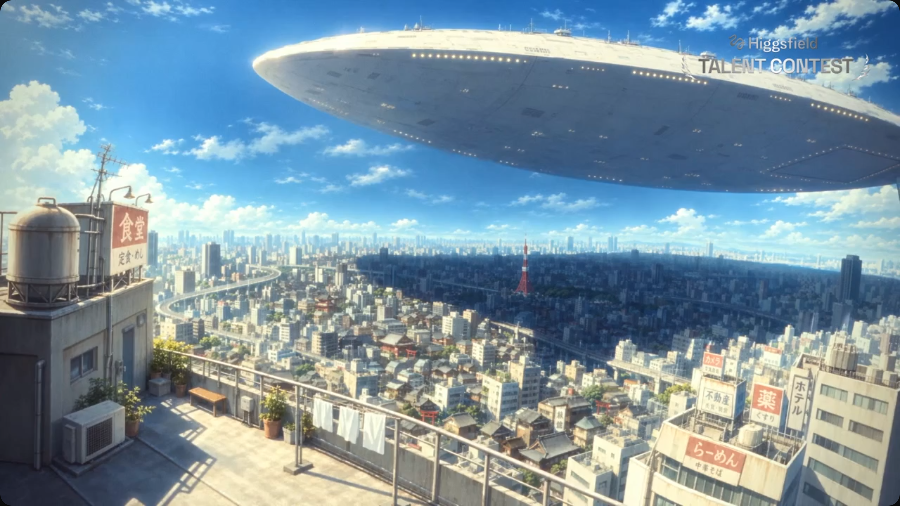
The world is lettered like the real thing, too. The signage is legible Japanese throughout — the takoyaki lantern, the shop sign たこ梅, the shopping-street arch, the police car’s doors — and the backgrounds have that painted, sunlit depth that makes the era’s anime feel like a place you could move to. The opening is pure confidence: a sleepy street, a taxi driver mopping his face, and then, at 0:56, the ship — vast, dark, silent — hanging over the skyline while red petals drift down. It is staged exactly the way the genre stages it, and it lands exactly the way the genre intends.
Go and Mo
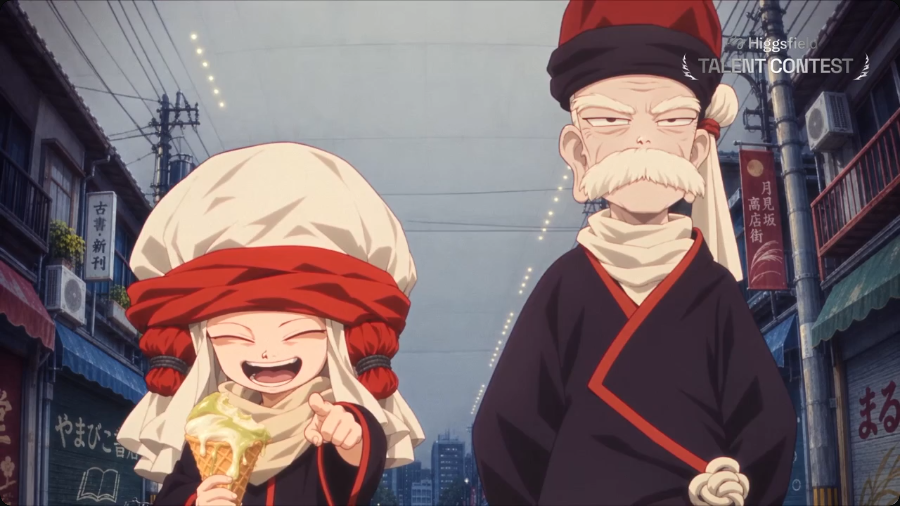
The film’s engine is the oldest one in comedy: a grump and a menace, stuck together. Go has the bearing of a man who has done this errand a thousand times and enjoyed none of them; his profile shot at about 3:40, delivering “You said it’d be fun” through the side of his mouth, is a whole character in one line. Mo is chaos in a headdress — a kid with terrifying powers and the attention span of a goldfish, whose priorities are food first and everything else later. His bliss over a matcha soft-serve at about 2:54 — “…But this? This is the best” — and the two-shot at about 3:20, Mo howling with laughter and pointing while Go stands beside him in magnificent disapproval, tell you everything about the pair of them.
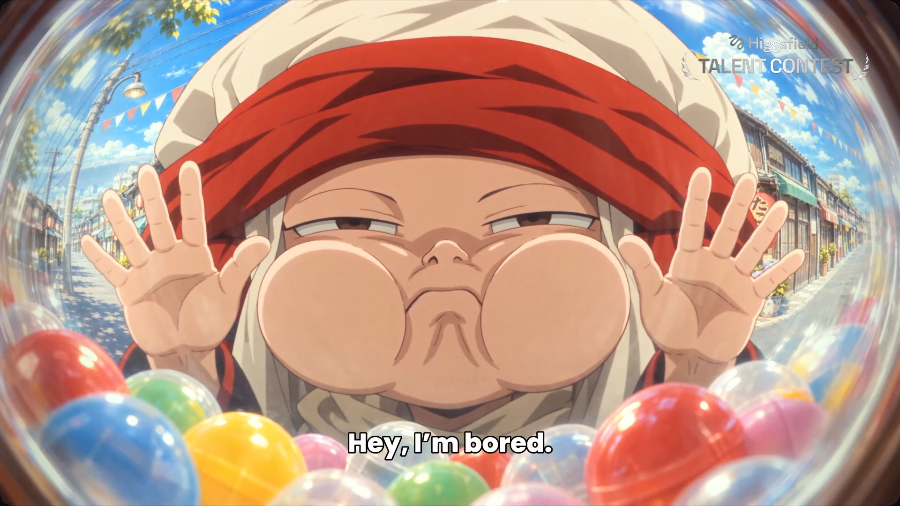
And then there is the bubble. At about 3:35, Mo’s face appears pressed inside a transparent gumball sphere, cheeks puffed to twice their size, little hands flat against the glass: “Hey, I’m bored.” It is the funniest single image in the film — a being of terrifying power, defeated by a waiting room — and it is drawn with total commitment, the face distorted exactly the way real anime distorts faces for a gag, not the way AI distorts them by accident. That distinction, held across the whole film, is the craft on display.
The Town Fights Back
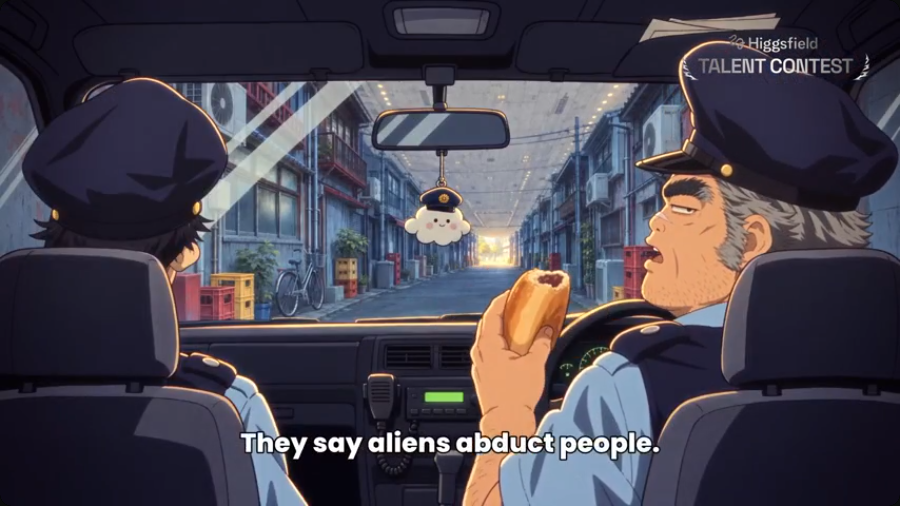
While the aliens run their errand, the film keeps cutting away to the town — and the cutaways are where I laughed most. The police are a double act of their own: inside the car at about 2:30, the senior officer is calmly eating a pastry — “They say aliens abduct people” — while a little cloud-shaped police-hat air freshener swings from the mirror; a minute later he is gripping the wheel, roaring “Hold on tight, rookie!” and “I’ll teach those aliens how things work in this town!”, while the rookie’s drink explodes over his glasses. The reporter screams “Roll it!” at her cameraman. A mother delivers a full scolding — “Are you listening?” — in the middle of an alien invasion.
And best of all, running through the film in brief intermediate moments, are the other two officers: a pink pig policeman and a tall white bird policeman, who keep dashing across the screen between scenes in their blue uniforms, there and gone before you can be sure you saw them. It is a pure anime sight gag — the kind of running joke a series would keep for a whole season — and every time they flashed past I was grinning. A film that understands its genre this well doesn’t just copy the look; it copies the jokes.
The Errand
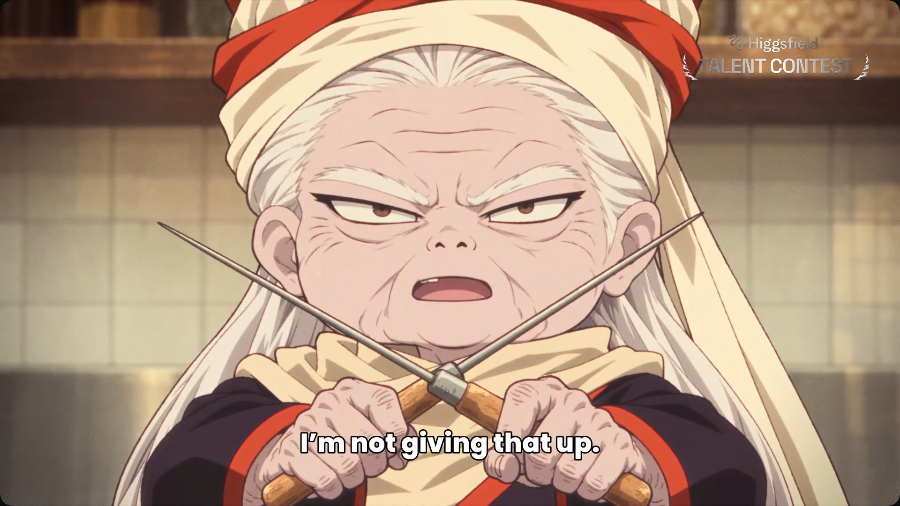
The last movement belongs to the takoyaki shop, and it is where the film’s warmth catches up with its comedy. Go and Mo arrive at the counter — the empty grill in the foreground, bowls of octopus and spring onion ready — and the keeper confronts them with a warrior’s stance and a pair of takoyaki skewers, purple aura swirling: “…What are you here for?” Crossed skewers, close-up: “I’m not giving that up.” For a moment the film plays it as a standoff. Then the cloth comes off the car, and her refusal is re-read in one line — “I’ve kept it safe all this time.” She was never the obstacle. She was the guardian. The red convertible, licence plate 10-10, sits gleaming in the garage with a tabby cat beside it, and Go’s grin is the most human expression in the film.
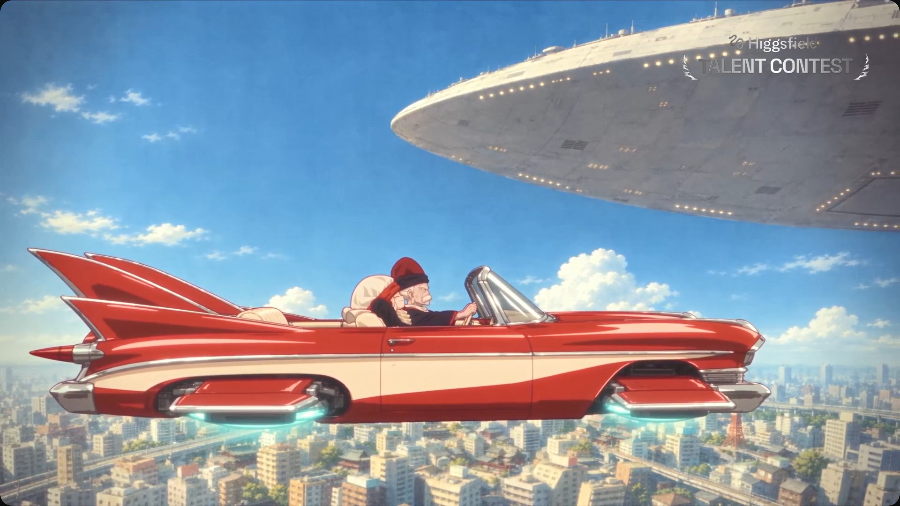
The chaos peaks outside — tanks tumbling over the highway, an officer bellowing through a megaphone — and then the film exhales: the convertible rises into the sky on glowing panels, two small figures in it, the mothership huge above the city they somehow did not break. “Hey, look! Look!” It is the right ending: the errand done, the town intact, the kid happy.
About That Story
The honesty, briefly: the plot is an errand, and it knows it — otsukai means exactly that, a small mission to fetch something. There is no deeper purpose underneath it that I could find, no theme being worked out, and the film’s middle is essentially a tour of the town’s reactions rather than an escalation of anything. Storytelling is the weakest thing here, and I have scored it that way. But I want to be fair about what that means: the errand is a frame, and the frame is chosen perfectly. A bigger story would have crowded out the town, the food, the police, the pig and the bird — everything the film is actually for. As a showcase of the genre it works completely; it just showcases by wandering, beautifully, rather than by building.
Best Scene (5:50–6:20)
“I’ve Kept It Safe All This Time”
The reveal. The keeper lifts the cloth, and the car is there — red, gleaming, loved. Everything the scene needs is in her one line: she has guarded this car for years, for a lord who might never return, in a town that never knew. It converts the film’s funniest standoff into its warmest moment in a single beat, it pays off the errand, and it gives Go the only thing that makes him smile in seven minutes. The comedy gets you to the shop; this scene is why the trip was worth making.
Final Thoughts
Allan Ripley made The Prompter, one of the highest-scored films on this site, and with Otsukai he has done something arguably harder: he has made an AI film that a viewer could sit in front of, unlabelled, and simply take for a real 1990s anime short — designs, jokes, lettering, timing and all. The story is a stroll rather than a journey, and I have said so. Everything else — the characters I loved from their first scene, the town I would happily watch a series about, the pig and bird officers I am still smiling about — is as good as this medium currently gets. Verdict: one simple errand, executed like a classic — the most spotless AI anime I have seen.
★★★★★ — Two aliens, one vintage car, and a whole town worth moving to
Scene Breakdown
0:00–0:50 — A quiet street. A beige kei car, the Yorimichi MART, a taxi driver mopping his face in the heat. Everyday anime calm, established in under a minute.
0:56–1:30 — The ship. The mothership hangs over the skyline, Tokyo Tower below, red petals falling. Inside a shop, Go watches the news: “So far, the ship has shown no sign of movement.”
≈1:30–2:30 — The town reacts. A chase through the streets; the TV reporter, trench coat and microphone, shouts “Roll it!” at her cameraman.
≈2:30–2:50 — The police. Inside the patrol car: the senior officer eats a pastry — “They say aliens abduct people” — then grips the wheel: “Hold on tight, rookie!” “I’ll teach those aliens how things work in this town!” The rookie’s drink explodes over his glasses.
≈2:50–3:20 — Tasting the town. Mo discovers the matcha soft-serve: “…But this? This is the best.” A view from inside the mothership’s great curved window; a mother scolds her boy by a vending machine: “Are you listening?”
≈3:20–3:50 — Go and Mo. The two-shot in the shopping street — Mo laughing, Go grumbling. Mo squashed in the gumball bubble: “Hey, I’m bored.” Go, in profile: “You said it’d be fun.” Between scenes, the pig officer and the bird officer dash across the screen on their own urgent business.
≈3:50–4:20 — The takoyaki shop. Go and Mo at the counter of たこ梅. The keeper confronts them, skewers crossed: “…What are you here for?” — “I’m not giving that up.” At the counter: “Would you rather Lord Dō came in person?”
≈4:20–5:50 — The standoff softens. Go and Mo in disguise as an elderly couple; the keeper’s girl works the grill; the three of them eat at the counter, and the errand turns into a visit.
≈5:50–6:20 — The reveal. The cloth comes off. “I’ve kept it safe all this time.” The red vintage convertible, plate 10-10, gleaming in the garage; a tabby cat in attendance; Go, grinning.
≈6:20–6:50 — The town’s last word. Tanks tumble over the highway; an officer bellows through a megaphone. The chaos peaks — after the car is already safe.
≈6:50–7:11 — Flying home. The convertible rises beneath the mothership, Mo leaning out: “Hey, look! Look!” Final card: “Directed by ALLAN RIPLEY.”
There are no reviews yet. Be the first one to write one.