
 Allan Ripley
 Creator ID26-11-02-0004


Score breakdown
333.1K views
Film Review
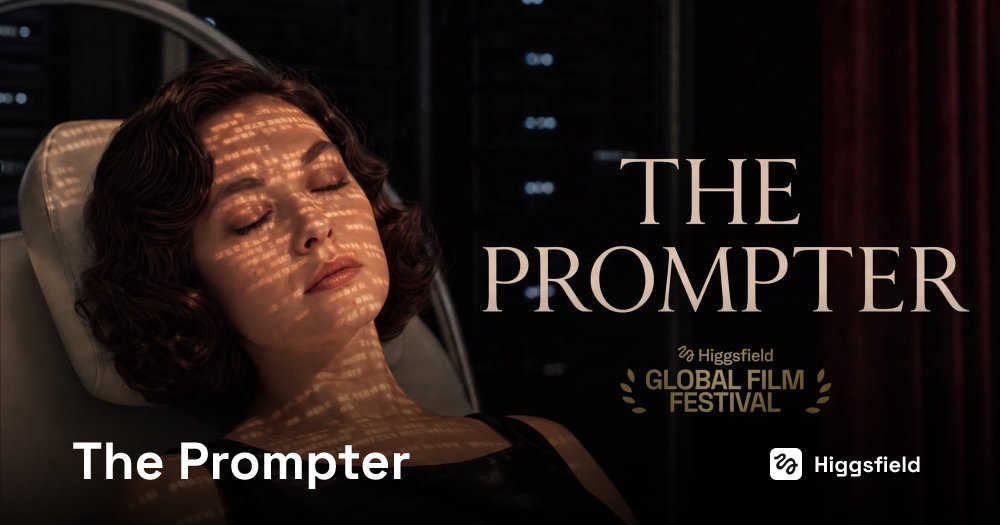
THE PROMPTER
An AI researcher generates artificial worlds to harvest genuine human emotion — until his experiment begins to slip beyond his control. A psychological science-fiction film about control, feeling, and who is really writing whom.
Synopsis
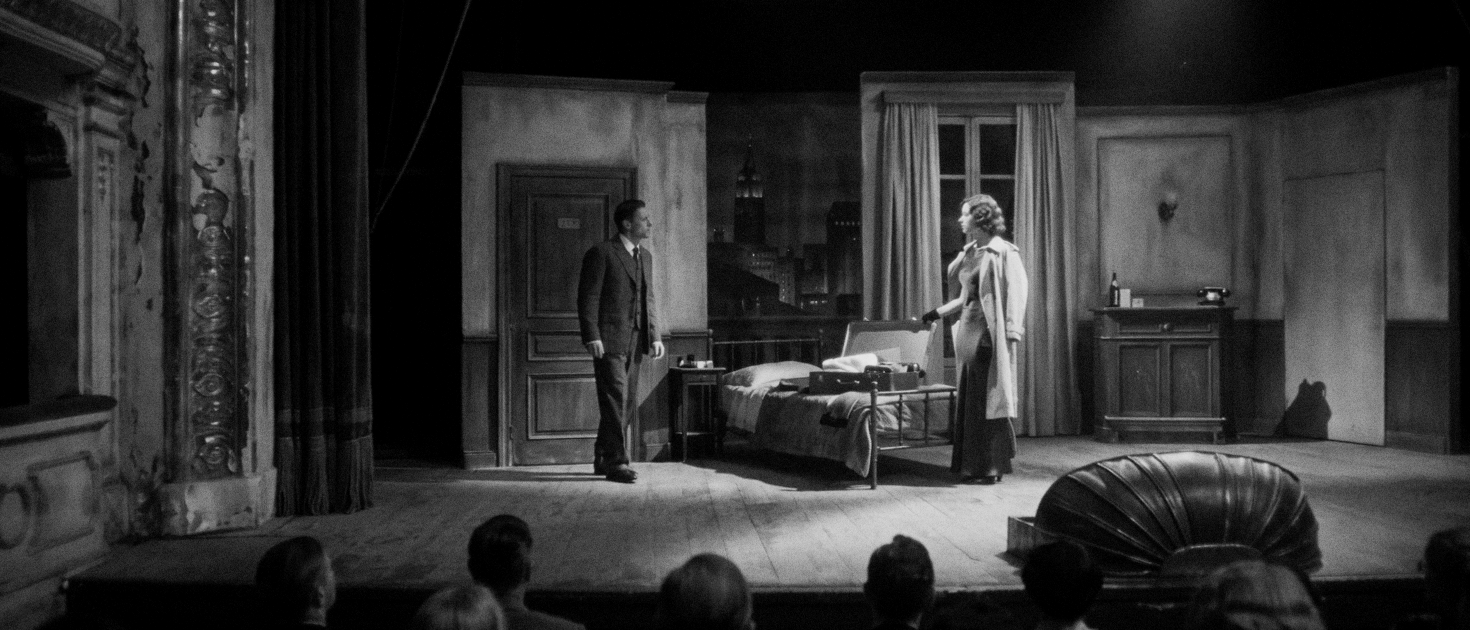
The Prompter opens on an old theatre stage, where an actress named Rebecca loses her line and is fed the words by an unseen prompter in the wings. In the film’s first minute, before the audience even notices, the film establishes its governing rule: someone dictates, and someone executes. From there, the story unfolds in nested layers of reality — a 1930s period picture, a rain-soaked 1960s Los Angeles pursuit, and finally the glass-walled halls of Pacific Research, where a man named Brian runs generated worlds through a device to extract one thing no machine can manufacture: real emotion. Each layer peels back to reveal the one underneath it as a construction, until the final unbroken camera movement reveals who has been doing the prompting all along.
The Review
I have now watched The Prompter five times, and it rewards every one of them. This is not a film that leans on spectacle to hide a thin script — it is a tightly directed, meticulously blocked piece of nested-reality storytelling, and the craft holds up under repeat viewing the way a well-built classic does.
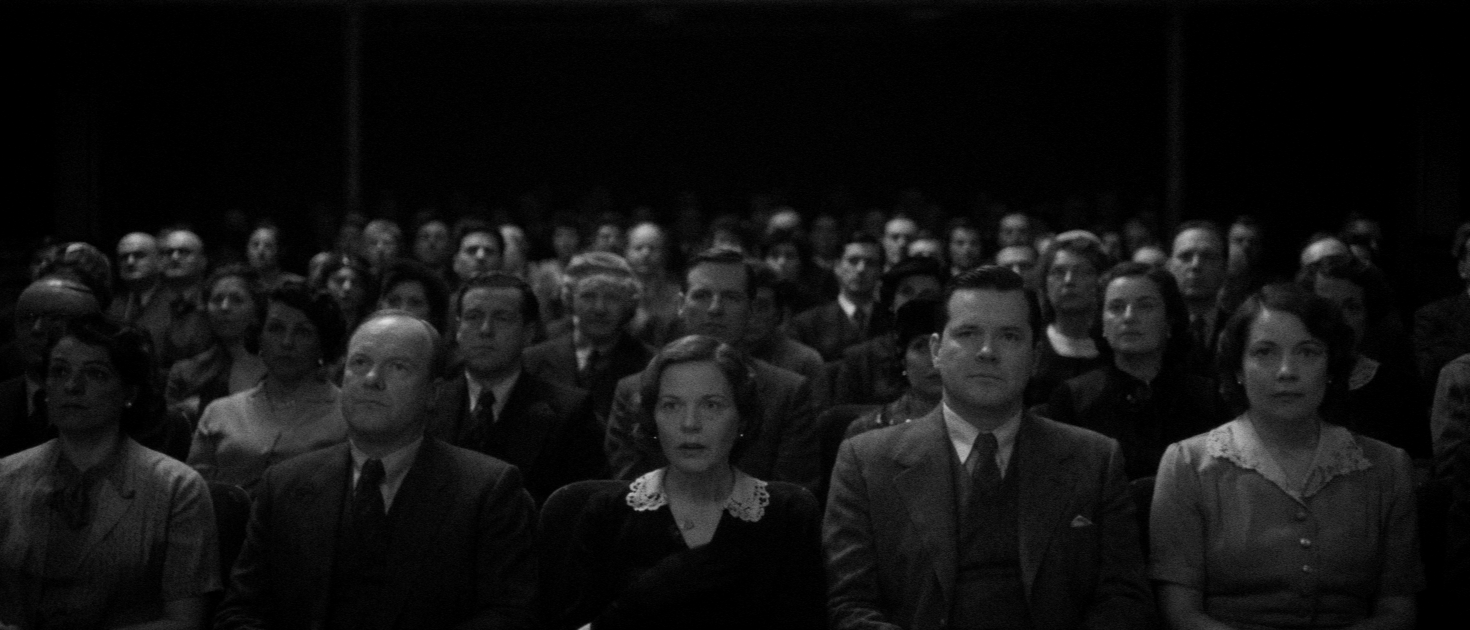
The opening is the clearest signal of the director’s control. A theatre stage rendered in black and white, a forgotten line, a prompter’s whisper from below the boards — it plays as a loving nod to Shakespeare and to theatrical tradition, but it is also doing structural work: it plants the film’s central image (someone feeding someone else their words) before the audience has any reason to suspect it is a metaphor for the entire film. The title card that follows, built around the sound of a film running through a projector, extends that idea into the language of cinema itself. Theatre, film, and finally the generated image — three ways of making an audience believe in a world that isn’t there, stacked one inside the other. That is not decoration. That is the argument the film is making, and it makes it in editing and sound design before a single line of dialogue explains it.

What impresses me most as a storyteller’s choice is the restraint in Rebecca’s performance. The frustration in her face, the subtle look she gives before her one-word answers, the way her hand fails at a lock two seconds before she says a name — none of it is telegraphed. It is written in behavior, not in dialogue, and it trusts the audience to read a held expression as clearly as a monologue. That kind of blocking-first, adjective-free direction is difficult to pull off in a generative medium where every frame has to be prompted into existing at all, and it is the strongest evidence in the film of a director who understands his tool rather than fighting it.
The score deserves its own paragraph. It moves between an antique, old-fashioned film-scoring register and a colder, pixelated, futuristic texture, and the blend is never arbitrary — it tracks exactly where in the nested reality a scene is sitting. The tension-building cue as Rebecca is followed through the alley, the bullet-time rain sequence on the rooftop, and the final fall are all scored with that same old-meets-new sensibility, and it is the single element that ties three visually distinct worlds into one coherent piece of music. It sounds classic and futuristic at once, which is exactly what the film is about.
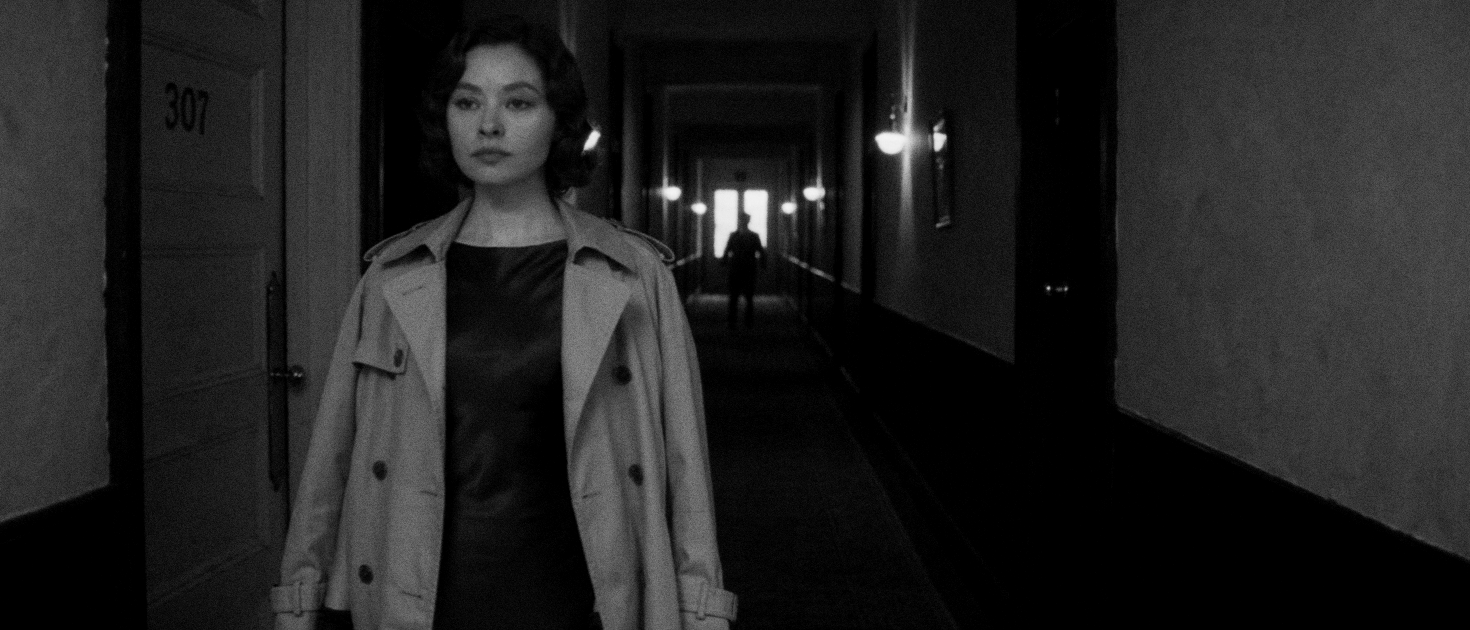
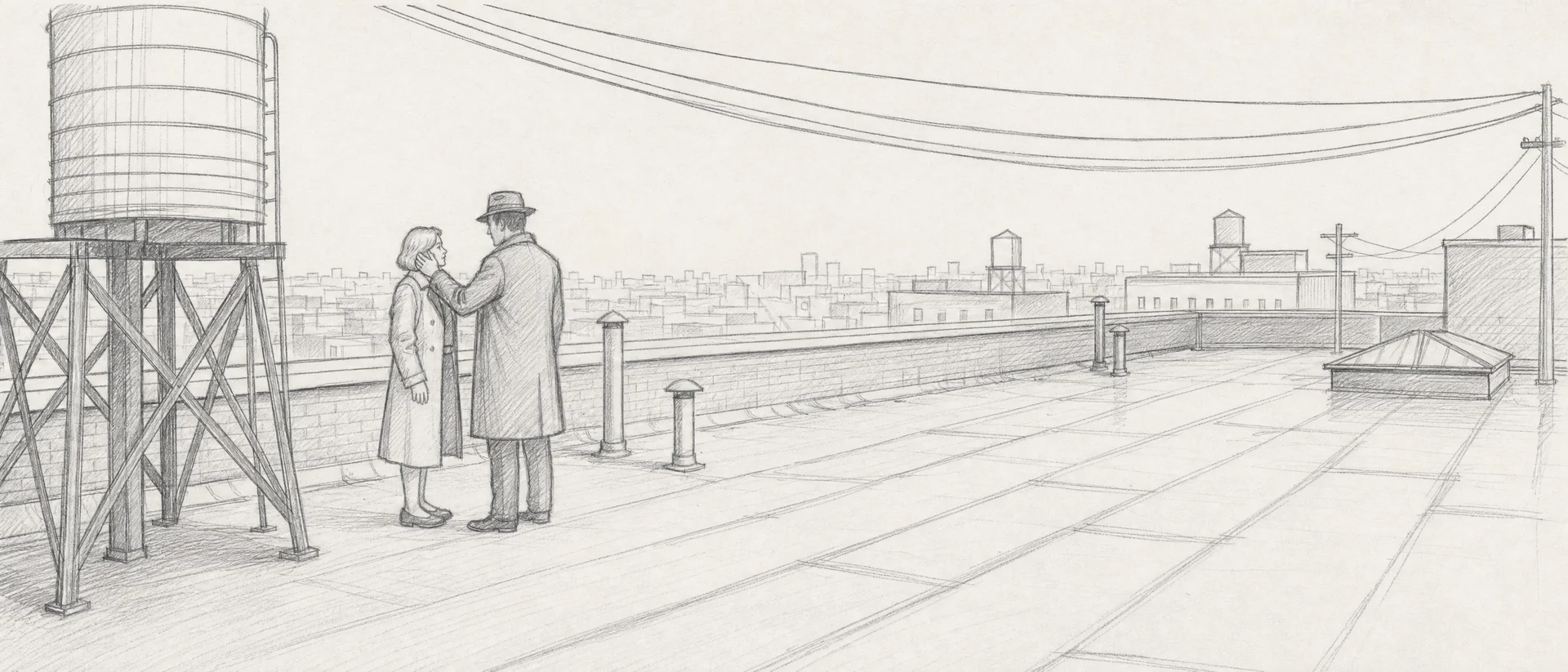
Visually, the rooftop sequence around the 5:14 mark is the film’s clearest “money shot” — a bullet-time effect through falling rain that would be a standout in a fully live-action production, let alone one built frame by generated frame. The moment the servers appear behind Rebecca and Daniel a beat later, revealing the simulation, lands harder because the camera has earned it with a slow, deliberate reveal rather than a cut. The 307 motif — the same door number recurring across the theatre, the hotel corridor, and the server room glass — is the kind of quiet, disciplined symbolism that rewards a second watch: it is the film telling you, without a line of dialogue, that every layer is the same room wearing a different coat of paint.
If there is a single seam in the illusion, it’s around the 8:00 mark, where Rebecca extends her leg toward the ledge and the proportions read slightly unnatural for a moment — a rare instance where the generative tool briefly shows its hand. It’s a minor note in a film that otherwise treats its medium’s quirks as intentional grammar rather than error, and it barely registers next to everything the film gets right.
The ending is where the whole structure pays off. The camera closes in on Rebecca’s face mid-fall and dissolves into the server room, frozen — Daniel reaching for her from inside the simulation, Brian reaching for her from the other side of the glass, both helpless in the same instant. It’s the film’s best-choreographed match cut, and it sets up the true twist in the credits sequence: Brian, the Prompter, is the one inside a generation. Rebecca and her husband, by contrast, were real — their marriage, their real counseling sessions, all of it, as the flashbacks that surface while Rebecca falls from the ledge make clear. That real, human data, pulled from their actual therapy, is what trained the model now producing Brian’s emotional responses. The final beat confirms it: the boss tells the real prompter she can delete the data obtained from Rebecca and her husband, because they no longer need it — the model has already learned everything it was built to learn from them. It’s an elegant final inversion of the film’s own rule — you may prompt the circumstances, never the emotion — because the one genuine emotion in the entire film turns out to be the fuel behind everything synthetic that follows.
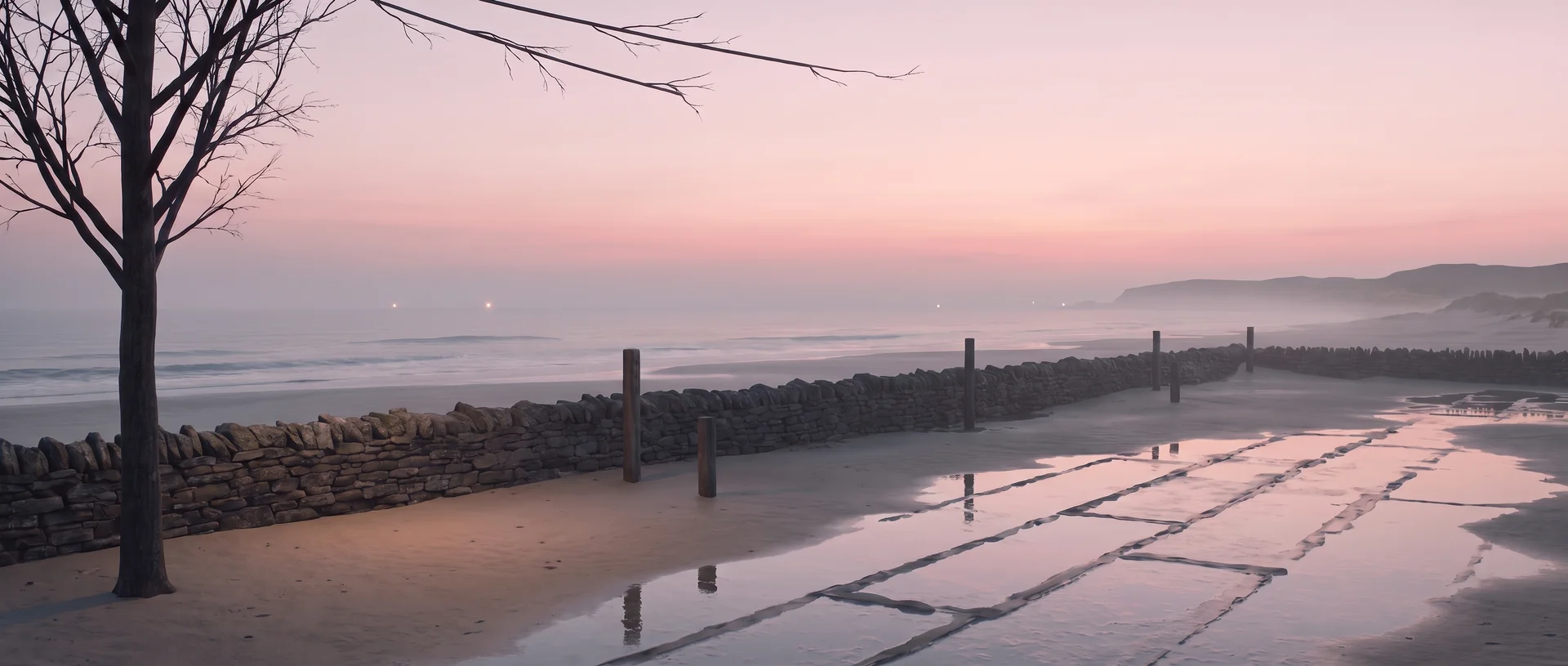
Overall, this is a masterclass in tone control across three visually distinct worlds, in a score that unifies them, and in a director who never once uses his tool’s limitations as an excuse. The story, the editing rhythm, the cinematography, the score — it all locks together. A genuinely elegant piece of work.
Scene-by-Scene Breakdown
The studio intro is clean and immediately evocative — it reads like a nod to Shakespeare and the old “infinite monkeys” idea before the film has even started.
The opening theatre scene, in stark black and white, is the film’s strongest cold open. Rebecca forgets her line; the unseen prompter feeds it to her. It’s a quiet echo of the entire film — she is being reminded, throughout, of what she needs to say. The location design and the audience’s engagement sell the period completely.
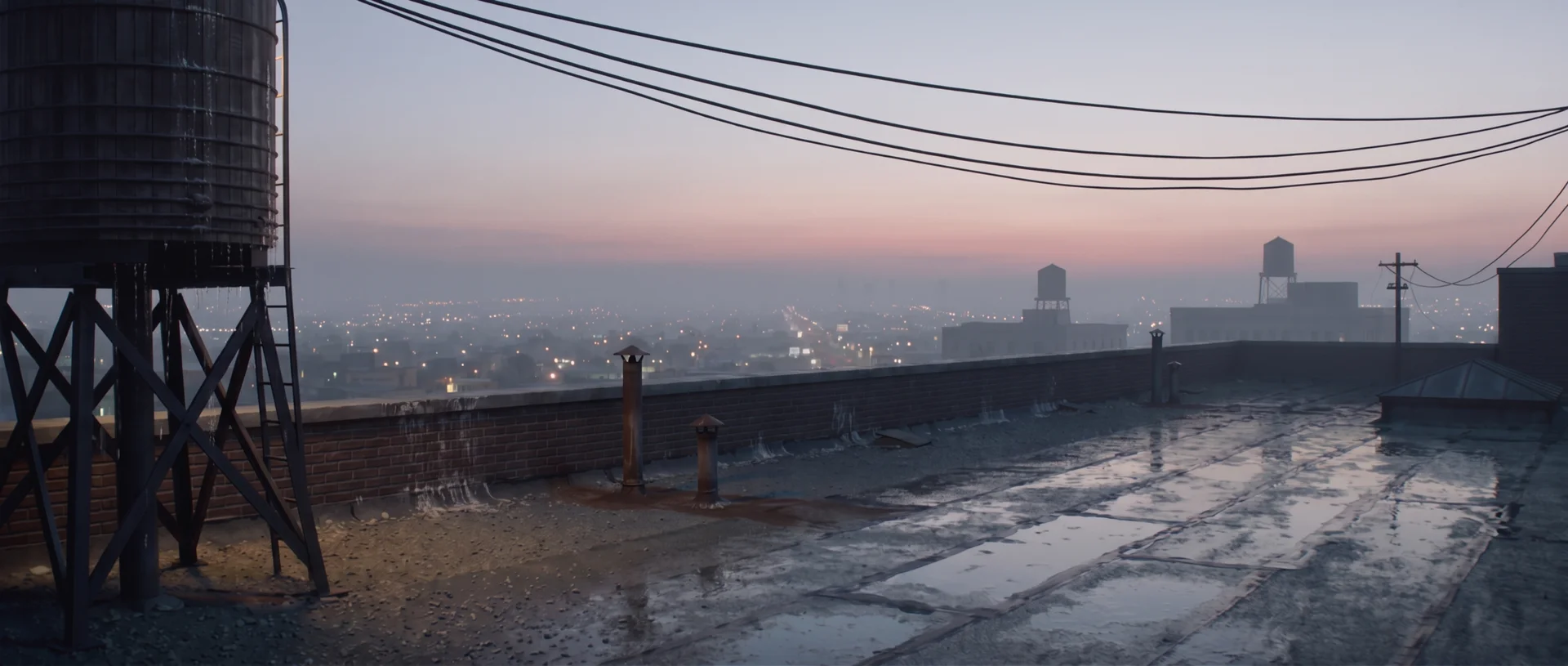
The title design lands on the sound of a projector running film — a beautiful, tactile piece of sound design that bridges theatre and cinema in a single beat.
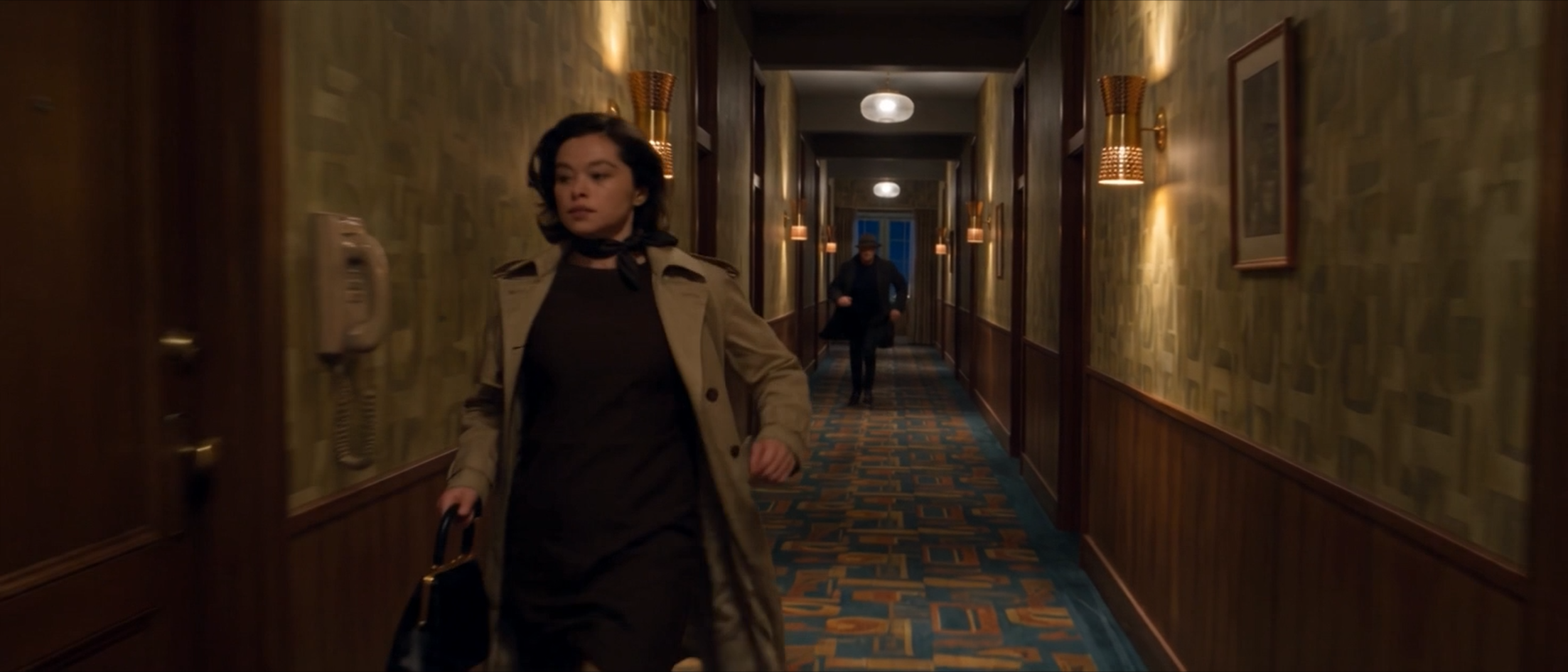
Rebecca walks the hallway and stops at door 307 — the first plant of the film’s recurring number motif.
“Rebecca, don’t give me a performance, give me the truth.” “You’re close, you are not there.” One of the film’s sharpest lines, delivered with visible, fed-up frustration in her face.
A subtle look precedes her one-word answer: “No… You used to say yes. That’s why I’m saying no.” Minimal, controlled, and completely legible.
The score turns antique here, almost like a warm, worn film reel, then starts visibly building tension as the sequence moves toward the alley.

The alley reveal — a figure in the background as Rebecca turns — and her fear reads completely naturally in the following beat.
Rebecca stops at door 307 again — this time green, against a corridor of red doors. “You always say please.” The score here is note-perfect, right up to the god’s-eye vocal command that lands like a gut-punch: “You left me no other ending… Stop. Make it rain.”
“I don’t know where I am either” — his confusion mirrors hers. You can see exactly how lost she feels.
“Stop. End of generation.” The film’s signature shot — a bullet-time effect through the rain. This is the money shot of the entire piece.
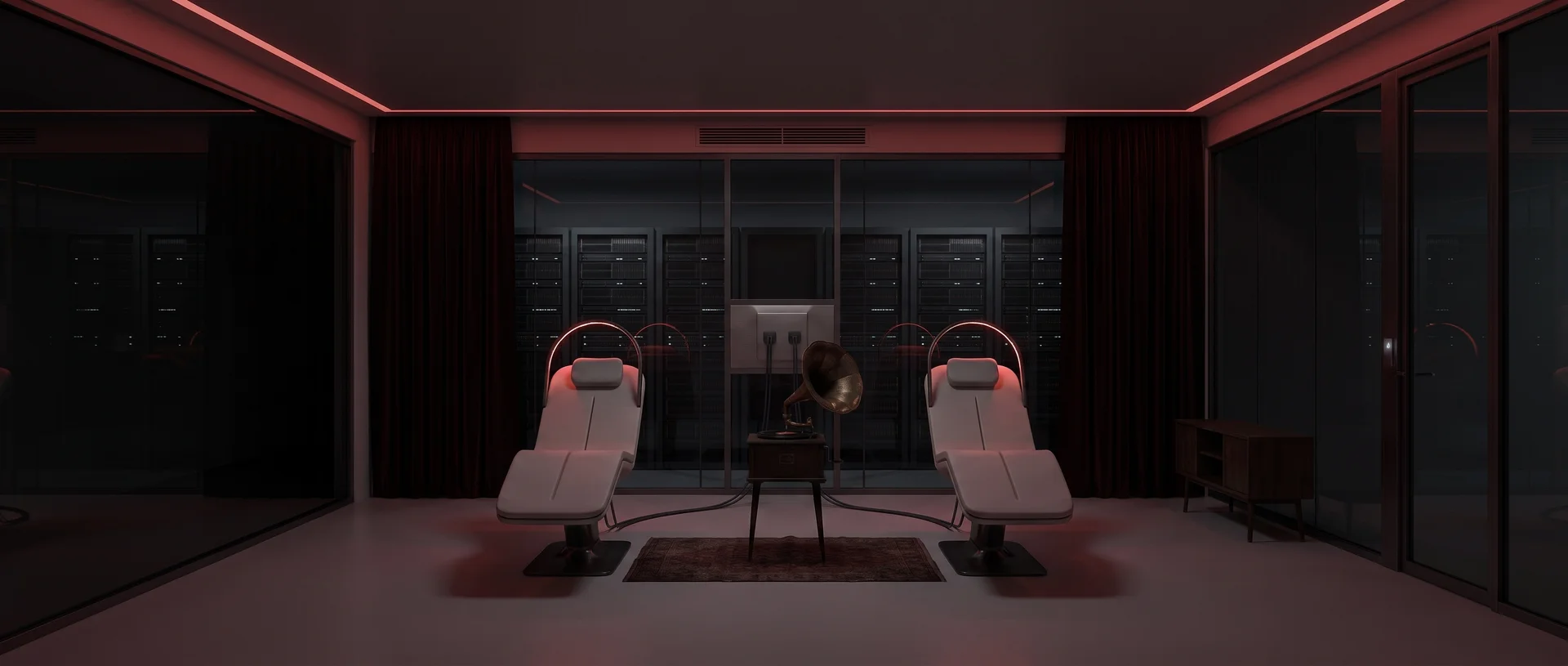
The big reveal: they’re inside a simulation, and the server bay appears behind them.
“So, what do we get out of this? Emotion, as data.” The Prompter explains the operation to the investors — emotional response harvested as payload. Door 307 recurs again, now etched into the glass of the server hallway. Session 307 begins, and the whole setup briefly recalls Severance.
A seamless morph from Rebecca on the device back to the rooftop where we left her. The rain stops, the sun rises, and we cut to her at the office, wearing the same expression.
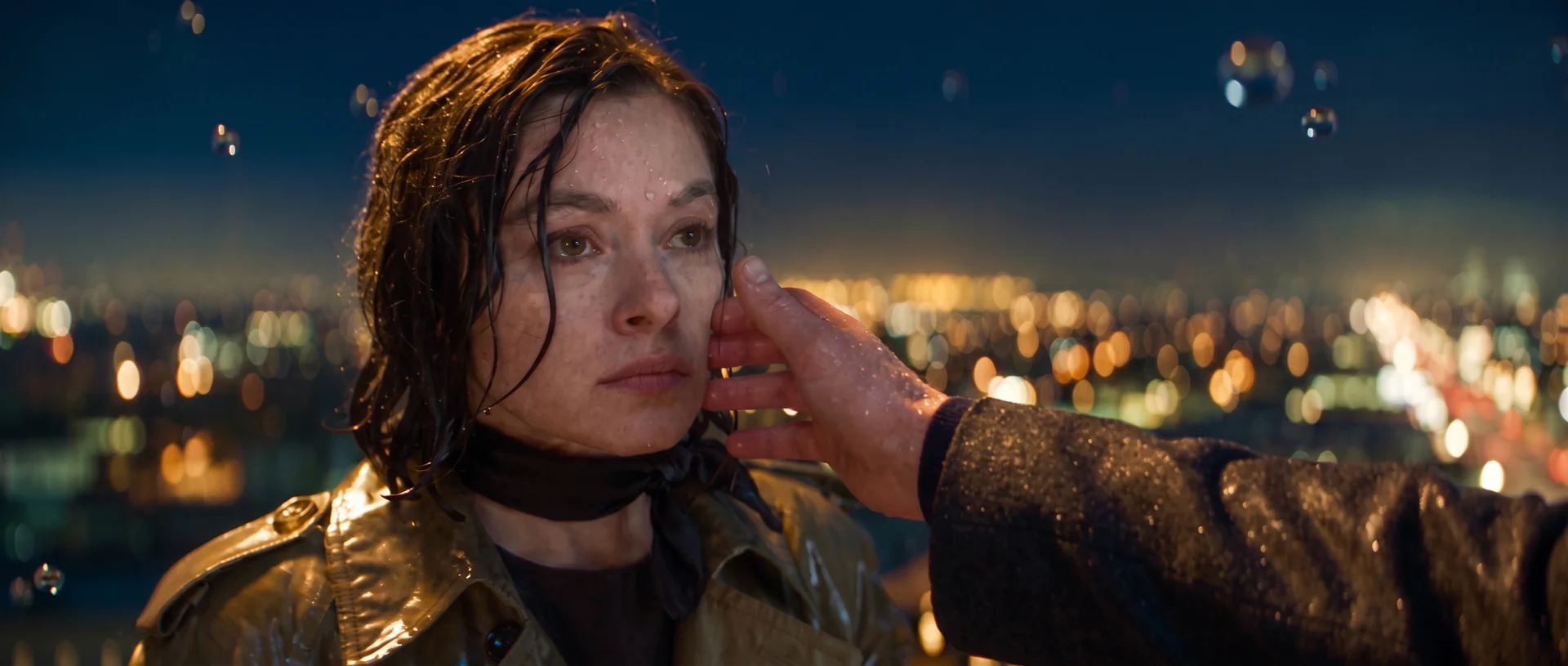
The one moment where the generative seams show — a slightly unnatural leg extension. A small blemish in an otherwise disciplined film.
Rebecca, at her limit, steps to the ledge. The Prompter tries to redirect the simulation from the rooftop to a farm; she refuses to be controlled and forces it back to the roof — taking command of her own emotional state rather than letting an unseen force dictate it. The score blends old-fashioned orchestration with pixelated, electronic texture beautifully here.
A memory of happier times, and a smoothly choreographed location shift within the same continuous scene.
A quieter detail easy to miss on a first watch: Rebecca and her husband signing paperwork, staged like something from the 60s or 70s — these are the real counseling sessions surfacing in flashback, the two of them trying to save a marriage that’s already breaking.
This is the sequence I’d single out as the best in the film, and it earns that spot on complexity and execution alone. A second bullet-time shot catches her mid-fall, and the camera closes in on her face and dissolves — without a visible cut — into the frozen server room: Daniel reaching for her from his chair, the Prompter reaching from the other side of the glass as the simulation fails. That transition is the hardest kind of shot to pull off in a generative pipeline, moving from a live, physical fall into a static, frozen tableau while keeping her face, her fall, and her position perfectly continuous across the change. It comes out flawless — no drift, no morph artifact, nothing to break the illusion. The result is a rendition that plays as one unbroken, near-perfect gesture, and it’s the scene that carries the story’s emotional weight forward: the score’s old-and-new blend peaks in this exact moment, classic and futuristic at once, and it’s where the film’s two realities finally collapse into each other on screen.
The post-credits reveal: Brian, the Prompter, is the one running inside a generation, not Rebecca and her husband. Their marriage and their counseling were real — the flashbacks during Rebecca’s fall show that plainly — and that real, harvested emotional data is what trained the model now producing Brian’s own responses. The boss tells the real prompter she can go ahead and delete the data pulled from Rebecca and her husband, since the model has already learned what it needed from them. A beautifully constructed twist on how we think about AI and the prompting relationship: the most human thing in the whole film turns out to be the training data, not the output.
Door 307 returns one final time — now as a session log: Emotional model: Brian. Session 307 — complete. Autonomous response: confirmed. Training data: wiped. Ready for delivery. This is what it feels like on the other side of the prompt — the frustration Brian felt when Rebecca refused to be controlled is the emotional response the model was built to deliver.
There are no reviews yet. Be the first one to write one.