
 Marcus McCormick
 Creator ID26-11-03-0181
Score breakdown
407.5K views
Film Review
This review discusses the ending. If you would rather watch the film first, we recommend you do, and then come back.
The God Who Is Losing Himself
The premise, from the creator’s own description, is enormous: Marcus Everett awakened an ancient power to save Earth, stopped time across all existence — the Great Pause — and unpausing it left reality fractured and something else awake in the dark. The film states almost none of this in dialogue; instead it arrives, nearly an hour in structure terms, in the sequence I would show anyone (~40:53–43:08). A body is brought home — ‘Thank you for returning the body of Kimon to us’ — and Khaeos, addressed as Lord Chaos, steps into the nothingness and admits the truth of the whole film: thousands of planets now have world killers, a few know Earth exists, he has been away from the nothingness too long, he is ‘losing physical continuity,’ and his powers are severely weakened. A protagonist who is a god and a casualty at the same time is a real character idea, and it retroactively gives the spectacle a spine: every battle in this film is being fought by someone who is fading.
The Data Everyone Will Kill For
The plot engine for most of the runtime is a fragment of bio-encrypted data — stolen, carried, bid for and hunted by a rotating cast of mercenaries. It gives the film its best hard-boiled beats: a prisoner who ‘would never tell a god killer’ anything (~12:41), a price that triples because the God Killer is on the trail (~28:23), a carrier warned not to come back because ‘the God Killer killed the last carriers’ (~29:24), and a hacker who explains, reasonably, that without the dead creature’s biodata the device is almost impossible to open (~1:00:41). The God Killer himself — a bounty hunter who has slaughtered whole squads and interrogates a captive with the promise to ‘rip every horn from your head’ (~31:13) — is the film’s most effective presence precisely because other characters keep pricing his approach. The problem is repetition: intercept, threaten, bid, teleport away, repeat, across Jasvon 3, Dramazan, Gravocar, Zalath and more. Each round is competent; together they blur, and the names come faster than the film can make them matter.
World Killers, Tested on Living Planets
Where the film earns its scale is the weapon thread. Chaos essence is handed out like a sacrament — ‘Take a piece of my chaos. This is all the power you will need’ (~53:41) — and a creature introduces itself with the film’s coldest line: ‘I am Metusara, the world killer’ (~54:08). Later, a report is delivered in the flattest possible terms: the weapon worked, ‘the entire planet was turned to stone,’ survivors: ‘None, my lord’ — and the next target is named in the same breath (~1:06:09–1:06:19). I want to be honest about the effect: the film does not linger on the dead, and that flatness is both its style and its limit. Planet-killing as logistics is a chilling idea; planet-killing as one more report in a chain of reports is also how the middle hour dulls its own stakes. The final confrontation (~1:20:58 onward) restores some weight — the creature can teleport at will and alter environments, the God Killer destroys the weapon — and the enemy’s response is the film in one exchange: ‘It matters not. We now know the chaos works. We have an army of trillions. He is only one entity’ (~1:26:06).
Only Nine
The ending reframes everything, and it is where this film joins Marcus’s wider universe. His servants report a search of ‘trillions of worlds in countless realities’: exactly nine species share the molecular structure of his past life and could potentially consume the chaos essence — but their genetic material needs roughly a thousand years to mature, and the chaos would kill them now. The nothingness cannot be extended; it was his first law. ‘Only nine.’ His answer is the film’s thesis and its promise: ‘So be it. I will forge my army with these nine’ (~1:34:38–1:36:19). Viewers who have met Rivnor — the storm-born child of his short film Beyond Human Limits, also on Kineograph — will recognize what is being assembled: the Nine who stand before Khaeos. It also means this feature does not end so much as muster. The last movement — a weapon tested, one of Them temporarily defeated and stopped by a device, the retreat ordered: ‘Ship, take me to the nothingness now’ (~1:42:18) — closes on a war widening, not a story resolving. As the first movement of something larger, that is legitimate. As a standalone feature, it leaves the audience holding the setup.
Best Scene (40:53–43:08)
The return of Kimon’s body
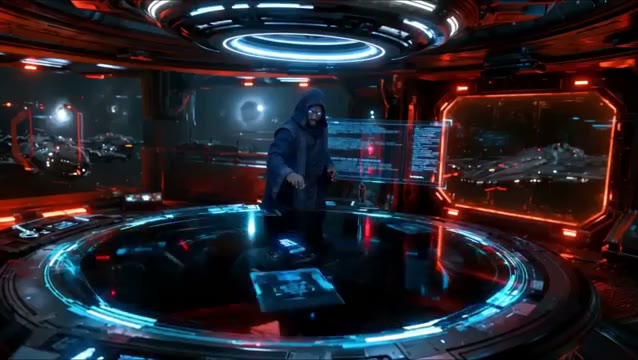
The return of Kimon’s body, flowing into the nothingness council (~40:53–43:08). It is the one passage where every register the film has comes together: a small act of decency (‘It didn’t feel right to leave his body there in that place’), the Valerin people’s gratitude, and then the god of this universe quietly confessing that he is weakening, that Earth has been discovered, and that he intends to forge an army from the strongest species in every reality. Everything before it is hunting; everything after it is war. This is the hinge.
Final Thoughts
Judged on the terms its creator sets — visuals, atmosphere, sound and emotion over dialogue — this is a film of genuine mythic ambition carried by a chase plot that repeats itself once too often, and it asks a lot of a viewer’s patience with names, planets and hunters who arrive faster than they can be known. Its lore, though, is not generic: the Great Pause, the nothingness, the law of nine. He broke time to save one world — and the most honest thing in this film is that fixing it is going to take nine other lives, a thousand years, and a god who may not last either.
Scene Breakdown
0:00–5:44 — Opening hunt: a music-led fight, told in sound and action
5:44–12:28 — The hunt concludes across a long, near-wordless passage
12:28–13:46 — Data acquisition: a prisoner refuses to tell a god killer anything
13:46–21:47 — A travel-and-combat passage, mostly music and action
21:47–22:15 — The data is bio-encrypted and cannot be opened without the spy’s bio-material
22:15–25:47 — The God Killer emerges: a mercenary holding the fragment must be intercepted
25:47–29:38 — The price triples; the carrier is warned — the God Killer killed the last carriers
29:38–32:33 — The God Killer interrogates under threat; a tip names the planet-destroying weapon
32:33–36:58 — Word arrives that the God Killer slaughtered an entire squad; the operation escalates
36:58–40:03 — A carrier offers the data; three buyers bid; an ultimatum is delivered
40:03–43:08 — Kimon’s body is returned; in the nothingness, Khaeos admits his powers are failing and orders an army forged
43:08–50:28 — Rival hunters collide over bounties; a lead dies with Kelvish
50:28–54:15 — A weapon is given chaos and activated: “I am Metusara, the world killer”
54:15–59:46 — A sister begs passage off-planet; the price is data, not coins
59:46–1:04:52 — The device cannot be hacked without biodata; word reaches Khaeos of four world killers on Skyvil
1:04:52–1:07:00 — A weapon test reported in full: a planet turned to stone, survivors none
1:07:00–1:14:29 — An attacked ally is given a new ID and an unmarked ship; the invaders are driven off
1:14:29–1:20:58 — The other data-holder is identified; a bar confrontation turns into a fight
1:20:58–1:26:18 — Final confrontation: the God Killer destroys the weapon; the enemy answers — an army of trillions, he is only one
1:26:18–1:32:34 — Operations ordered to lie low; a king killed; the next destroyers already deploying
1:32:34–1:36:19 — The council’s report: across trillions of worlds, only nine species can embody the chaos — “I will forge my army with these nine”
1:36:19–1:41:55 — A weapon tested; one of Them temporarily defeated, stopped by the god collar
1:41:55–1:46:27 — Retreat: “Ship, take me to the nothingness now.” The war widens rather than resolves.
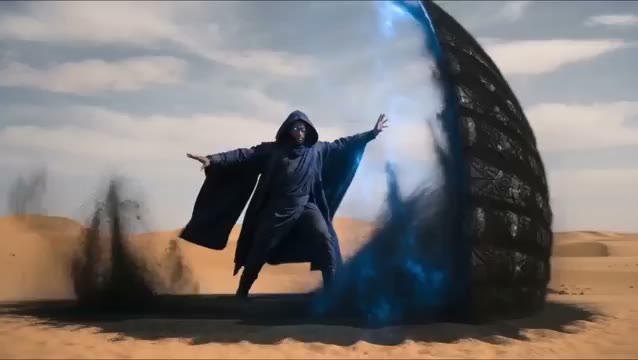
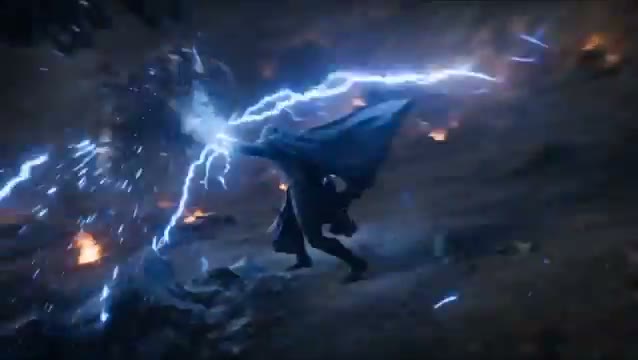
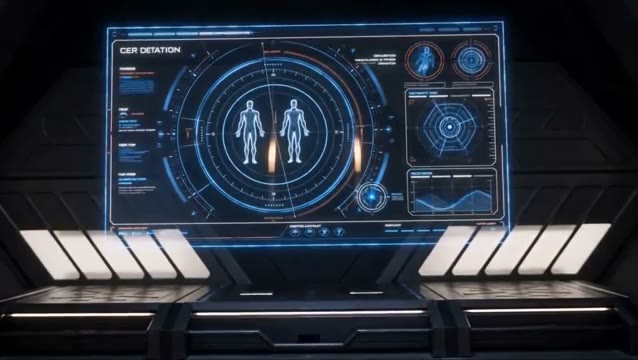
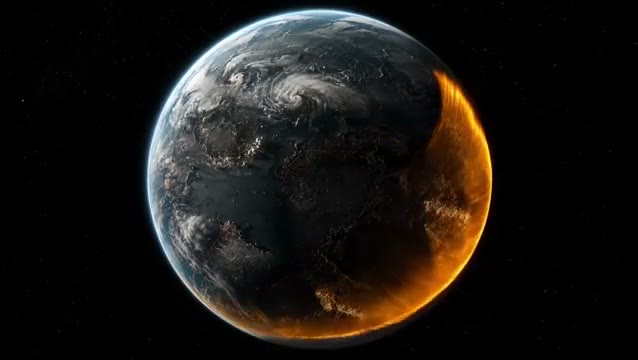
The hooded central figure holds one consistent silhouette and costume across desert, bridge and council scenes, holographic displays and ship interiors are crisp with legible interface text, and the effects work — lightning, portals, the burning planet rim at ~55:00 — is clean and confident. The clearest seam: the twin serpent-haired figures at ~1:25 have soft, waxy, near-identical duplicated faces. Several battle passages are very dark, which flatters detail, and background figures in wide combat shots soften. Strong spectacle, held at Mostly clean by the duplication and the darkness.
Watched on YouTube. All of the film was viewed in full for this review.
There are no reviews yet. Be the first one to write one.