

 Nikolay Shestak
Score breakdown
8.3K views
Film Review
This review discusses the ending. If you would rather watch the film first, we recommend you do, and then come back.

The morning the faces changed
It begins as an ordinary bad morning. Producer Stan is begging his anchor to come in — half the crew have called in sick, the CDC is blasting out advisories — and Veronika Hale is having the kind of morning she will spend the film paying for: a phone call full of small lies, and a wedding ring put back on in a cab. Before the newsroom, the film takes three short walks through the city, and each one is a small play about a lie. A charity influencer, filming day 147 of making somebody’s day, feeds a homeless man for the camera and directs him like an actor — “That’s the line. Cut” — until the man looks up and asks what is wrong with his face. A boss fires Walt, a year out from his pension, in a voice dripping with concern: you gave this company your whole life, call me anytime, you have my cell. And in an ambulance, a rich patient with a face already swelling out of shape berates the paramedic driving him: “I could buy this hospital.”


What I admire is the dosing. The film never explains its rule with a diagram; it shows you three performances of virtue and lets the faces deliver the verdicts. The influencer’s kindness is content. The boss’s kindness is a script. The rich man’s cruelty doesn’t even bother dressing up. By the time the scientists arrive, you already know the law of this world better than they do.

Whatever they send, word for word
The newsroom half of the film is a satire of managed truth that would be funny if it weren’t so recognisable. The CDC sends three drafts of language and then sends lawyers instead. Legal has circled everything in red: whatever they send, word for word; no virus, no outbreak; calm faces, calm voices, cut to commercial. Stan, watching the numbers, is almost happy: “Everybody’s watching. Nobody knows what they’re watching, but they’re watching.” On air, the official story lasts about a minute before the corrections start — a million cases, not a disease, it began everywhere at once, and the three crew aboard the space station, four months into a sealed orbit, have it too. The explanation, when a scientist finally gives it, is beautifully plain: “The new tissue is ordinary tissue. Normal cartilage, normal fat. There’s just more of it. And it’s in the wrong place.” And then the sentence the whole film turns on: kindness and calculation have different chemistry, and both of them leave marks on a face.


The film argues with itself
Lesser satires would stop at the joke. This one stages its own rebuttal. A panel of scientists tears into the premise — “Morality has no mass, no charge, no spin… That’s not a hypothesis, colleagues. That’s a prayer in a lab coat” — and then a man born disfigured says the thing the film most needs said: “Ugly face don’t mean ugly soul, all right? I was born like this.” He’s right, and the film knows he’s right, and it lets the objection stand in the middle of the movie like a stone in the road. What follows is the film’s real argument, delivered by an epidemiologist with twenty years in the job: the group changing least, at four per cent, is the people who care for others — animal shelters, ICU night shifts, volunteers. And lest that sound like a loophole, the film immediately shows a billionaire at a charity gala transferring twelve billion dollars to a children’s relief fund live in front of the cameras — and cuts to the room’s laughter at what his face does next. Good done for the mirror doesn’t count. The film said so in its first ten minutes, with an influencer and a sandwich.

Best Scene (14:24–15:57)
The confession
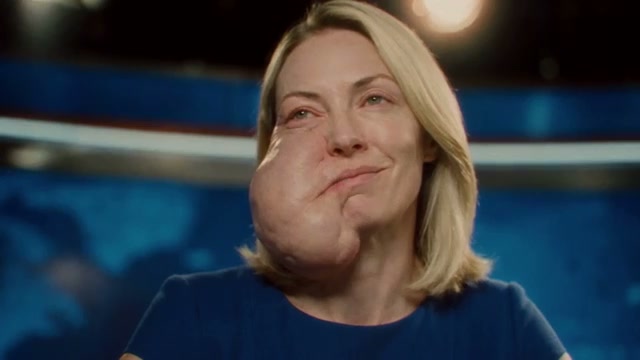
Her own cheek has swollen grotesquely by now, live on air, and Stan is still feeding her the copy. Veronika puts it down. “There’s no hiding it anymore. And as you can see, I’m no exception. Even though I spent my whole life trying to be one.” Then, in front of millions: the ring she put on in a cab that morning after walking out of another man’s apartment; the eight-year marriage to a man she didn’t love, kept so she could be “successful Veronika Hale”; and the sentence the whole film has been walking towards — “My whole life is a goddamn fake.” She tells her husband not to wait up, and not to wait at all, and she does not ask to be forgiven, because she says she doesn’t have the right. “I’m just not lying to you anymore. This is my first honest day.” It is played in close-up, at speaking volume, and it is the best piece of acting — human or generated — that I have seen in an AI film this year.

The future worth living in
The last stretch opens the film out into a montage of the world’s first day: a voice crying “Guilty!” and a gunshot; a priest claiming the change for God; and a quiet speaker reframing the whole event — punishment takes something from you, he says; nothing was taken this morning; something was given. The film’s conscience arrives via Oscar Wilde: Dorian Gray does one good thing and runs to the portrait to check whether it fixed his face, and it hasn’t, because a good deed done to repair your reflection is vanity wearing a costume. Then the film lands, gently, on the line its festival was themed around — maybe we really can get better, just a little, and maybe this is it: the future worth living in. The closing song, “Leave the light on” by The Honest Men (the band on the tour T-shirt Veronika wears in the first scene — the film plants its details early), follows an ordinary unchanged man home through the dusk: the trains were slow, the bakery was open, and nobody looked at him a second time, same as any day. After twenty minutes of faces shouting the truth, the film ends by honouring the people nobody notices.

Final Thoughts
The First Honest Day was written, directed, edited and produced by Nikolay Shestak of Latvia, and at the first Astana AI Film Festival (AAIFF 2026) a five-member jury chose it from ten finalists of the main competition and awarded it the Grand Prix — $450,000, from a field of 8,067 entries sent from 125 countries. Watching it, the scale of that win makes sense: this is a twenty-minute photoreal drama that holds dozens of faces steady, argues both sides of its own premise, and still finds room for a joke about a reputation system patched into the simulation overnight. Its tools, as the maker states them, were Seedance, Midjourney, Seedream, ChatGPT, Claude and Suno, finished in DaVinci Resolve — but what stays with you is not the toolkit. It is a woman at a news desk, deciding that the face she has been given is finally the true one. A film about the day lying stopped working — and about how the truth, given twenty minutes, can start to look like mercy.
The First Honest Day is by Nikolay Shestak (channel: Shestak), through his production company SIA SHESTAK. The video’s credits name the Russian dub cast (SYNCMER: Olga Verbitskaya, Anatoly Fechin, Victoria Babanova, Dmitry Shandro) — a full Russian version, performed by professional actors, is available as an alternate audio track on the same video.
Scene Breakdown
0:00–1:44 — The call. Stan begs his anchor to come in; half the city is calling in sick; Veronika’s morning starts with small lies and a band T-shirt that matters later.
1:44–3:27 — Coffee, a ring, a cab. A morning-after row, a ring put back on, and a cab driver hoping this isn’t another COVID: “People panic first, ask later.”
3:27–4:54 — Day 147. A charity influencer stages kindness for his camera; the homeless man won’t say the line; the influencer’s face changes mid-shoot.
4:54–6:19 — Two kinds of cruelty. A boss fires Walt in the language of love, and a rich man threatens the paramedic driving him to hospital. Both faces answer.
6:19–7:24 — The newsroom. The CDC sends lawyers instead of language; legal red-circles the copy; Stan counts the audience.
7:24–9:37 — On air. The official story, the corrections, the space station, and a scientist’s plain verdict: ordinary tissue, in the wrong place, responding in real time.
9:37–10:50 — “It responds to intention.” Veronika says the unsayable on live television, and the break gives her face time to agree with her.
10:50–12:33 — The argument. Scientists fight over whether morality can touch a cell; a man born disfigured objects; the president’s address slips again.
12:33–13:31 — The donation. Carers are changing least, an epidemiologist says — four per cent. A billionaire gives twelve billion dollars on camera, and the room laughs.
13:49–15:57 — The confession. Veronika puts the copy down: the ring, the marriage, the fake life. “This is my first honest day.”
15:57–19:03 — The first day, worldwide. A gunshot, a priest, the Dorian Gray warning, and a quiet hope: maybe we really can get better.
19:03–20:15 — Leave the light on. The closing song carries an ordinary man home; nobody looks at him twice, same as any day.
≈6:00 — The ambulance passenger’s swollen face is the waxiest close-up in the film: the new tissue reads slightly CGI-smooth where it should be fleshy. It is the one transformation that looks generated rather than grown.
3:27–4:54 — The influencer sequence is shot as in-world phone footage, softer and noisier than the rest of the film, and the faces there are its least stable. It plays as a deliberate aesthetic — his camera, not the film’s — but it is where the seams live.
≈8:20 / ≈13:00 — Press-room and gala backgrounds soften into shapes behind the principals; the leads carry every close-up, and at this scale it barely registers.
≈20:05 — Presentation, not craft: the film closes on an Instagram QR card laid over its final orbital shot, which breaks the spell for a beat.
Against all of that: Veronika is the same woman in every scene, light and hour; lip-sync holds through long dialogue close-ups; and the on-screen text I checked — the WNN cap, the “The Honest Men — American Tour 1999” T-shirt — is legible, spelled right, and planted on purpose. For a twenty-minute photoreal film with this many faces, that consistency is the story.
There are no reviews yet. Be the first one to write one.