
 arkokin
 Creator ID26-11-01-0238

Score breakdown
2 views
Film Review
This review discusses the ending. If you would rather watch the film first, we recommend you do, and then come back.
Synopsis
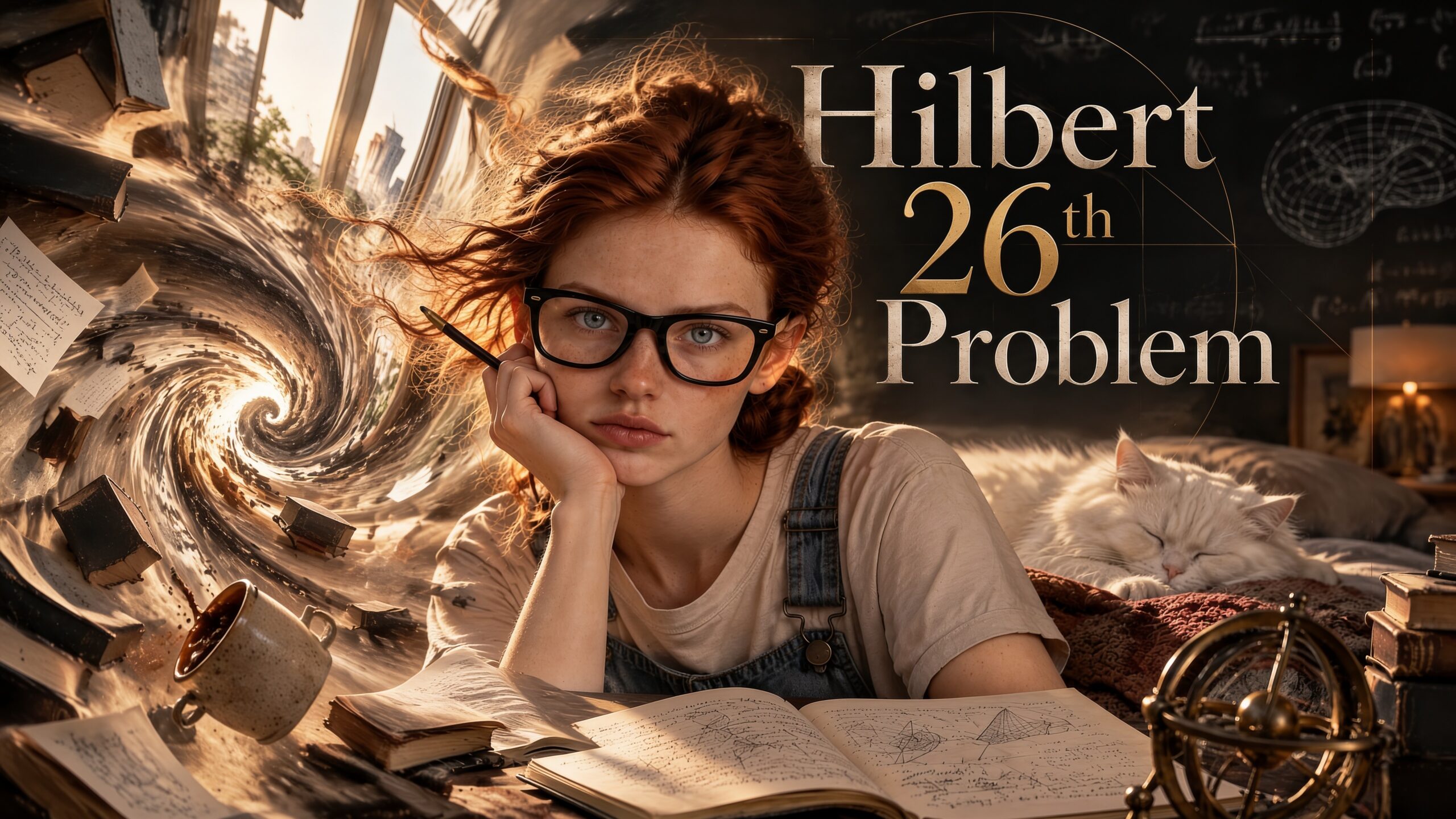
Sarah is 22, a math student with an idyllic life: a home, a university, a boyfriend named Alan, and a cat, Mr. Ken, who demands his breakfast. Her days run on lectures — including one on the Hilbert curve — and small routines, set to a song called “Broken Umbrella.” Alan books a dinner at Monroe’s. Then Sarah comes home to an empty house. “Dad? Mr. Ken?” No one answers.
“They” have arrived. A security violation has been committed: Alan has been erased, her parents are interrogated, and the rules of a kingdom are laid over her ordinary life like a grid over a map. Sarah, now in a white futuristic suit, is told the terms of her new reality: “Magic is restricted.” The rescue, when it comes, comes from inside the family — her father tells her to jump, her mother sets the coordinates — and the truth surfaces with it: “You have seen the 24th and the 25th. They cannot allow that.” Mr. Ken, the cat, has been protecting her all along. Sarah escapes on a hoverbike through a desert-city market, boards a ship, and flies into a purple vortex, screaming. “What the hell is this 26?!” Cut to black. Nothing is resolved.
A Morning Worth Losing
Sarah herself is the film’s anchor, and a good one. She is likeable from the first scene — 22, in her pyjamas, negotiating with a cat — and the idyllic opening stretch does its job efficiently: family, boyfriend, cat, student life. It gives the rupture something to rupture. When she opens her front door at around the 2:43 mark, alarmed, calling “Dad? Mr. Ken?” into an empty house, the film has genuinely earned its unease. The ordinary world was drawn warmly enough that its absence registers.
The smallness of the details helps. Mr. Ken demanding breakfast is the kind of throwaway domestic beat that most short films skip, and it matters twice over: it makes the home feel lived in, and it plants the cat — who turns out to have been her protector all along — in plain sight, in the most ordinary role imaginable. That is good construction, and it is the kind of construction the film’s second half could have used more of.

The Idea: A Problem That Cannot Exist
The premise deserves to be stated plainly, because it is excellent. David Hilbert set out 23 problems in 1900, and mathematics has been working through them ever since. There is no 24th. There is no 25th. So when the film’s powers accuse Sarah of having seen them — “You have seen the 24th and the 25th. They cannot allow that” — the crime is impossible knowledge: she has looked past the edge of the list, and something on the other side is looking back. And beyond those two there is the 26th, the thing Sarah herself screams about — “What the hell is this 26?!” — which the film holds as its final mystery.
The university material sets this up with a light touch. Around the 1:44 mark, on the campus lawn, Sarah’s notebook carries a Hilbert curve — or means to; what is drawn there is a triangular scribble, which is either a joke the film did not intend or the first visible sign of how quickly this was made. Either way, the lecture and the meeting with Alan establish a heroine whose world is made of problems with solutions — which is exactly the world the rest of the film takes away from her.

The Erasure
The turn, when it comes, is the film’s boldest stroke. Sarah’s life is not attacked; it is administered away. A security violation. An erasure — Alan, simply gone. Parents interrogated. Kingdom rules. The language is bureaucratic, and that is what makes it frightening: the powers confronting Sarah do not rage, they process. By the 3:50 mark she is standing on a bridge in a white futuristic suit, being told “Magic is restricted,” and the film has fully changed genres around her without ever raising its voice.

The trouble is that on a first viewing, this middle is incoherent in a way that works against the mystery. The jumps arrive faster than the film can explain them, and passages of dialogue come out garbled. Instead of feeling like a mystery deepening, the sequence feels like several films colliding: student drama, fantasy tribunal, science fiction. A second viewing assembles more of it, but a short film has to land the first time. The ideas are strong enough to carry a much longer film; the connective tissue between them is not here.
The Rescue, and the Answer That Raises More Questions
The rescue is the film’s best idea after the premise itself. It is not a hero who saves Sarah — it is her parents. Her father tells her to jump; her mother sets the coordinates. The family that the opening established over breakfast turns out to be the resistance, and Mr. Ken — the cat, the comic relief, the breakfast tyrant — has always been her protection. In one stroke the film re-reads its own first act: nothing in that warm home was only what it seemed.

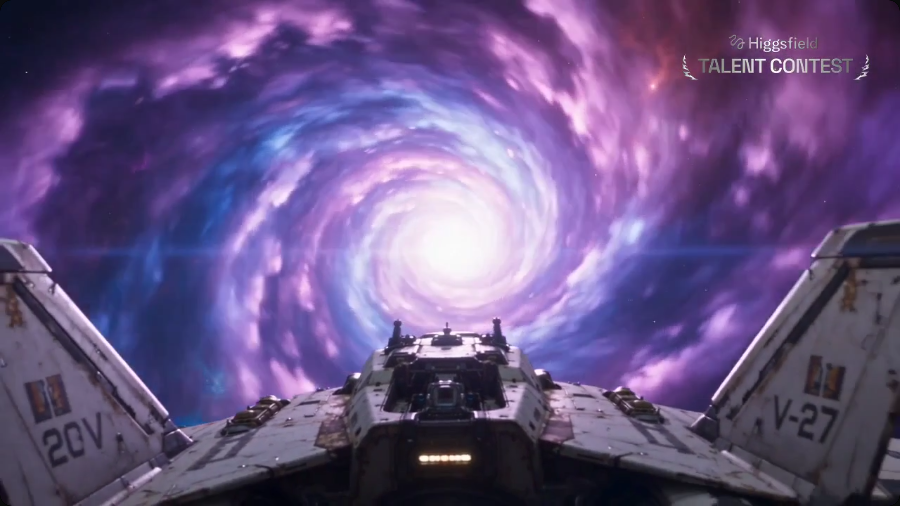
Then the film spends its winnings immediately. The escape — a hoverbike through a desert-city market, a ship, a purple vortex — is a chase in search of a destination, and Sarah’s scream as the ship goes in is the last thing we get. Cut to black. The 24th and the 25th are named but never shown. The 26th is screamed about but never explained. The erasure of Alan is never answered, the kingdom never confronted, the parents’ fate never given. Screams into a black card is not a conclusion; it is an interruption. A story built entirely on a question owes its audience at least the shape of an answer.
And yet there is one more turn, folded into the jump itself, that re-reads everything a second time: when Sarah jumps, the film pulls back — a zoom out of a computer screen, and a man looking at it. It leaves a question hanging over the whole film: was any of it real, or was Sarah’s world a made-up one, watched from outside? The film never answers, and for once the unanswered question feels like a gift rather than a gap. It looks beautiful, too — that pull-back is one of the loveliest moments in the film.
Best Scene (4:25–5:25)
“Jump”
The rescue is the best scene in the film because it is the one where the premise, the family and the mystery all pay off at once. Her father tells her to jump. Her mother sets the coordinates. And the line that explains the title lands at last: “You have seen the 24th and the 25th. They cannot allow that.” Everything the film has been circling — the impossible knowledge, the erasure, the kingdom’s rules — snaps into focus in a single sentence, and it snaps into focus in the mouths of the two people the opening taught us to trust over breakfast. Mr. Ken’s lifelong protection is revealed in the same movement. For one minute, Hilbert 26th Problem is exactly the film its hook promised: a family smuggling their daughter out of a reality that has outlawed what she knows. It is the scene the rest of the film should have been built to deserve.
Final Thoughts
Come for the premise, which is excellent, and stay for Sarah — but know that the film raises a superb question and then declines to answer it. The warmth of the opening, the chill of the erasure, the rescue that re-reads them both: there is a real film in here, and its best scene proves the makers can build it. What is missing is the ending, the connective tissue, and a slower, more careful finish. A brilliant problem, left unsolved.
★★½ — A brilliant problem, left unsolved
Scene Breakdown
0:00–0:25 — Morning. Sarah, 22, introduces herself; her cat Mr. Ken demands breakfast. The idyllic life, established in one domestic beat.
0:25–1:00 — Routine. Home and university life, set to the song “Broken Umbrella” — whose lyrics come out garbled.
1:00–1:50 — The Lecture. A Hilbert curve lecture on campus; Sarah meets Alan. Her notebook’s “curve” is a triangular scribble.
1:50–2:45 — The Empty House. Alan books dinner at Monroe’s; Sarah comes home to silence. “Dad? Mr. Ken?”

2:45–3:50 — The Erasure. “They” arrive: a security violation, Alan erased, her parents interrogated, the kingdom’s rules imposed.
3:50–4:25 — The Terms. Sarah in a white futuristic suit, on a bridge: “Magic is restricted.”
4:25–5:25 — The Rescue. Her father tells her to jump; her mother sets the coordinates. “You have seen the 24th and the 25th. They cannot allow that.” Mr. Ken has always protected her.
5:25–6:20 — The Escape. “What the hell is this 26?!” Mr. Ken, the white cat; Sarah flees on a hoverbike through a desert-city market.
6:20–6:54 — The Vortex. The ship enters the purple vortex; Sarah screams; cut to black. Nothing resolved.
There are no reviews yet. Be the first one to write one.