
 Marcus McCormick
 Creator ID26-11-03-0181
Score breakdown
23.9K views
Film Review
This review discusses the outcome of the Storm Crucible. If you would rather watch the film first, we recommend you do, and then come back.
The World Is the Best Idea Here
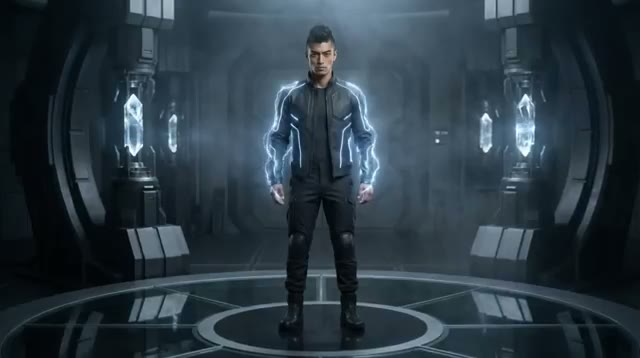
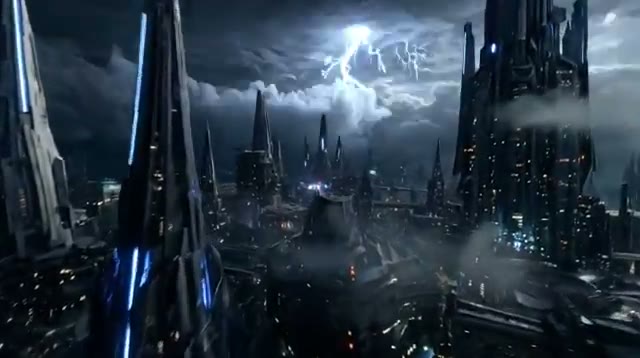
Arcadia Prime is a place where storms are worshipped, lightning powers the cities, and the Denjin people’s own cells resonate with electricity — ‘lightning was not weather, it was breath.’ That is a real piece of world-building, and the film opens by trusting it: nearly two minutes of storm and city imagery before a word is spoken. Rivnor is born inside such a storm, sparks leaping from his skin, the midwives whispering that the storm chose him. His parents are not royalty but engineers who maintain the lightning towers — a small, good detail that grounds the myth in a working world.
A Life Told, Not Shown
The structure is a biography in four acts, and narration does all of it. The Circuit Trials fuse Rivnor’s gift with Denjin technology — plasma chambers, electromagnetic coils, charge manipulated at the quantum scale — and the script finds its best idea here, mapping physics onto character: Ohm’s law teaches him restraint, induction teaches him control, superconductivity becomes his shield. It is clever writing. But Act 2 then describes the same trials a second time in almost the same terms, and across the whole film there is exactly one line of in-scene dialogue (‘The energy flow is unstable. We must secure the perimeter,’ ~8:31). No scene is allowed to play. We are told his victories isolated him, told his parents feared for him, told the power was eating him — and being told, however elegantly, is not the same as watching it happen.
The Cost, and the Crucible
Act 3, ‘The Weight of Power,’ is the strongest stretch of writing: a storm that never releases consumes itself, and Rivnor’s body keeps the score — muscles trembling with charge at rest, a heart forced into ‘a rhythm more machine than organic,’ peers who see an anomaly rather than a man. The Storm Crucible that follows is the film’s promised climax, a dome suspended over Arcadia’s worst weather where he fights lightning duelists, arc riders and storm callers until collapse or victory. He wins, obviously — this is an origin story, and the ending was never in doubt — and the narration lands its best line as the clouds split around him. Then the film stops at the threshold of the story it has been advertising: the Challenging Halls, Khaeos, the Nine. As a chapter of Marcus McCormick’s wider KHAEOS universe, that is a legitimate shape. As a standalone seventeen minutes, it is all prologue.
What the Pictures Do Well
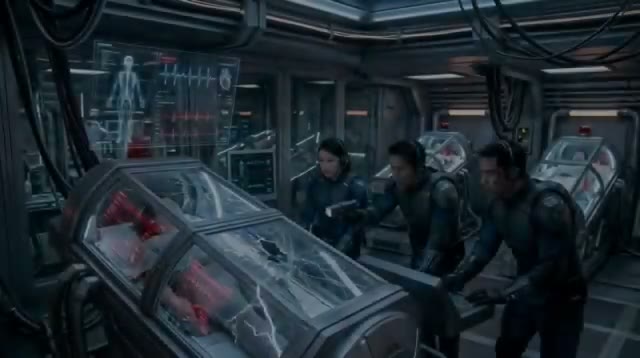
The imagery carries more than its share and mostly carries it well. Once the adult Rivnor arrives — white armor, blue lightning emblem — he stays himself: the same face and kit in the lightning corridor (~9:30), holding a bolt in the corridor (~10:30), kneeling spent on the crucible ground (~13:30) and standing battle-dirtied over the city (~14:30). The seams are in the growing up: the child at ~4:30, the adolescent on the trial platform at ~7:30 and the adult from ~9:30 are three different people, and background figures soften into waxworks in the wider shots. The storm, at least, never misses — it is the one character the film fully casts.
Best Scene (13:30–14:39)
The end of the Crucible
The end of the Crucible (~13:30–14:39). On screen, Rivnor is on one knee in the rain, armor lit by the storm, two armored soldiers standing off behind him; over it, the narration gives him his scars — ‘burns like constellations’ — and his title, as the clouds split and the lightning arcs in spirals around him. It is the one moment where image and writing are doing the same thing at the same time.
Final Thoughts
Watch this as what it is — the illustrated first chapter of a universe Marcus McCormick is building across his channel, including the feature KHAEOS: Breaking Reality — and it is an atmospheric, good-looking piece of myth-making with a smarter-than-usual script underneath. Watch it expecting a self-contained drama and you will feel the narration keeping you at arm’s length. He was expected to burn out; instead he became the storm — and the film is at its best exactly when it lets us see the weather.
Scene Breakdown
0:00–1:47 — Narration-free opening: storm and lightning over the spired city of Arcadia Prime
1:47–3:52 — Act 1, “The Stormborn Child”: Rivnor is born in a storm, sparking at the touch; his engineer parents
3:52–5:21 — Visual passage: the young Rivnor and his uncontrolled gift
5:21–7:55 — Act 2, “The Circuit Trials”: plasma chambers and coils; Ohm’s law as restraint, induction as control, superconductivity as shield
7:55–9:23 — Act 3 title; a council chamber, and the film’s only line of scene dialogue (~8:31)
9:23–11:09 — Act 3, “The Weight of Power”: revered and feared; the physical cost of containment; a prophecy of the Nine
11:09–12:56 — Act 4 title; Rivnor’s strained close-up and the mech hangar as the Crucible begins
12:56–15:12 — Act 4, “Ascension of Lightning”: the Storm Crucible; Rivnor undefeated, named Storm Incarnate
15:12–17:39 — Production credits.
The adult design holds: the same face, hair and white armor with the blue lightning emblem at ~9:30, ~10:30, ~13:30 and ~14:30, with battle dirt accumulating on the same kit. Lightning effects sit in the world cleanly throughout, and the credit cards are crisp and correctly spelled. The clearest seam is the growing up: the child at ~4:30, the adolescent at ~7:30 and the adult from ~9:30 are three different faces for one hero. Background people soften into waxworks in the wider shots, and the holographic displays are glowing shapes rather than anything readable. That balance — a held hero design against a changing face — is what Mostly clean means here.
Watched on YouTube. All of the film was viewed in full for this review; the final 2:27 is production credits.
There are no reviews yet. Be the first one to write one.