
 jamil_safari
 Creator ID26-11-01-0239

Score breakdown
40 views trên Kineograph
Film Review
This review discusses the ending. If you would rather watch the film first, we recommend you do, and then come back.
Synopsis
The judgment of humanity will be decided by a single match. In an infernal arena — a dome set in lava, under an orange hell sky — a host welcomes Heaven and Hell, and the terms are set: six humans against the gods, at volleyball, for the next hundred years of Earth’s existence. Lose, and humanity’s time runs out.
The gods dominate early. The humans rally — “We’re not done yet” — but the gap is what it is, and so the Devil makes his offer: power, at the price of never returning to Earth. “100 years,” the answer comes. “Take it with all of us.” Empowered, the humans fight back while a masked god keeps the score like a sentence: “I’ll record this as your final point.” The match levels at 5:5. “Smash it!” The arena shakes. “The next point decides everything!” A winged god faces a flaming ball, a voice cries “Stop” — and the film cuts to black, the final point forever in the air.
A Match for the Next Hundred Years
The stakes are in the title — Hyakunen, a hundred years — and the film states them with wonderful bluntness in its first seconds. A black god-figure fills the screen at around the 0:14 mark and the judgment is announced: humanity’s fate will be settled not by war or prayer but by a single match. There is something perfectly anime about the confidence of that — the end of the world, decided by sport — and the film never winks at it. Heaven and Hell are welcomed like visiting teams. The crowd takes its seats. The gods serve.
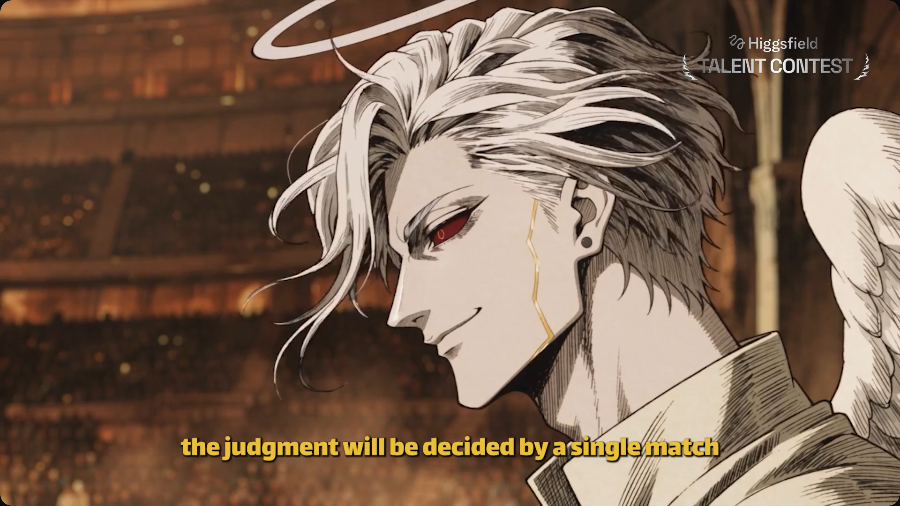
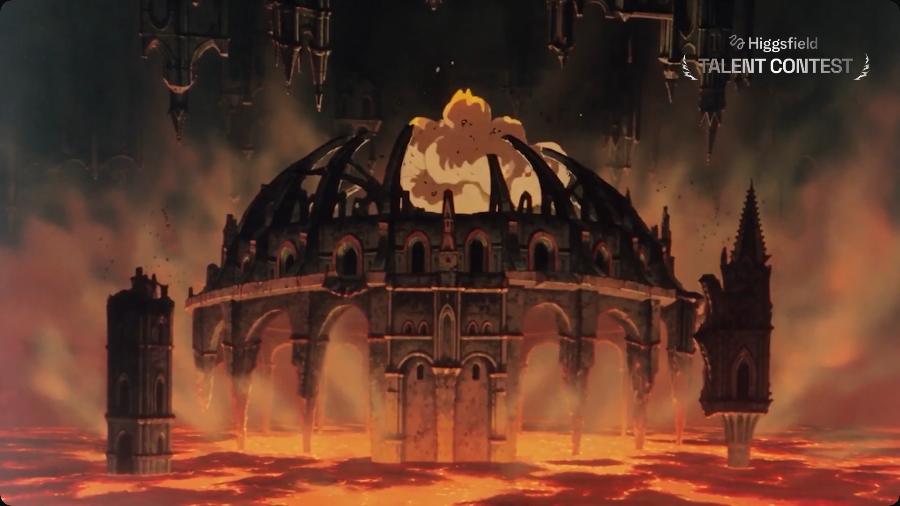
That straight face is the film’s great strength. The infernal arena is a strong visual identity — a dome in lava, hell-orange skies — and the Japanese dialogue with English subtitles on the key lines gives the piece an authenticity a dubbed version would have lost. For long stretches, this plays like a real episode of a real series, and it is easy to forget you are watching a short at all.
The Rally
The match footage is the film, and it is genuinely exciting. The rallies have pace and escalation; the energy effects sell the supernatural element without swallowing the sport underneath; and the dramatic close-ups understand exactly what sports anime is for — faces at the moment of effort, carrying stakes the scoreboard will not. When the humans claw their way back into the match and the cry goes up — “We’re not done yet” — the film earns a real surge. When the score levels at 5:5 and someone screams “Smash it!”, the comeback feels complete in miniature: a whole sports arc, compressed into five minutes, at full volume.
The craft underneath the spectacle is mostly clean, too. The animation holds together across nearly six minutes of fast, effects-heavy action. This is a remarkably clean film, and its 9 on the meter is earned the honest way — by spectacle that stays coherent while it moves.
The Devil’s Bargain
The darkest and most interesting element of the film is the contract. Losing, outclassed, the humans are offered power by the Devil — at the price of never returning to Earth. The exchange is the moral center of the match: “100 years. Take it with all of us.” A player does not sell his soul for himself; the team takes the bargain together, trading their way home for Earth’s next century. It is the one moment where the match acquires a personal cost, and it reframes everything after it — every powered rally from that point on is played by athletes who have already paid to be there.
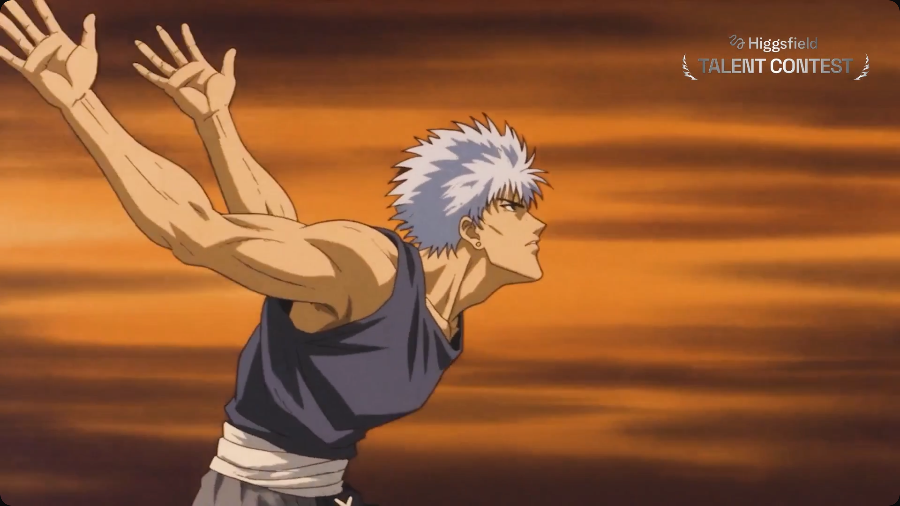
The gods’ answer is contempt, and it is chillingly delivered. The masked god does not rage; he keeps the books. “I’ll record this as your final point.” It is the voice of a bureaucracy of heaven — the same cold administration of fate that makes the bargain necessary — and it sets up the film’s best stretch: powered humans against indifferent gods, 5:5, everything on the next rally.
Rooting for No One in Particular
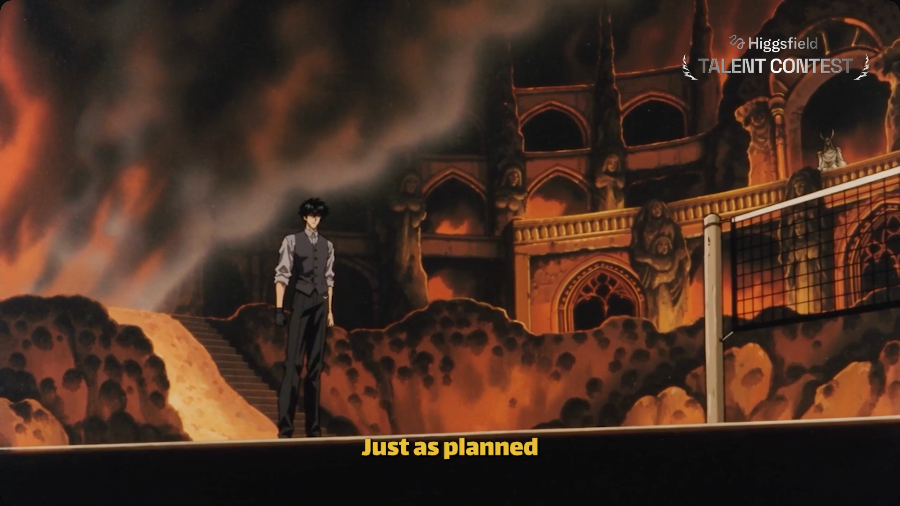
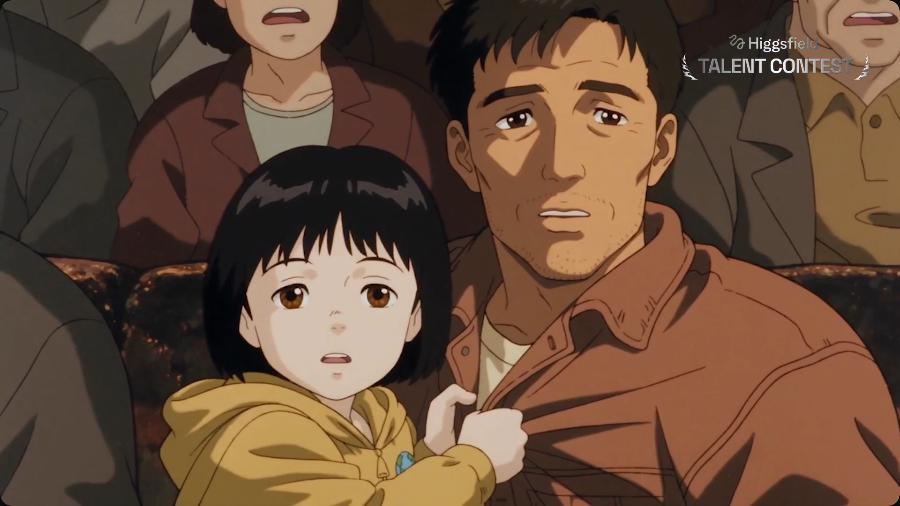
And here is the structural problem the spectacle cannot outrun. Not one character is named. The humans and the gods are hard to tell apart — a girl in a yellow hoodie clutching her jacket at around the 1:15 mark registers as a person, briefly, and the white-haired human shouting against the hell sky registers as a presence — but sides blur, faces pass, and in a match framed as humanity’s last stand that is a serious handicap. Every rally should carry the weight of extinction, but without knowing who anyone is, or reliably which side is which, the emotion has nowhere to attach. We are watching superb athletes in a beautiful arena, and rooting for no one in particular.
It is worth being precise about the cost. The bargain scene works because it briefly gives the humans a collective identity — the ones who paid. But a collective is not a character, and when the final rally comes, the film needs a face to cut to, a name to fear for, and it does not have one. The match is for Earth’s hundred years; the film never lets us spend a single one of them with a person.
The Point That Never Lands
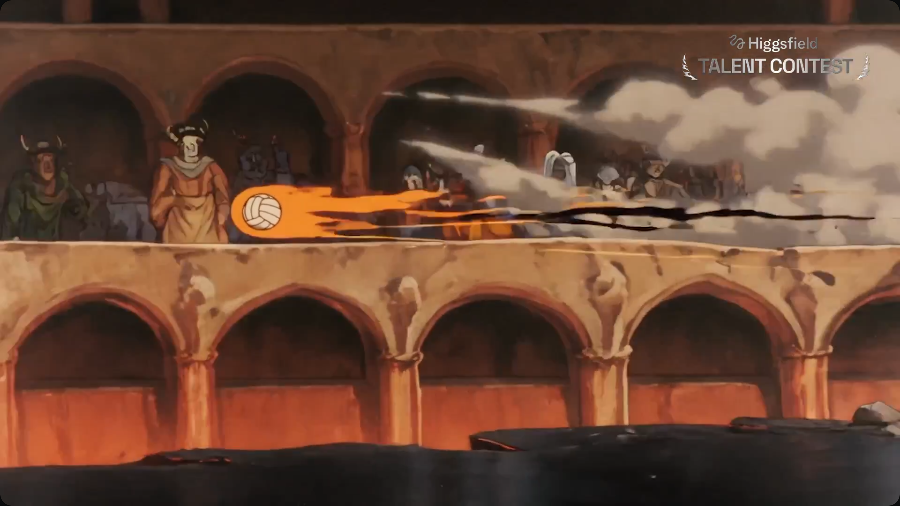
Then there is the ending, or the absence of one. The final rally builds exactly as it should — the arena shaking, “The next point decides everything!” — and the film delivers its single most dramatic image: a winged god facing down a flaming volleyball at around the 5:35 mark. A voice cries “Stop.” Black. The fate of the Earth is left hanging, and the film’s own framing confirms the hang is deliberate: the final point is never scored, the winner never named, the hundred years never granted or refused.
As the middle of a longer work, that might be a legitimate cliffhanger. Judged as a standalone piece, it is a story with no payoff — six minutes of rising tension released into nothing. A match with extinction on the line has to tell us who won. Hyakunen tells us, instead, that it knows how to make us ask — which is a real skill, and not the same one.
Best Scene (2:00–3:12)
“I’ll Record This as Your Final Point”
The best scene in Hyakunen is the turn: the Devil’s contract and the god’s taunt, played back to back. First the bargain — power, at the price of never returning to Earth — and the team’s answer, “100 years. Take it with all of us,” which converts a sports match into a sacrifice in a single line. Then the empowered humans fighting back, and the masked god’s cold reply: “I’ll record this as your final point.” In just over a minute the film finds everything it elsewhere struggles for: a cost, an antagonist with a voice, and stakes that are suddenly personal as well as cosmic. The white-haired human shouting against the orange hell sky and the masked god’s asymmetrical face are the two images that stay with you. If the whole film had been built at this temperature, we would be talking about a remarkable film.
Final Thoughts
I love this film. Hyakunen is the closest an AI film has come to making me feel like I am watching actual anime — and it is fantastic. The action is great, the editing is sharp, and the way the whole piece is done shows a real feel for the genre it loves. I am even fine with the thing I criticized above: nobody in it has a name. Names would help, and I said so — but I find I do not actually mind, because the match carries me anyway. More than anything, this feels like an introduction to a larger story, and it is a world I would love to explore. The one thing I do not like is that there is no ending: the final point hangs in the air, the result never comes, and I wanted that result. Verdict: a fantastic first chapter — now I want the rest of the story.
★★★ — Superb rallies, a devil’s bargain, and a final point that never lands
Scene Breakdown
0:00–0:25 — The Judgment. A black god-figure announces that the judgment will be decided by a single match; the host welcomes Heaven and Hell.
0:25–1:00 — The Teams. The crowd fills in; the teams take the court; the gods serve.
1:00–2:00 — Outclassed. The gods dominate; the humans rally. “We’re not done yet.”
2:00–2:50 — The Bargain. The Devil offers power at the price of never returning to Earth. “100 years. Take it with all of us.”
2:50–3:30 — The Taunt. The powered humans fight back; the masked god keeps score like a sentence: “I’ll record this as your final point.”
3:30–4:10 — Level. The score reaches 5:5. “Smash it!”
4:10–5:00 — The Final Rally. The arena shakes; the last rally builds. “The next point decides everything!”
5:00–5:56 — The Point in the Air. A winged god faces the flaming ball; the final point hangs; a voice cries “Stop” — and the film cuts to black.
There are no reviews yet. Be the first one to write one.