

 Atomic West
Score breakdown
564 views
Film Review
This review discusses the ending. If you would rather watch the film first, we recommend you do, and then come back.
The curse that opens the film
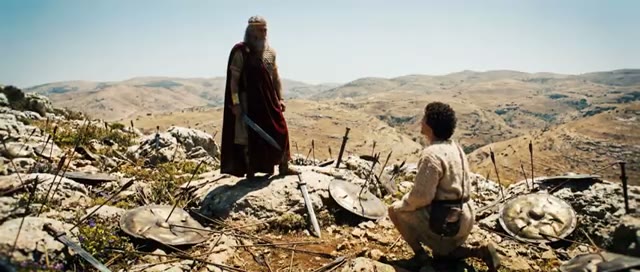
The film begins, unusually, not with Bathsheba but with Saul. In a dark hall, the dying king accuses David of stealing his music, his people’s praise and his daughter’s love, and David answers with a loyalty Saul can no longer believe. Saul’s parting line — “As I am, so you will be.” — is the film’s thesis, and it is a good one: David will fall the way Saul fell, through pride and a God gone silent. The scene is played in tight close-ups, and it works because both men sound exhausted rather than villainous. Saul is not a monster here; he is a man who knows he is condemned, and David is not yet a sinner — he is a friend who cannot save the man he once served.
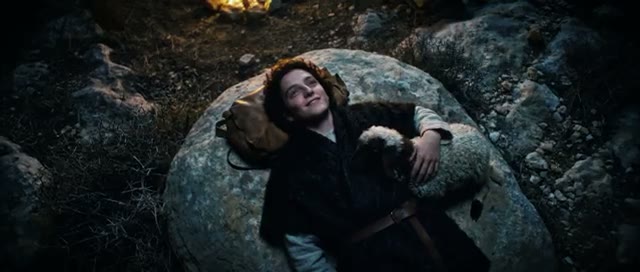
Then the film cuts to a young David asleep on a rock in open country, cradling a lamb against his chest. It is a dream, or a memory, of the shepherd he was, and it sets up everything that follows: the man who once slept in fields now sleeps in a palace and cannot sleep at all. I liked this choice. It gives the film a frame — shepherd, king, and then a king who has forgotten how to be either — without needing a narrator to explain it.
A king with nothing to do
The middle of the film is really about idleness. David stays in Jerusalem while his army is at the siege of Rabbah, and the prophet Nathan tells him plainly that he is not resting, he is hiding. David’s complaint — that he has spent thirty years sleeping in open fields and has not earned a single season of rest — is the most human line in the film, and also the most damning, because Nathan is right and David knows it. The film lets that restlessness sit. David wanders the palace, watches the city, and then watches Bathsheba.
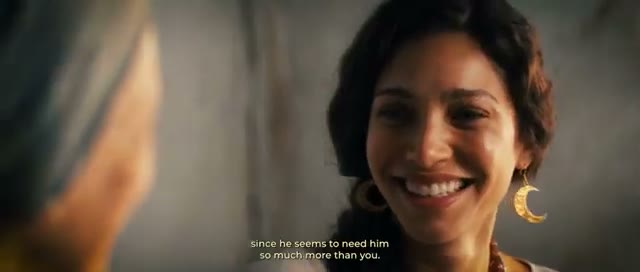
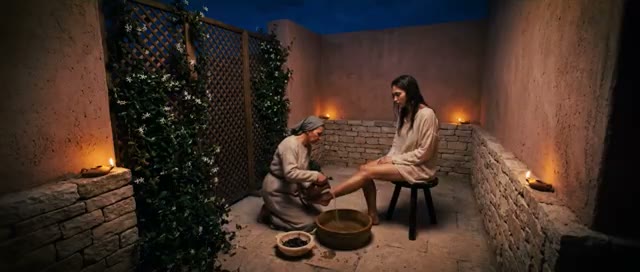
Bathsheba herself is introduced with her servant Zila, talking about her husband Uriah, a good man who is away at war and who has not yet given her a child. The writing here is gentler than I expected: Bathsheba is not presented as a temptress, and David is not presented as a predator in a single scene. The problem is that the film is more interested in David’s desire than in Bathsheba’s mind. We hear her worry about what people will say and about her husband’s honor, and Zila warns her to leave Jerusalem, but Bathsheba’s own feelings stay at the edge of the frame. The film is honest about the power imbalance — a king summoning a soldier’s wife — and David’s talk of “purity” as a pretext for seeing her again is chilling precisely because it sounds so pious. I just wished the film had let Bathsheba push back harder, or want something of her own, before she gives in.
The cover-up, and the prophet’s trap
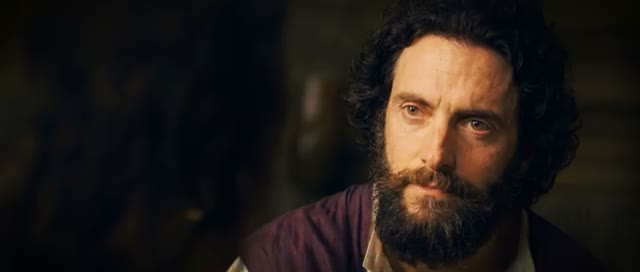
The film’s second half moves faster and is better for it. David summons Uriah home from the siege, pours him wine, and orders him to go down to his house — and Uriah, loyal to the ark and to his men in the field, refuses: “As you love and as your soul lives, I will not do this thing.” It is a short scene, but it is the moral center of the film, because Uriah’s honor makes David’s scheme look small. David’s answer is a sealed letter, carried by Uriah himself, and the film does not need to show the battlefield in detail for the betrayal to land.
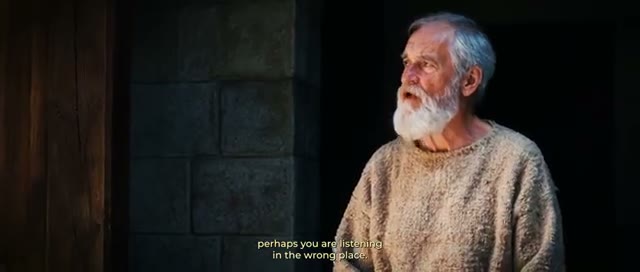
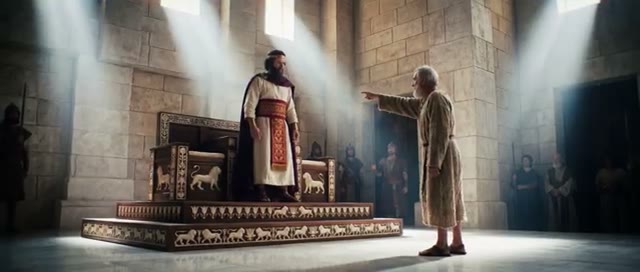
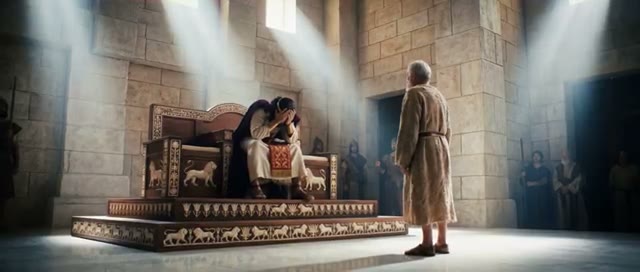
That is why Nathan’s return works so well. He tells David the parable of the rich man who took the poor man’s one little lamb, lets David condemn the rich man in his own words, and then turns the story on him. The film trusts the audience to know what is coming and still makes the moment land, because David’s face, as he understands it, does the work. Nathan’s judgment — that evil will rise against David out of his own house — is delivered without shouting, and the film ends not with a death or a battle but with David slumped on his throne, his head in his hands, while Nathan stands over him in the sunlight. It is a brave, quiet ending for an AI film, and it is the right one.
Best Scene (26:20–28:14)
Nathan’s parable
Nathan stands in the sunlit throne hall telling the story of the poor man’s lamb while David listens from his throne, condemning the rich man before he realizes the story is about him. It is the best scene because the film’s whole structure pays off here: Saul’s curse, the shepherd’s lamb from the dream at ≈2:32, and Uriah’s loyalty all converge in one story, and the camera stays on the two men’s faces instead of cutting away to spectacle.
Final Thoughts
I came to this expecting a curiosity — a biblical story made with AI tools — and found a film that mostly behaves like a real drama, with real scenes and a real ending. Its weaknesses are the usual ones for a work like this: a slow, underwritten middle, a heroine who deserves more of the film, and a few visual seams. Its strength is that it knows what it is about: a good man who stopped listening, and the price of that silence. It is not a perfect film, but it is an honest one, and the last ten minutes justify the first twenty.
Scene Breakdown
0:00–0:41 — The song. In Saul’s dark hall, a song praises David’s victories over Saul’s thousands; Saul broods as David stands before him.
0:41–1:56 — The curse. Saul accuses David of stealing his music, praise and daughter’s love; David insists he is a friend, not an enemy, and Saul curses him: “As I am, so you will be.”
1:56–3:33 — The shepherd. A dream or memory: a young David asleep on a rock in open country, cradling a lamb against his chest; he wakes, and the film returns to the palace.
3:33–5:54 — Hiding, not resting. David, restless in Jerusalem while his army is away, argues with the prophet Nathan, who tells him he is hiding, not resting.
5:54–7:50 — Bathsheba and Zila. Bathsheba talks with her servant Zila about Uriah, her husband away at war, and about children; she asks for a bath to be prepared in the courtyard after dark.
7:50–13:51 — The courtyard. At night in the walled courtyard, Zila washes Bathsheba’s feet by candlelight; David watches from the palace rooftop above.
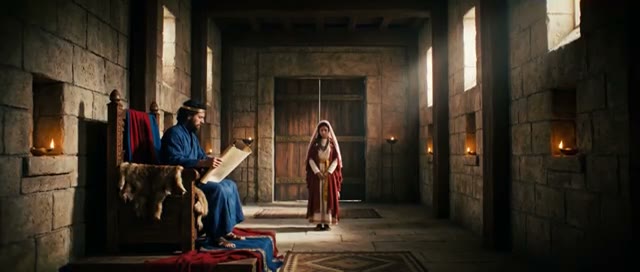
13:51–17:17 — The summons. David summons Bathsheba and questions her about bathing in the open air, under the guise of teaching purity, and tells her to return tomorrow.
17:17–19:53 — The warning. Bathsheba and Zila debate the summons; Zila warns her that the king’s interest is desire dressed as righteousness and urges her to leave Jerusalem.
19:53–21:54 — The second meeting. David and Bathsheba meet again in the palace; he tells her of playing for Saul and of his anger at a woman he cannot have, and draws her to him.
21:54–24:31 — Uriah recalled. Joab reports the siege goes well; David recalls Uriah from the front, drinks with him, and orders him home to his wife.
24:31–25:48 — The refusal. Uriah refuses to go home while the ark and his men are in the field; David gives him a sealed letter to carry back to Joab, and Uriah thanks him, unaware of its contents.
25:48–26:20 — Time passes. Bathsheba is now in the palace, and Nathan is summoned before the king.
26:20–28:14 — The parable. Nathan tells the parable of the rich man and the poor man’s lamb; David condemns the rich man, and Nathan delivers God’s judgment on David for striking down Uriah and taking his wife.
28:14–29:26 — The aftermath. Silent aftermath: David slumps on his throne with his head in his hands as Nathan stands before him in the sunlit hall; the film ends on that image.
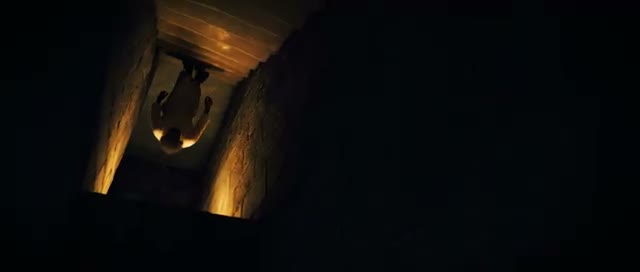
≈24:31 — An overhead shot looking down a stone stairwell flips perspective and the descending robed figure’s scale reads wrong against the steps.
≈2:32 — The lamb cradled against the sleeping young David’s chest holds an unnaturally still, statue-like pose against the landscape.
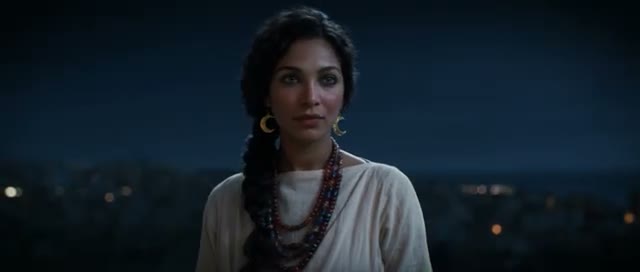
≈16:04 — In the night close-up, Bathsheba’s braid softens where it crosses her shoulder and the dark background behind her loses definition.
≈28:46 — As David covers his face on the throne, his hands and the edge of his crown soften and lose definition.
Lip movement also feels slightly loose in the long Saul–David exchange at ≈0:41–1:56.
There are no reviews yet. Be the first one to write one.