

 F Xavier Mastrangelo
 Creator ID26-11-01-0251

Score breakdown
138 views
Film Review
This review discusses the ending. If you would rather watch the film first, we recommend you do, and then come back.
Synopsis
A grey-haired executive in a blue blazer chairs a boardroom where Greg, a blond man with a mustache and an orange lanyard, is pitching an idea: a film festival offering “a million dollars to the best film anybody makes without tools. Judged by proper filmmakers, real ones.” Around the pitch, the room lurches through the practical crises of prestige — a journalist is coming in nine minutes and needs “a different story”; the festival will need judges, so Greg offers Kevin, whose qualification is that he is “very good at resetting passwords”; the money is defended as “a marketing spend or it doesn’t exist.” The room argues about whether critics or a public vote should decide (“It’s not seven people in a room. It’s democracy, Greg”), promises an “unlimited” queue that everyone in the room knows would fall over, settles on filmmakers creating in public as “transparency,” and finally names the thing it is actually selling: “Name it. Engagement.” The festival is christened on screen as the Higgsfield Global Film Festival, Greg is told he will present it to the board on Thursday — “It’s your baby” — and the film drifts into a looping attempt to define what a film festival is, a question it circles without ever quite answering.
The Room Where Prestige Is Manufactured
The premise is a joke engine with a long fuel line. Treat a film festival like a soft-drink launch and every ordinary agenda item becomes an exposure: the prize is “the millions, the bait — the don’t say bait”; the judging problem is solved by whoever is nearby; the audience is not a public but a metric waiting to be named. What makes the satire land is that nobody in the room is a villain. Greg is not corrupt; he is fluent. The chair is not cynical; she is practical, a woman who cannot hear the word Discord “right now, it gives me gastric distress,” and who steers the meeting the way real meetings are steered — by deadline, by optics, by whoever is coming through the door in nine minutes. The film understands that prestige is not manufactured by conspirators. It is manufactured by competent people in a room, being reasonable, one compromise at a time.
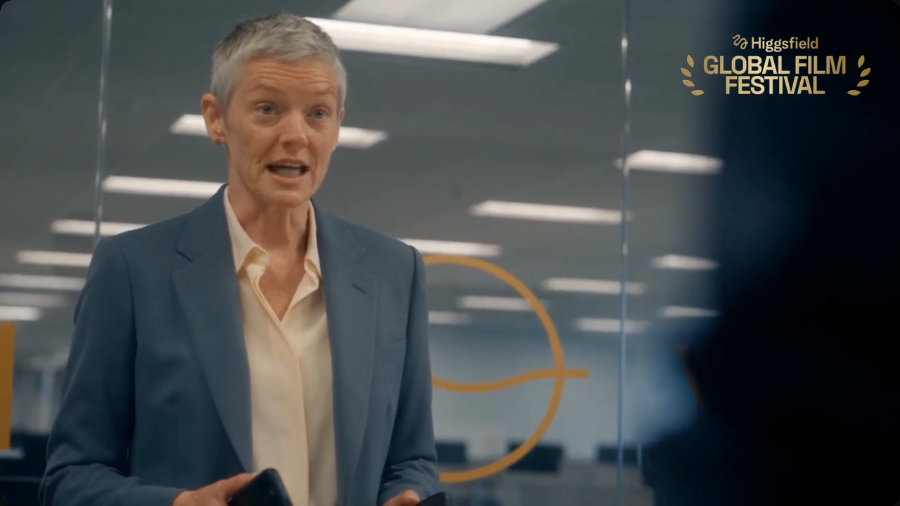
That understanding is what separates this from sketch comedy. A sketch would give the executives one absurd line each and cut away. The Festival stays in the room for nearly eight minutes and lets the logic compound: first the prize, then the judges, then the money, then the vote, then the queue, then the name of the metric — each step reasonable, the sum damning. By the time someone observes, almost as an aside, that “AI is writing all their films for them,” the film has built a complete little machine and shown you every gear.
Dialogue With a Scalpel
The writing is superb throughout. The lines have the snap of people who have sat through these meetings. “My team is Kevin. Kevin is very good at resetting passwords.” — “Kevin, are you qualified to judge cinema?” The critics-versus-public argument produces the film’s best exchange, at around the 4:03 mark: “That is the entire job of a critic!” answered by “We can get that for free. It’s called the internet!” And the “unlimited” sequence at around 5:02 is a perfect miniature of corporate language doing its work: “Tell me what an unlimited queue does under that.” — “It falls over.” — “It is if we call it unlimited.” Three lines, and an entire philosophy of marketing is on the table.
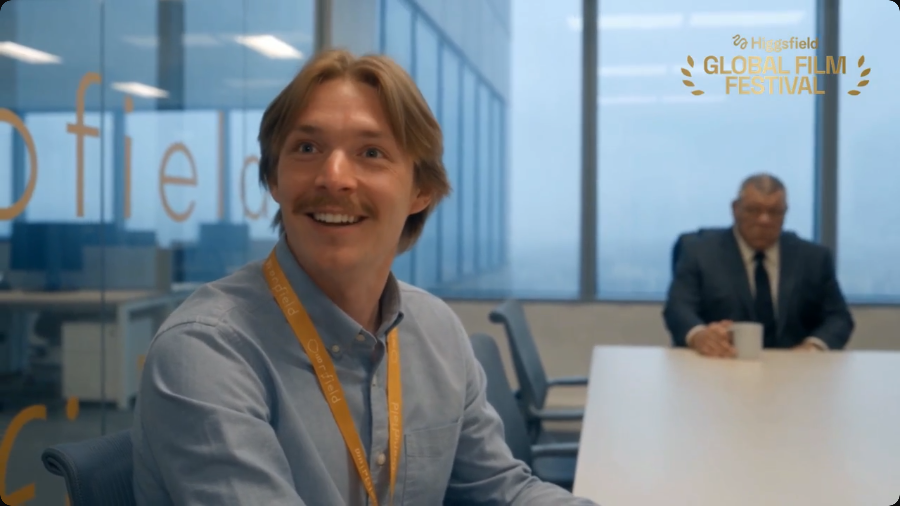
The performances serve the writing the way they should: dry, unhurried, never winking. The chair’s close-ups carry the film — a woman listening to nonsense with the patience of someone who has decided which nonsense is useful. The boardroom itself is visually consistent throughout, a clean corporate space with a black smart speaker sitting on the conference table in sharp focus at around the 5:45 mark, quietly listening to everything — the one member of the meeting nobody thought to pitch to, and maybe the only one taking notes. It is the best visual joke in the film, and the film is disciplined enough never to point at it.

A Satire That Turns on Itself
The extra layer, and the reason this film belongs at a festival, is that it knows exactly where it is. This is a film about the invention of the Higgsfield Global Film Festival, screened as part of that festival’s world — the gold HGFF logo sits over the boardroom footage itself. When the room debates “create in public” — “Post the shots as they go… It’s transparent.” “That’s not how film festivals work.” “Well, it should be.” — the film is describing the conditions of its own existence and daring you to object. When the metric is named — “Name it. Engagement.” — it is naming the currency every film, this one included, is ultimately paid in. Satire that exempts itself is advertising. This one doesn’t exempt itself, and that honesty is a large part of its 7.7.
Where the Assembly Shows
And now the honest cost, because there is one and it is structural. At around the 1:44 mark, Greg’s pitch scene plays again — the same dialogue, the same beats, the chair’s close-up recurring at around 2:45 — nearly verbatim, for the better part of a minute. In a film this controlled at the level of the line, the repetition is jarring. One can construct a defense — the pitch is a product, re-sold to each new audience, and the loop is the point — but the film gives no signal that the repeat is a joke rather than a join: no variation, no reaction shot acknowledging it, nothing. It plays as an accident, and I have scored it as one. The same problem returns near the end, when “What is a film festival?” is asked and answered in a circle — “The film festival is a film festival.” — a definition loop that spins where a climax should be.
One correction, because it matters: a few seconds of snowy samurai footage — a red demon against a black samurai — sit at the very end of the file, after the film is over. That is not the film’s ending, and it is not the filmmakers’ choice: it is Higgsfield’s own advertising for the festival, attached to the films that took part in it. The Festival’s actual closing is the one it earned — Greg, alone with his baby, presenting Thursday, and a room still unable to say what a film festival is. Add the satire’s usual tax — you admire these people being dismantled more than you ever feel anything for them, and emotional connection is the softest line on this scorecard — and you have the shape of the film: brilliant dialogue, honest targets, and an assembly that lets the writing down.
Best Scene (4:03–4:33)
“That Is the Entire Job of a Critic”
The room turns to who should judge. Someone defends the critics — “That is the entire job of a critic!” — and gets the film’s most cheerful execution in reply: “We can get that for free. It’s called the internet!” The chair gives them six minutes and lands the compromise: “Let the audience decide.” It is the best scene because the whole film is inside it: expertise priced, found too expensive, and replaced by a vote, in under thirty seconds, with every line landing and nobody raising their voice. The satire never gets sharper than the moment it prices its own reviewers at zero.
Final Thoughts
I keep thinking about the smart speaker on the table — the silent listener at a meeting about a festival for machine-made films, at which someone eventually admits the machines are writing the films anyway. The Festival is a clever film, written by someone who has clearly sat in the room it depicts, and its best exchanges deserve to be quoted back at every festival that will ever screen it. Its repetitions are real, and they cost it. But the writing is the thing festivals exist to find. A festival film about festivals, written with a scalpel — it deserves to be shown at every one.
★★★★ — Sharp dialogue, aimed at the room that built the festival
Scene Breakdown
0:00–0:25 — Title and first crisis. A dark title card with the HGFF logo; in the boardroom, Greg asks about a dog and Discord, and the chair shuts it down: “Because I cannot hear the word discord right now, it gives me gastric distress.” / “It’s a festival.”
0:25–1:16 — The pitch. Greg lays out the idea: “A million dollars to the best film anybody makes without tools. Judged by proper filmmakers, real ones.”
1:16–1:44 — Nine minutes. A journalist is coming and the story isn’t ready: “She said 40 minutes. That was 31 minutes ago. Okay, so we have nine minutes to have a different story.” The word “throttle” causes its own small crisis.
1:44–2:40 — The pitch, again. Greg’s pitch repeats almost verbatim — the same dialogue, the same beats — and the chair’s close-up from the first telling recurs at around 2:45.
2:40–3:05 — The costing. How many films can seven judges actually watch? “A few hundred? If we do this right, 100,000.”
3:05–3:35 — Kevin. The judging team is produced: “My team is Kevin. Kevin is very good at resetting passwords.” / “Kevin, are you qualified to judge cinema?”
3:35–4:03 — The money. The prize is defended the only way it can be: “This is a marketing spend or it doesn’t exist.” / “The millions, the bait, the don’t say bait.”
4:03–4:33 — Critics or the crowd. “That is the entire job of a critic!” / “We can get that for free. It’s called the internet!” / “Six minutes. Let the audience decide.”
4:33–5:02 — Democracy, Greg. The vote mechanics are argued out: “It’s not seven people in a room. It’s democracy, Greg.” / “Popular isn’t the same as good.”
5:02–5:28 — Unlimited. The queue problem meets the naming solution: “Tell me what an unlimited queue does under that. It falls over.” / “It is if we call it unlimited.”
5:28–5:57 — Create in public. Radical transparency is proposed as a feature: “Post the shots as they go… It’s transparent.” / “That’s not how film festivals work. Well, it should be.”
5:57–6:26 — Approval. The room talks itself into yes: “Is a million dollars going to a filmmaker? Is that more than anyone has ever given them? Yes.” And, quietly: “AI is writing all their films for them.”
6:26–6:52 — Name it. The real product is identified and the festival christened: “Name it. Engagement.” / “Introducing the Higgsfield Global Film Festival.”
6:52–7:19 — Your baby. The pitch is handed back to its author: “Send it… You’re presenting it to the board Thursday. It’s your baby.”
≈7:19–7:44 — The definition loop. An office phone call about the jury (“You got Anderson for the jury?… Did you say Wes?”) circles a question nobody can answer: “What is a film festival? … The film festival is a film festival.” The film ends there. (The few seconds of samurai footage after it are Higgsfield’s festival advertising, not part of the film.)
There are no reviews yet. Be the first one to write one.