
 João Brandão
 Creator ID26-11-01-0249

Score breakdown
39 views Kineograph에서
Film Review
This review discusses the ending. If you would rather watch the film first, we recommend you do, and then come back.
Synopsis
Morning in a puppet town: a yellow house with flower boxes, and Daniel, a wooden-faced puppet, beginning the day he always begins. His narration states the terms of his life: “Every day, I do exactly what they expect of me.” From above, the town is revealed as a world hung from the sky — strings run down from overhead to every puppet in it. Daniel looks up at his own strings. He commutes by train among rows of puppet-men, all of them strung, all of them riding the same ride. At his office desk he raises a wooden hand; at the office, across the middle of the film, something in him begins to question and decide, and he raises a single wooden finger. The film ends not with an escape but with a connection: Daniel’s wooden hand resting on the shoulder of a fellow puppet, a woman, and a final card that reads: “THE HARDEST STRINGS TO BREAK ARE THE ONES WE CANNOT SEE.”
A World Hung From the Sky
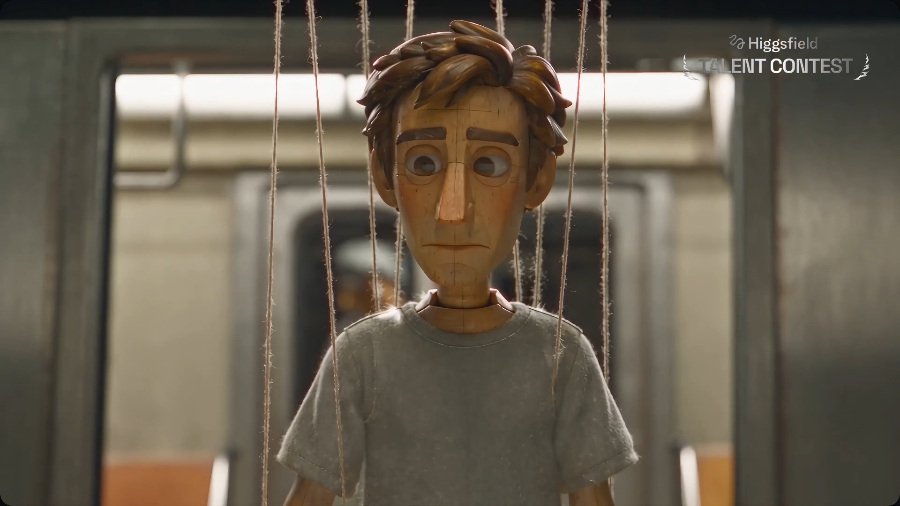
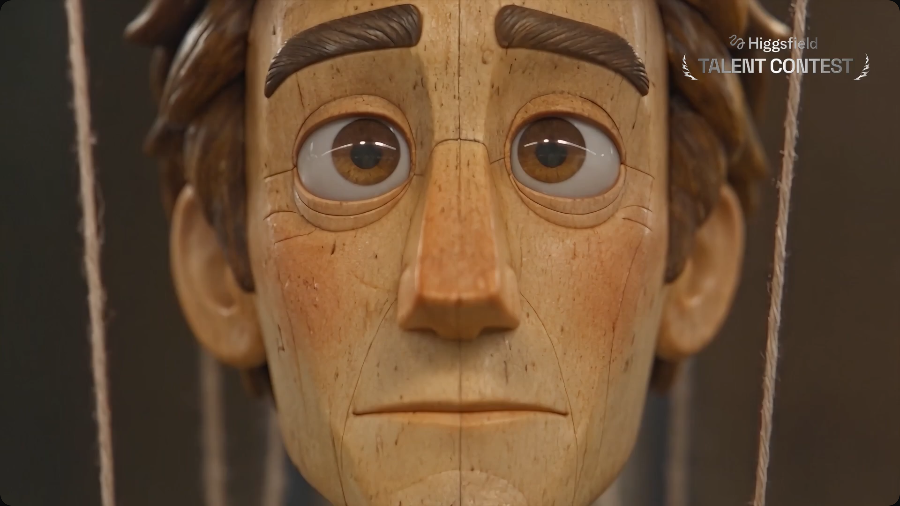
The design is the foundation, and it holds. The puppets are consistent and expressive across the whole film, which matters enormously in a piece carried by faces and posture: Daniel’s wooden face — the close-up at around 1:40, tilted up toward his own strings — has to do the acting, and it does. The puppet conceit is never a gimmick pasted onto one scene. It is the physics of the entire world: the strings are in the domestic morning, in the aerial view of the town, in the train, in the office. Because the metaphor is the world’s operating system rather than a single visual joke, it compounds instead of repeating — each new location is another institution (home, transport, work) revealed to be run on the same strings.

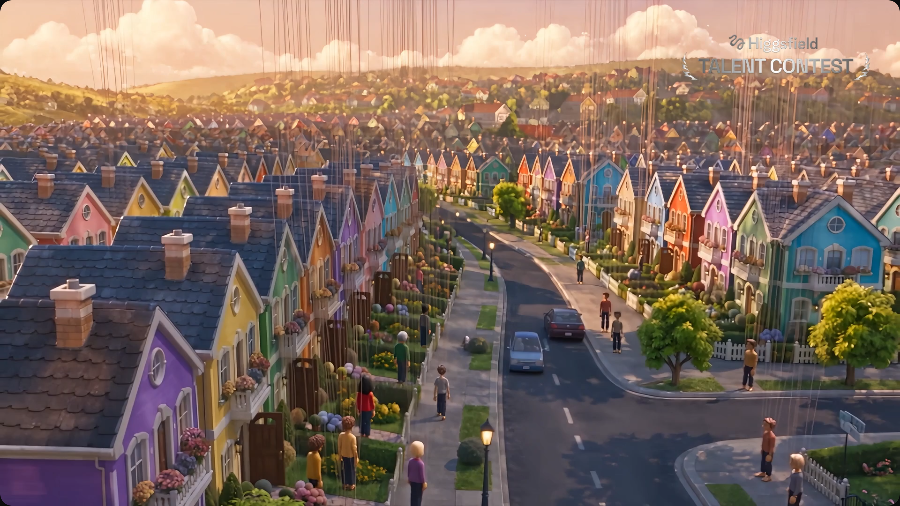
The aerial shot at 1:00 is the film’s thesis in one frame: a whole town, every inhabitant suspended. It is also the moment the film’s scale declares itself — Daniel’s routine is not a personal failing but a universal condition, one cell in a very large organism of obedience. The scale here is social rather than scenic, and it is eloquent.
The Loop
The middle of the film is a circuit — town, train, office — and the circuit is deliberately airless. The train at around 2:00 is the loop’s best image: rows of puppet-men in their seats, strings rising from all of them, commuting in a body. Nobody in that carriage is unhappy in any way they could name; that is the horror of it, and the film is wise enough to play it as normality rather than dystopia. The narration stays sparse throughout — a handful of plain statements, with the images doing the sustained work — and the sparseness suits the subject: a man who does exactly what is expected of him does not have much to say, at first.
Honesty requires naming the cost of the design. A loop, faithfully rendered, is still a loop: the film circles its locations with little progression, and Daniel’s awakening arrives by accumulation rather than by event. Nothing happens to him; he simply, gradually, looks up. Some viewers will feel the four minutes as static, and I felt the drag myself in the office stretch — the film’s middle is its subject (routine is boring) enacted a little too faithfully. The defense is that the drag is the argument. The criticism stands anyway: an argument you can feel costing you time is an argument that needed one more turn of the screw.
Looking Up
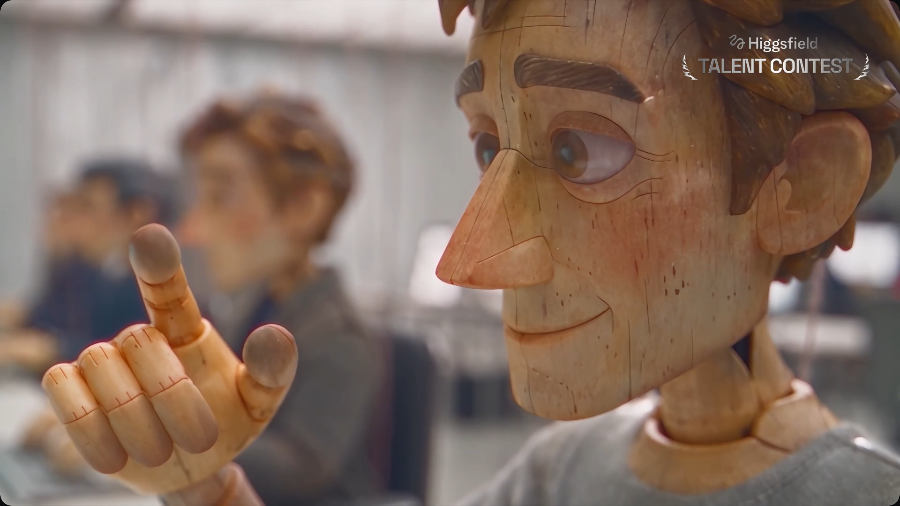
The turn, when it comes, is beautifully small. At around 1:40 the film gives us Daniel’s wooden face in close-up, looking up — the first time anyone in this world has been shown attending to the strings at all. At his desk he raises a wooden hand. Later, in the office, in profile and smiling, he raises a single wooden finger (around 3:00) — the gesture of a man in whom a question has become a decision. The film’s whole drama is in the size of these gestures: in a world choreographed into unison, one raised finger is a revolution’s first inch.
What the film withholds is any consequence. The raised finger changes nothing yet — no string is cut, no fellow puppet reacts, the train presumably runs again tomorrow. The film ends at the seeing, not the breaking, and pairs that open ending with a closing card that states its theme in so many words. “The hardest strings to break are the ones we cannot see” is a good line; it is also the film telling us in text what it had already shown us better in wood and string. I wanted the film to trust its own images all the way to the black.
The Hand on the Shoulder
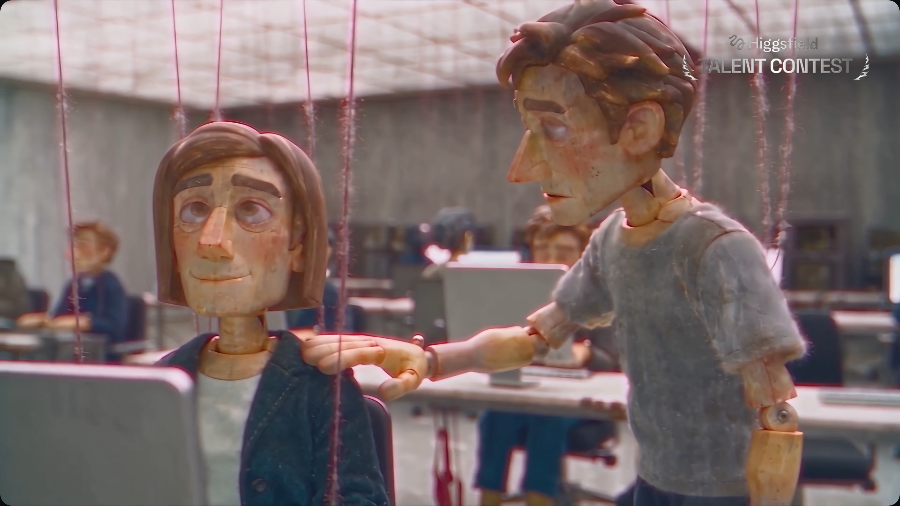
And then the final beat complicates my own criticism, in the film’s favor. Daniel’s awakening does not end in escape, rebellion, or a cut string. It ends with his wooden hand on the shoulder of a fellow puppet — a woman — at 3:49. Connection, not liberation. It is the film’s most mature choice: it understands that the first thing a person who sees the strings can actually do is not to free himself — he cannot, yet, and neither can she — but to stop being alone inside the mechanism. The strings stay up. The hand comes down, onto another person. Whatever breaking eventually happens in this world will happen together or not at all, and the film says so without a word of dialogue — in the end, it trusts the image after all.
Best Scene (3:30–4:01)
“The Ones We Cannot See”
The scene is two gestures and a sentence. First, the gesture the whole film has been building toward: Daniel’s wooden hand, the hand that typed and commuted and obeyed, comes to rest on the shoulder of a fellow puppet — not raised against the strings, not sawing at them, just placed, deliberately, on another person inside the same machinery. The film holds on the simplicity of it. Then the card: “THE HARDEST STRINGS TO BREAK ARE THE ONES WE CANNOT SEE.” It is the best scene because it refuses the ending the premise begs for. Every puppet film about conformity wants its hero to cut the strings and dance; this one understands that seeing is not breaking, that its hero is at the beginning of something rather than the end, and that the honest first act of a free person in an unfree world is witness — one puppet acknowledging another. The card may state the theme more plainly than the image needed, but the image underneath it earns the statement.
Final Thoughts
I keep returning to the raised finger — a wooden puppet in an office, smiling slightly, lifting one finger against the whole sky. The Weight of Strings is a disciplined, expressive piece of visual metaphor-making whose loop does not progress as much as it should and whose ending explains itself a little too eagerly; but its central realization is honestly built, and its final gesture — connection before liberation — is wiser than the escape fantasy it declines. A puppet who sees his strings, in a film that trusts its images almost all the way — and ends by reaching for another puppet instead of the scissors.
★★★½ — One raised finger against the whole sky
Scene Breakdown
0:00–1:00 — Morning in the puppet town. The yellow house with flower boxes; Daniel’s daily routine begins. Narration: “Every day, I do exactly what they expect of me.”
1:00–1:40 — The town from above. An aerial view of the puppet town, strings running down from the sky to every inhabitant; Daniel’s wooden face in close-up, looking up at his own strings.
1:40–2:40 — The commute. Daniel rides the train among rows of puppet-men, strings overhead all around; at his office desk, he raises a wooden hand.
2:40–3:30 — The decision. In the office, Daniel questions and decides; in profile, smiling, he raises a single wooden finger.
3:30–4:01 — The connection. Daniel’s wooden hand rests on the shoulder of a fellow puppet, a woman. Final card: “THE HARDEST STRINGS TO BREAK ARE THE ONES WE CANNOT SEE.”
There are no reviews yet. Be the first one to write one.