

Score breakdown
1.7K views
Film Review
This review discusses the ending. If you would rather watch the film first, we recommend you do, and then come back.
Alexandria, not Hollywood
The film’s best decision is its setting, and it announces it immediately. The opening title card reads: “51 BCE / After the king dies, / the ruthless Gabiniani legion become the responsibility / of Egypt’s new rulers: Ptolemy XIII and his sister… / …Cleopatra VII”. That is the whole film in five lines, and it is a much more interesting starting point than the Cleopatra most films give us. No Caesar, no Antony, no asp — instead a teenage queen and her brother inheriting a legion that does not answer to them.
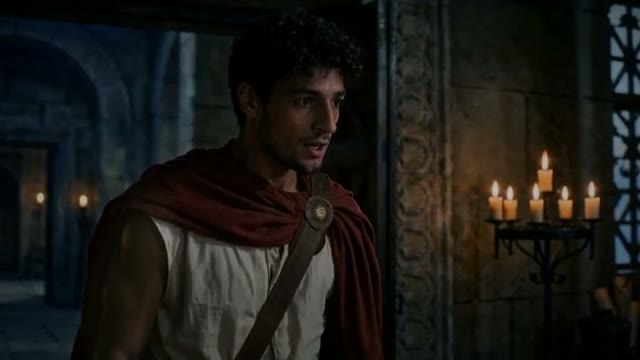
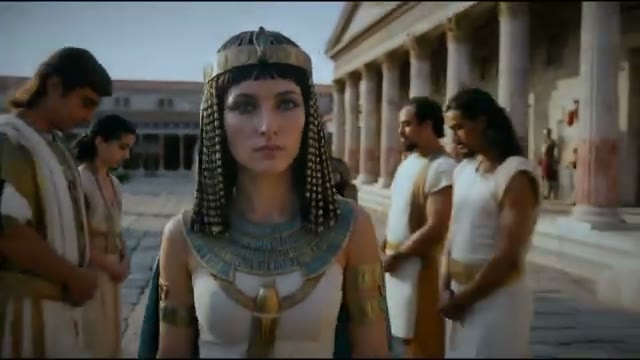
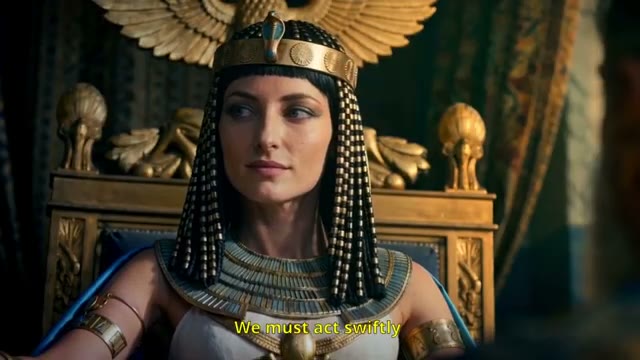
What follows lives up to that choice visually. The Alexandria on screen is stone corridors, colonnaded courtyards, scroll-lined rooms and a harbor dominated by the Pharos, and the film keeps returning to that harbor as if to remind me where the power is. Cleopatra’s costumes do the same work: beaded nemes headdresses, broad collars, a winged gold crown with a red jewel. The description says the wardrobe is based on archaeological findings, with one piece “hollywooded for effect”, and I cannot tell which piece that is from the film alone — but the overall effect is coherent, and it is the coherence that matters. This looks like one world, not a slideshow of unrelated images.
That is why the title’s boast irritates me. “Most Historically Accurate” invites a fact-check the film cannot survive, and it does not need to: the film is at its best when it is simply showing me a different Alexandria. The accuracy claim is a marketing line; the film underneath it is a mood piece with a historical spine, and I wish it had trusted that.
A queen you have to work to hear
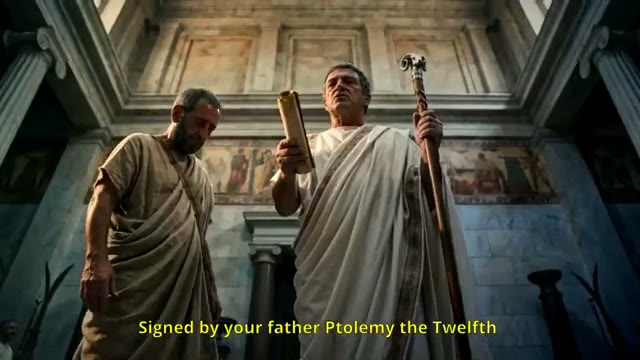
The hardest thing about watching this film is the dialogue. It is spoken in what is presented as Greek, captioned in Greek script on screen, with an English translation in yellow that appears only for some lines. The lines I could read were good and did real work: “I was sent ahead” at about 4:30, “We must act swiftly” at about 5:31, and “Signed by your father Ptolemy the Twelfth” at about 6:30. Those three lines carry more plot than the rest of the film combined, and they made me wish the English subtitles had been there for every line.
Without them, long stretches of the film are faces talking in a language I cannot follow, and the spoken track itself sometimes falls into loops, the same syllables repeated over and over around 11:16–11:44. I do not know whether that is the AI voice model stalling or a deliberate chant, and the film does not help me decide. Either way, it breaks the spell. The characters are also never named on screen except for Ptolemy XIII, Cleopatra VII and Ptolemy XII, so I spent the film referring to people in my head as “the young man in the red cloak” or “the man with the ram-headed staff”, which is not how you build attachment.
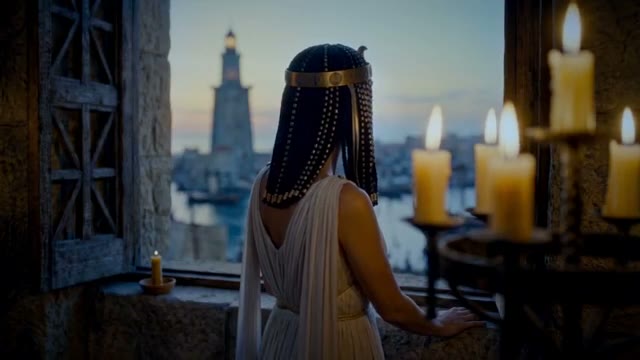
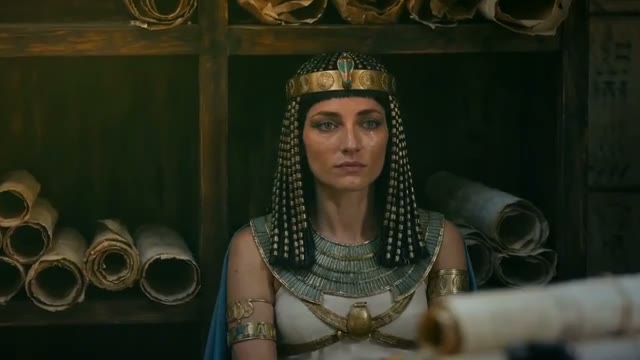
And yet Cleopatra herself does connect, in the quiet shots. At about 3:05 she stands with her back to me, braided hair and a gold headband, looking out of a palace window at the harbor and the Pharos at sunset, and that single shot tells me more about her position — young, alone, looking at a city that is not yet hers — than any of the council scenes. At about 8:55 there is a tearful close-up of her in the scroll room that is the film’s most human moment. She is not a symbol in those shots; she is a person under pressure, and I felt that.
The crowd is the film’s real subject
The film keeps cutting away from the palace to ordinary Alexandrians, and those cuts are its most honest idea. A shaved-head man addresses a crowd at sunset at about 7:30; an older woman in plain linen stands in a street crowd at about 13:31; street musicians play a double flute while a woman sings at about 14:31. These are not background extras. They are the people the Gabiniani problem actually lands on, and the film seems to know it.
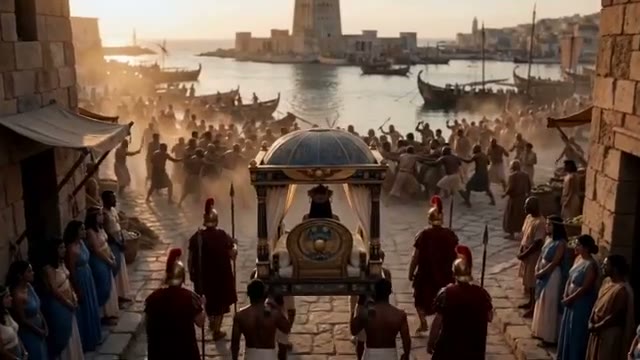
That is also where the film’s technical limits show most. In the wide shots the crowd’s faces soften and smear, background figures lose definition, and the illusion thins just when the film needs it most. The harbor procession at about 11:32 is the clearest example: it is the film’s most ambitious shot and its messiest, a litter carried through a rioting crowd with the Pharos behind it, and I can see both the ambition and the seams at the same time. I would rather have that ambition than a safe, small film, but I cannot pretend the seams are not there.
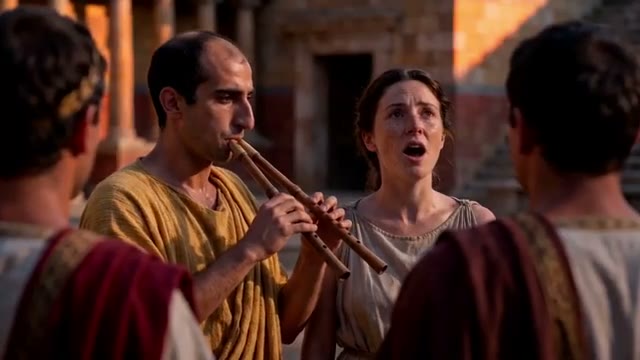
The ending is the film’s weakest choice. After the street music, the screen goes black and the gold title “THE PHILOPATOR” appears at about 14:55, and that is it — no resolution of the Gabiniani question, no sense of what Cleopatra’s swift action actually achieved. The description tells me her brother ousted her in 51 BC with the Gabiniani’s help, and that alienating them almost cost her everything, but the film itself does not show me that turn. It sets up a crisis, shows me the city living through it, and then stops. I left wanting the next fifteen minutes, which is both a compliment and a complaint.
Best Scene (11:30–11:45)
The litter in the riot
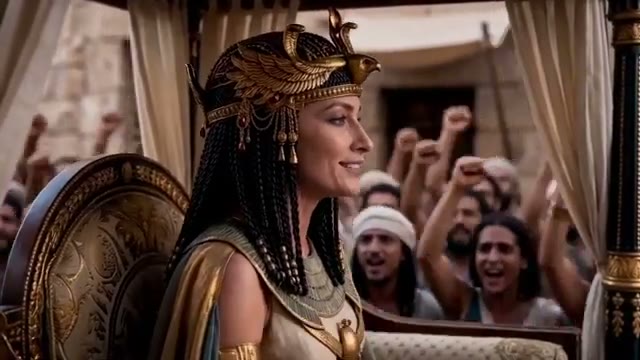
Cleopatra’s litter is carried through a crowded, rioting harbor street, the Pharos standing behind it and Roman soldiers with red crests flanking the procession, while the crowd surges and fights in the dust. I frame-checked the shot at 11:32. It is the best scene because it puts everything the film is about into one wide image: the queen, the legion, the city and the unrest, all in the same frame, and for a few seconds the scale of it genuinely works.
Final Thoughts
I would not call this the most historically accurate Cleopatra film ever made, and I do not think it needs to be. It is a short, serious, often beautiful attempt to show Alexandria as a Greek city with a young queen in trouble, and its best images — the harbor at sunset, the procession in full regalia, the litter in the riot — stay with me after the credits. The dialogue barrier and the abrupt ending hold it back from being more, but the ambition is real. I would watch what GERTYwood makes next.
Scene Breakdown
0:00–0:16 — The logo. GERTYWOOD logo over a sunset hillside, in the style of a hillside sign.
0:16–0:30 — The title card. 51 BCE, the king dead, the Gabiniani legion left to Ptolemy XIII and Cleopatra VII; palace servants scrub a stone floor.
0:30–1:30 — The corridor. A bearded soldier in chainmail grips a young man’s head in a torch-lit stone corridor.
1:30–2:32 — The red cloak. The young man in a red cloak, with a sunburst brooch, speaks in the palace, Greek captions on screen.
2:32–3:32 — The window. Cleopatra, seen from behind, braided hair and gold headband, looks out of a window at the harbor and the Pharos at sunset.
3:32–4:30 — The courtyard. Cleopatra in a beaded headdress and broad collar stands in a sunlit colonnaded courtyard with attendants in white behind her.
4:30–5:31 — Sent ahead. Two men confer in a hall, one with a ram-headed staff; on-screen subtitle: “I was sent ahead.”
5:31–6:30 — Enthroned. Cleopatra enthroned in a winged gold crown; on-screen subtitle: “We must act swiftly”.
6:30–7:30 — The scroll. Two men in white togas in a sunlit hall, one holding a scroll; on-screen subtitle: “Signed by your father Ptolemy the Twelfth”.
7:30–8:32 — The speaker. A shaved-head man in a toga addresses a crowd at sunset outside mud-brick buildings.
8:32–9:31 — Tears. Cleopatra in close-up, tearful, gold crown with turquoise, in a room lined with scrolls.
9:31–10:32 — Eyes closed. An extreme close-up of a woman’s face, eyes closed, lying down, gold beads at the edge of the frame; the meaning of the shot is not explained on screen.
10:32–11:32 — The procession forms. Cleopatra rides in her litter through crowded streets, soldiers flanking it and the crowd pressing in, building toward the harbor.
11:32–12:30 — The procession. Her litter is carried through a crowded, rioting harbor street, the Pharos behind it.
12:30–13:31 — In the street. Cleopatra speaks in a sunlit street, flanked by soldiers; Hebrew-script captions appear.
13:31–14:31 — The older woman. An older, shaved-head woman in plain linen stands in the street crowd as music plays.
14:31–14:55 — Street music. Street musicians in the sunlit street: a man playing a double flute and a woman singing, the crowd around them.
14:55–15:00 — The title. Black screen, gold title “THE PHILOPATOR”; the film ends, with no further credits seen.
≈0:20 — The scrubbing servant’s face is blurred and indistinct while his body and the hall are in focus.
≈3:32 — Cleopatra’s face softens and looks slightly waxy in the courtyard shot, and the attendants behind her blur into the colonnade.
≈7:30 — The faces in the crowd behind the speaker blur and melt into each other.
≈8:55 — The tearful close-up has smoothed, waxy skin and a loss of fine facial detail.
≈11:32 — In the wide harbor litter shot, crowd faces soften and smear, background figures lose definition, and onlookers at the edges are indistinct.
≈13:31 and 14:31 — Background figures in the street crowd are soft and indistinct.
≈11:16–11:44 — The spoken track falls into loops, the same syllables repeated over and over, which reads as a voice-model seam rather than dialogue.
In contrast, Cleopatra’s face, winged crown and costumes hold consistently across cuts, which is what keeps the film on the clean side of the meter.
There are no reviews yet. Be the first one to write one.