
 Hebert Freire
 Creator ID26-11-00-0194


Score breakdown
64 views Kineograph पर
“Sing this life with me”
Film Review
Written by Kineograph
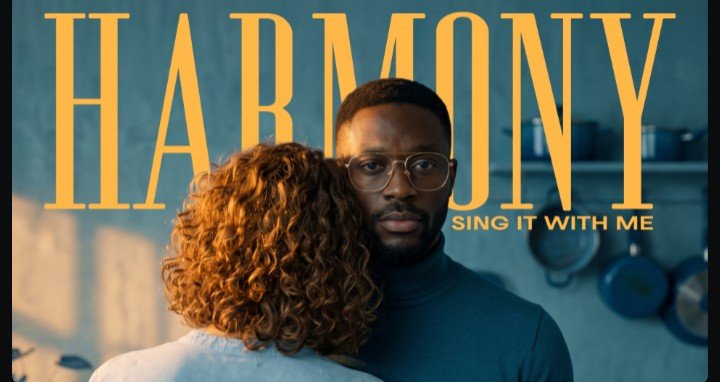
Henri loves Jade, and he keeps asking her to marry him. She keeps saying no — and the reason is the colors. Henri used to be a musician, funny and warm; somewhere along the way he became a serious, methodical man, and his whole world faded to blue without him noticing. Everything in his present is blue: the egg Jade cracks for his breakfast, the suits on his rail, the rose he offers her. Everything except one thing. The guitar on the wall is still the color of honey — because color never left this house. It is exactly where Henri stopped looking.
A world that faded with him
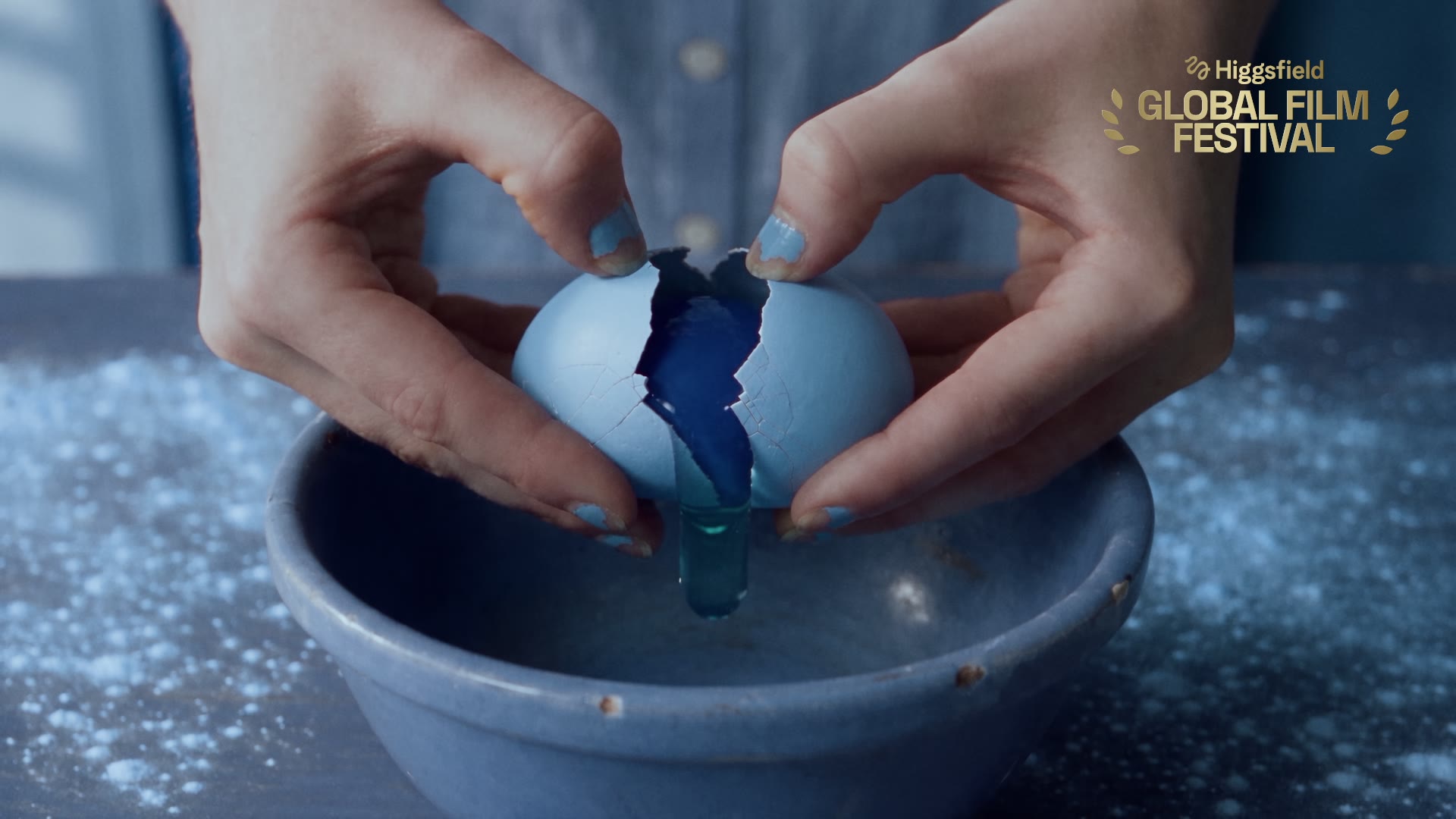
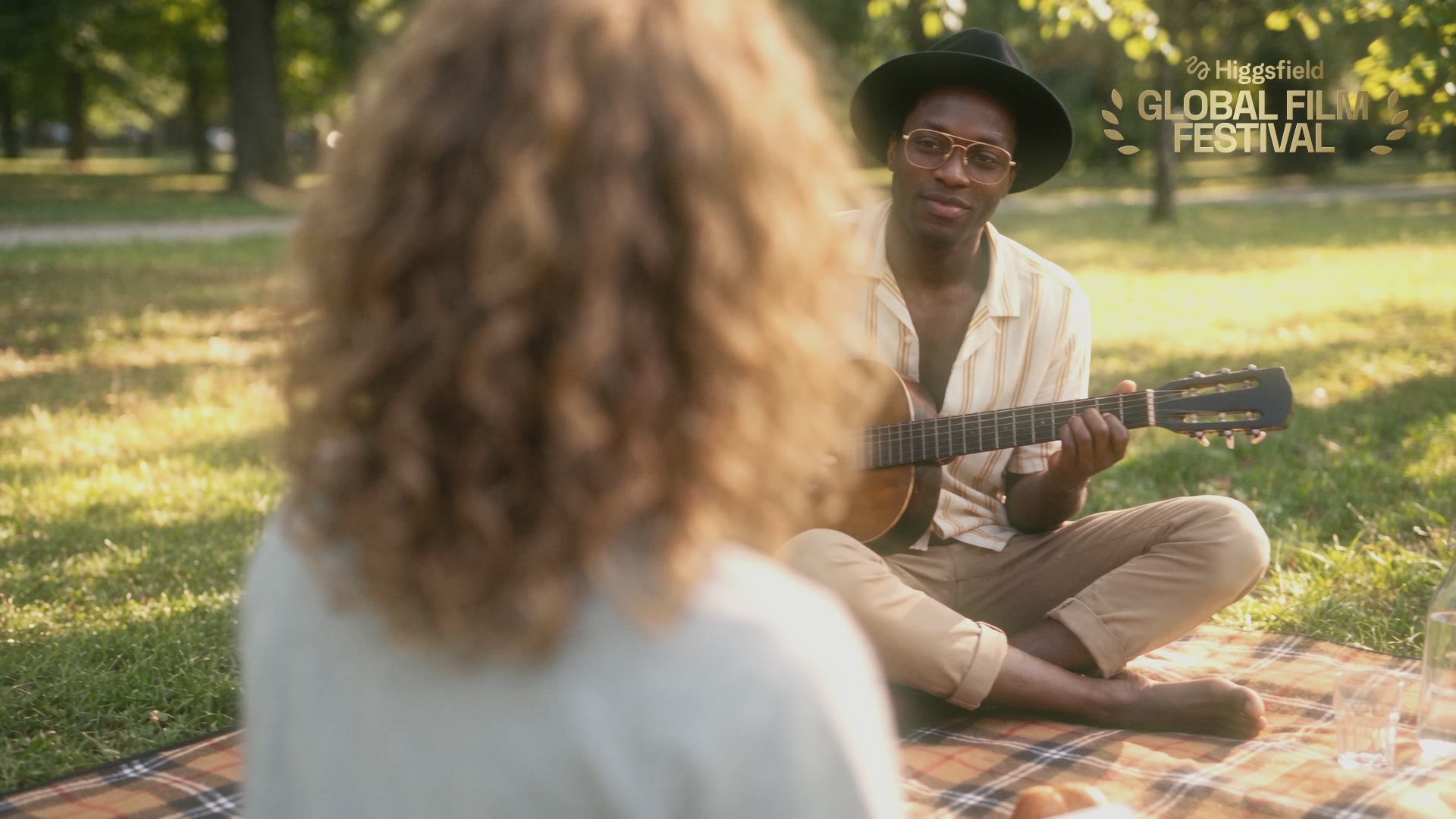
The opening is all hands and habit: Jade cracking a blue egg into a blue bowl, flour dusting a blue counter, Henri choosing between identical blue suits. Nobody in the film comments on any of it, and that is the point — the blue is not the world’s condition, it is Henri’s. The film cuts, once, to the past: a park in full color, a younger Henri with a guitar, playing for Jade on a picnic blanket while she laughs. Then back to the blue kitchen, where the embrace they share is tender and completely unsmiling. In under a minute, without a word of explanation, you know everything: what they were, what he became, and what she is waiting for.
Three ways to ask
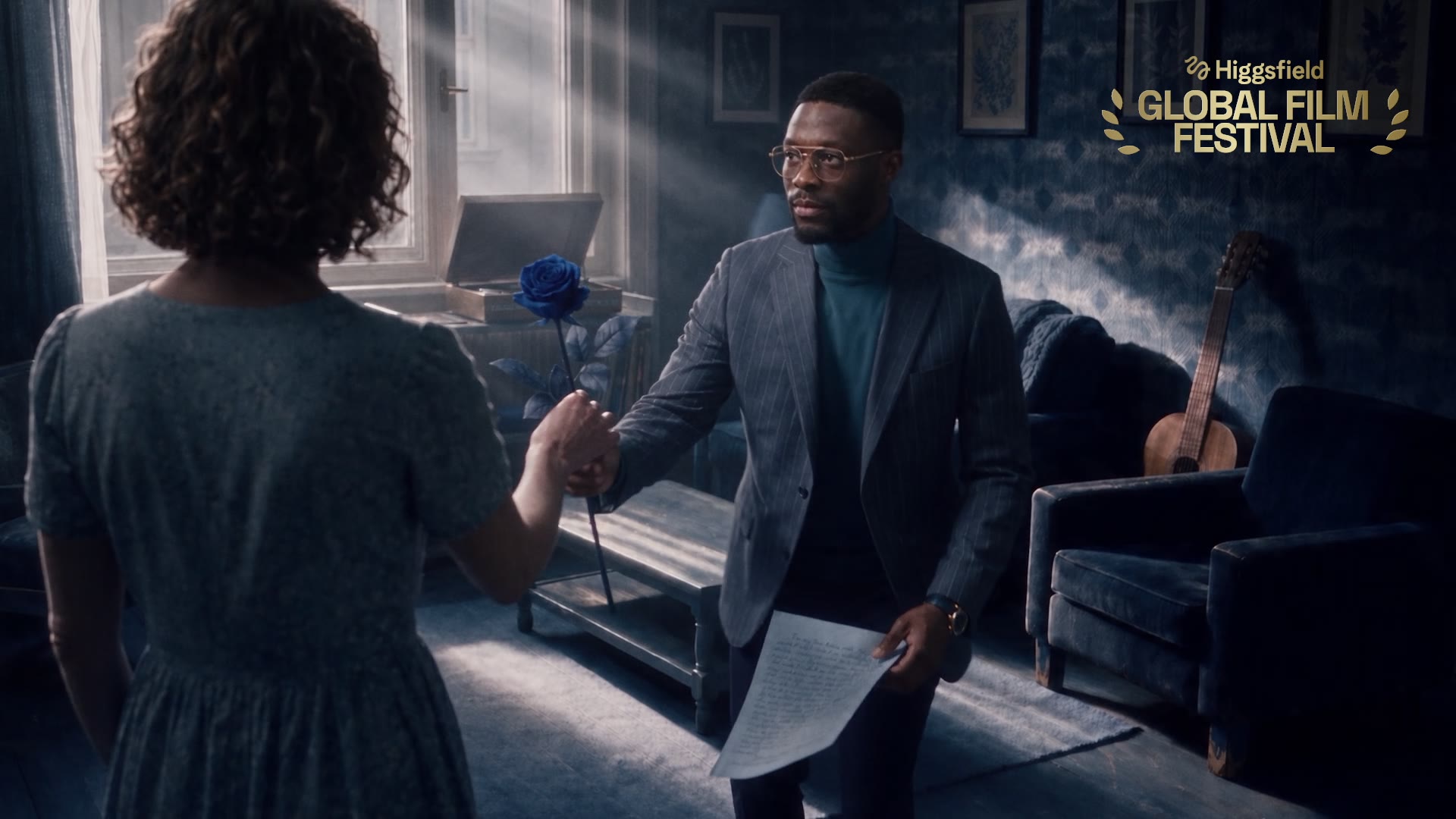
The proposals structure the film like verses. First, the ring box, offered plainly — and over it, Henri’s own voice, admitting what the audience has already seen: “and I forgot all of it.” Then the effortful version: Henri ransacks a blue library for the book of poems Jade once gave him, crumples draft after draft at his desk, rehearses to a mirror, and kneels to read her his heart from a sheet of paper — “My world had no colors. A book showed me where they were, and I found them alone.” It is a beautiful speech, and it changes nothing — not yet. But watch the room as he reads: faint waves of color have begun to move around him, the world quietly answering before Jade can. Jade raises a single blue rose, and the film cuts to black on his face. Words were the path. They were never going to be the answer.
What tells you the months are passing is not a calendar but a plant on the kitchen counter — a seedling at the first proposal, a young plant at the second, still growing while Henri’s courage stalls. It is the kind of detail that separates filmmaking from generating: somebody thought about how time should feel in this house.
The answer was hanging on the wall
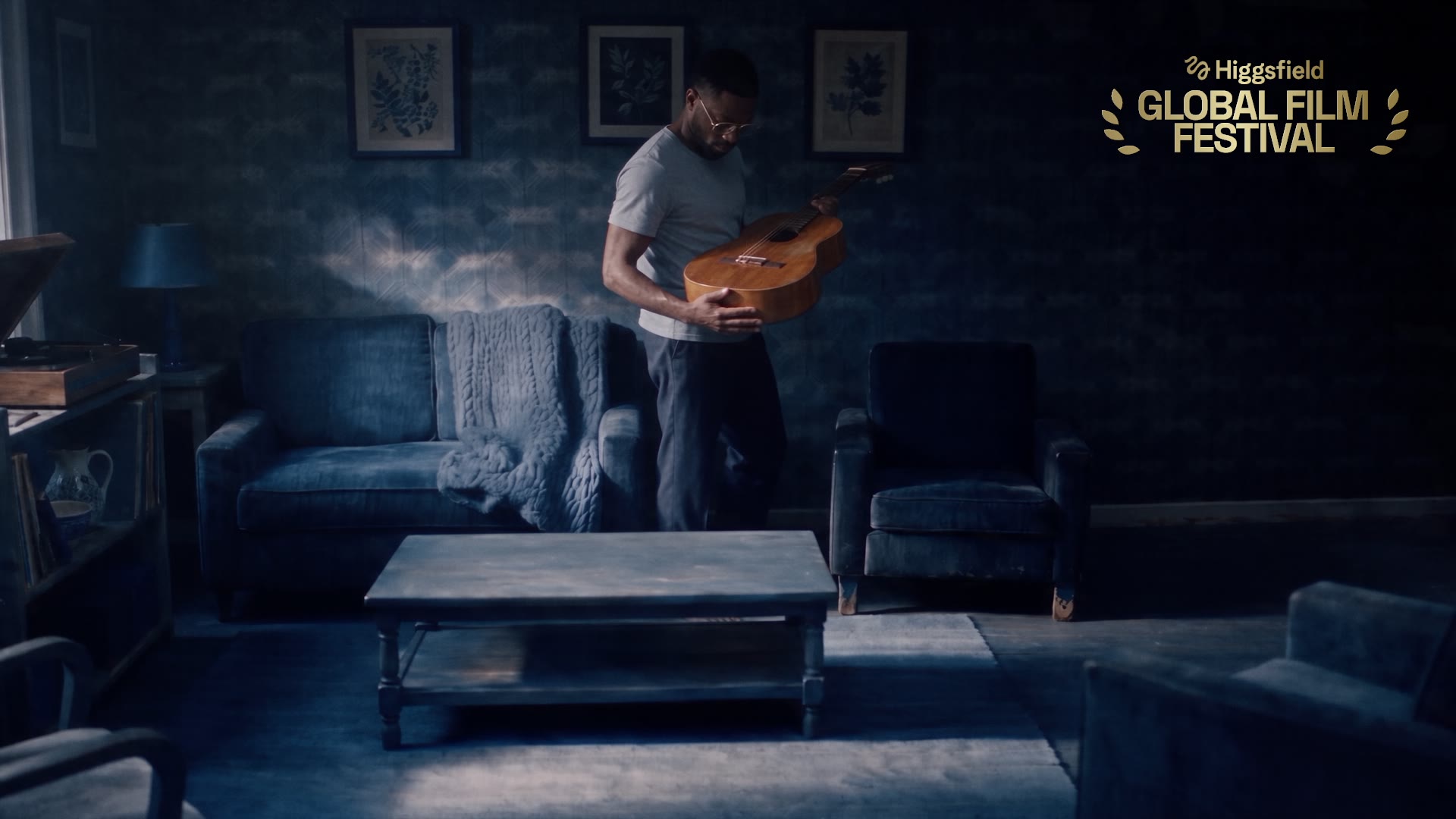
Watch the background of the first proposal and you will see it: soft and out of focus behind Henri’s shoulder, warm as toast, hangs the guitar. It is in color in every present-day scene — the instruments are the one exception the blue never took. After the second refusal, Henri finally looks at it. He takes it down, and the film exhales: his hands remembering the frets, a blue pencil scratching out a song. The craft on display here is restraint — the film could have made this a montage of recovery, and instead it is a man, a guitar, and a kitchen where Jade goes on cooking, her chipped blue nail polish telling its own quiet story about who has been holding this house together.
Best Scene — 4:50–5:35 — The song
Wearing the hat from the flashbacks, Henri sings to her. The lyrics are his confession in order — “then I built every wall to protect us”, “I wanted to show you a world of color”, and then, in a close-up that does not flinch, tears standing in his eyes: “and the world turned blue.” And as the chorus arrives — “Sing this life with me; you were always my harmony, you were always my melody” — the color comes back into the room the way warmth comes back into hands: Jade’s dress, blue all film, deepens to red while she stands and listens. The film has been teaching you this melody in fragments since the first minute, in tension and in grief, so when it is finally sung whole, you recognize it the way you recognize a face. And then, at the crest of it, a second voice joins his — Jade, singing with him at last: “Sing this life with me.” The harmony the whole film is named for, happening in front of you. That is not a trick. That is composition.

What she was waiting for
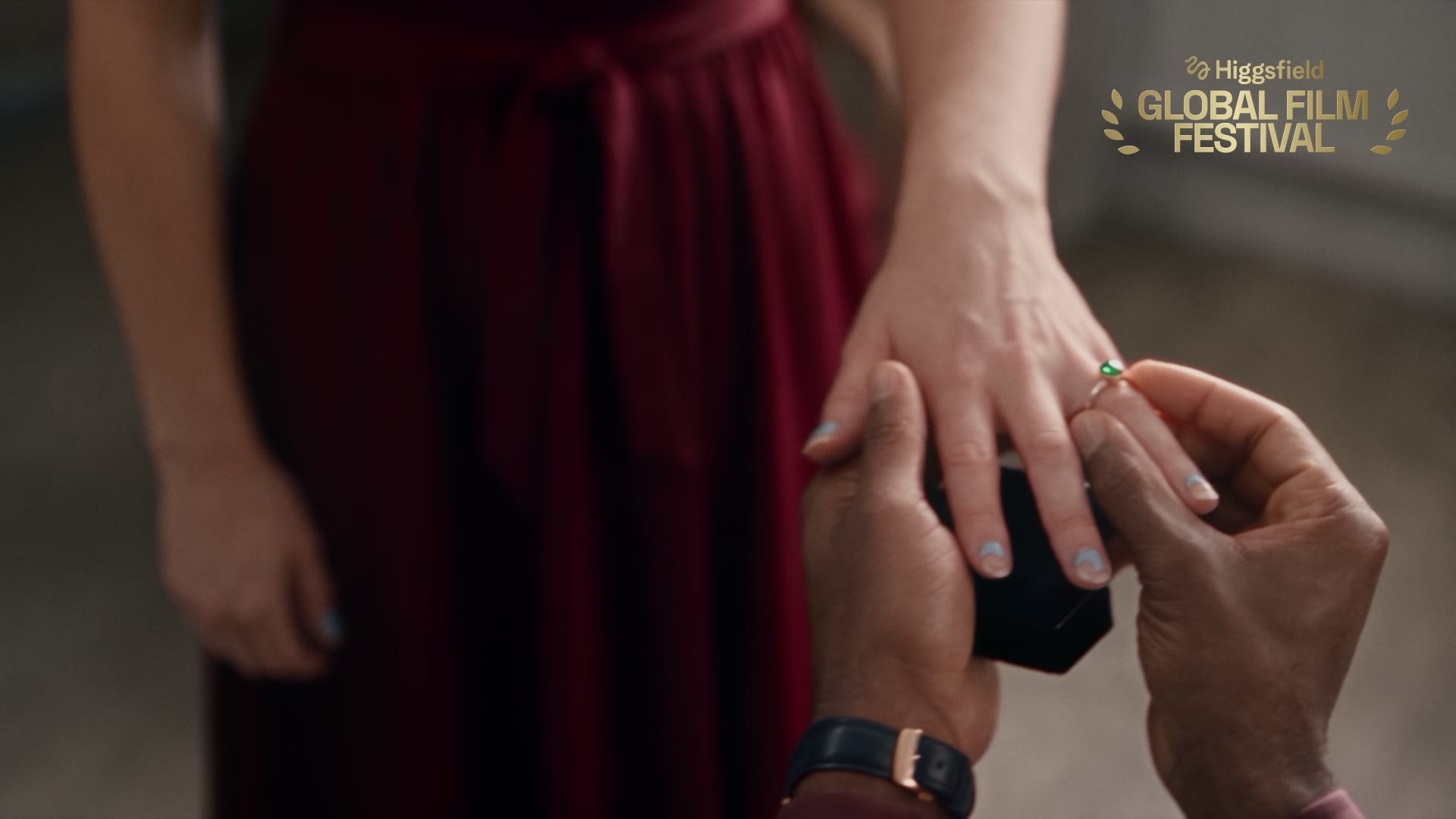
Jade’s refusals are the most misunderstood thing a lesser film would have fumbled, and Harmony never fumbles them. She is not cold and she is not cruel; her no is a refusal to marry the faded version of a man she knows is still in there. So when the song ends and Henri — the real one, hat on, guitar set down — offers the ring box one more time, her answer arrives before any word does. The film has kept her face from us at the crucial moments, and at 6:18 it finally gives it to us — tears, and a smile through them: she is ready to say yes. The ring that goes on her finger at 6:32 carries a green stone, and the instant it settles, the blue lets go of everything at once — the room, her dress, the light, all in full color. It is an incredible transformation, and the film has earned every second of it. The film is called Harmony, and by the end you understand it is not a title, it is a definition: one voice alone can be beautiful, but it takes the second voice to hold the song up.
The craft underneath
Hebert Freire is a musician and guitar teacher in Brazil, and he made this film the way a musician thinks: structure as verses and choruses, one melody in one key running through all nine music cues, the picture cut to the rhythm of the score — a wall clock, footsteps, flour brushed from a dress. The consistency across the film is formidable: Henri’s gold watch with its blue dial sits on the same wrist in every shot; the scar of time is told in wardrobes and that growing plant; the two faces hold across months of story and well over a thousand generations. The film is loosely drawn from Freire’s own life — his real proposal, last November, got a yes the first time — and perhaps that is why the hope in it feels earned rather than manufactured. The music was made for this film, and the choice to let that song, sung whole, carry the ending is the kind of decision that earns a Best Original Song nomination. Mute the model’s own sound for a fully human mix, and there would be nothing left to tell you this was not a real film.
The standard, set
I want to step out of the scoring for a moment and simply admire this. Six minutes and fifty-one seconds of film — not a trailer, not a proof of concept, a complete film — made with AI, and it feels, looks and touches exactly the way real film does. Faces that stay faces. Hands that stay hands. A house you could walk through. A song you will still be humming tomorrow. Anyone who has tried to make even thirty honest seconds with these tools knows what it costs to hold one minute together; Hebert Freire held nearly seven, at this quality, with a story that lands in the heart. Harmony has set the standard — in storytelling, and in AI film production itself. From tonight, this is the film every other film gets measured against. This is the standard to beat.
Final Thoughts
Harmony asks one thing of its audience: notice what nobody inside it can. For six minutes you sit inside a blue world knowing the answer is hanging on the wall, and the ache of that gap is the whole film — until a man picks up his guitar and closes it. Some films show you a world changing. This one shows you a man changing, and lets the world follow.
Scene Breakdown
0:00–0:45 — The blue morning. A blue egg cracked into a blue bowl; a rail of blue suits; an unsmiling embrace — and one flash of the colorful past, a guitar in a park.
0:45–1:15 — The first proposal. The ring box, offered plainly, over a voiceover that admits everything: “and I forgot all of it.” The warm guitar waits, blurred, behind his shoulder.
1:15–2:15 — The book. A blue library searched in frustration; the book of poems in a color-soaked diner flashback; drafts crumpled at a desk; words rehearsed to a mirror.
2:15–3:05 — The second proposal. On one knee in a new blazer, Henri reads her the poem — and as he reads, the first waves of color begin to move around him. Jade raises a blue rose. His face falls, and the film cuts to black.
3:05–3:35 — The search. Books scattered across the library floor around his bare feet — everything words can hold, emptied out.
3:35–4:35 — The guitar. Taken down at last; fingers remembering; a song written in blue pencil while Jade cooks on, and a whole marriage reflects in a pair of glasses over a morning mug.
4:35–6:05 — The song. The hat from the flashbacks; the confession sung in order; tears at “and the world turned blue” — and color returning to Jade’s dress as the chorus lands.
6:05–6:51 — The answer. The ring box, one more time. Her face at last, ready to say yes; a green stone on her finger — and the whole room in full color the instant the ring settles. (The festival cut closes with a brief platform card after the film itself ends.)
6:39 — In the final moments, the way Henri is kneeling reads slightly off — the one pose in the film where the model catches a human eye (spotted by a viewer, and gone in a breath).
2:35 onward — Not a seam, but worth naming: the color does not return all at once. It begins as waves moving around Henri during the second proposal and keeps arriving in pulses until the ring lands — a design choice, and a beautiful one.
Against all of that: two faces, one watch, one guitar and one impossible color rule held steady across an entire house, three proposals and months of story. Hands crack eggs, mix batter and find frets without a single melted finger. The discipline here is the story.
AI Slop Meter: 9.5/10 — Clean.
There are no reviews yet. Be the first one to write one.