
 Khaled El Refay
 Creator ID26-11-01-0267

Score breakdown
28 views en Kineograph
Film Review
This review discusses the ending. If you would rather watch the film first, we recommend you do, and then come back.
Synopsis
One rainy winter night in an old city, 1935. Fahmy, an elderly man with almost nothing, holds a worn wallet over his work table: “It’s enough for the medicine. Just enough.” His granddaughter Nour is feverish in bed — “She’s burning, Baba” — and the money in that wallet is the price of her medicine. At the market, a hand lifts the wallet from his coat pocket in one smooth macro shot: “Pardon me, sir.” “God keep you, son.” The hand belongs to Yusuf, a young pickpocket who works the crowds and answers to a boss who keeps the takings. The chase that follows costs Constable Abdo his own wallet — “Abdo went to catch the pickpocket and came back without his wallet” — and by tonight, the constable swears, Yusuf is in a cell. But Fahmy is sitting alone in a stone stairwell with empty hands, and Yusuf is about to open the wallet and find a child’s drawing folded among the coins.
A Painting You Can Step Into
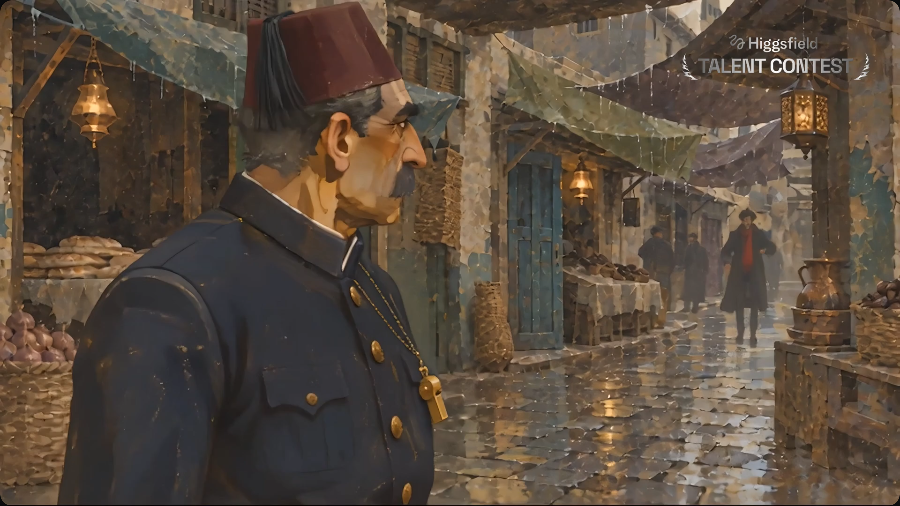
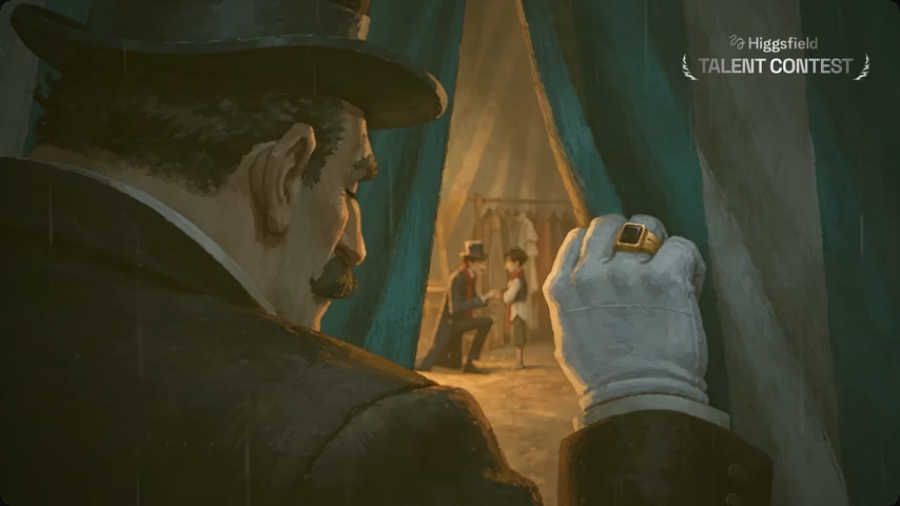
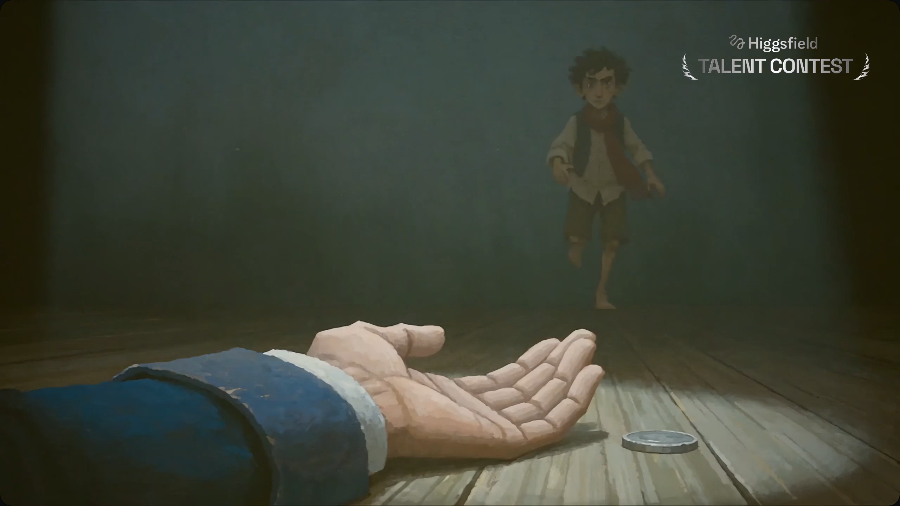
Every frame of LEGERDEMAIN is a painting: hand-worked gouache, faces built from angular planes like carved wood, no outlines, light falling in dramatic shafts through rain and lamplight. The city is grey stone, faded teal and umber; almost the only red in the film is Yusuf’s scarf, so your eye follows him through every crowd and across every rooftop without the film ever raising its voice. The flashback to his father’s circus is graded warm, gold against the night’s cold — memory itself is warmer than the present. Movement is deliberately still: near-painted frames, slow push-ins, the drama carried by close-ups and macro inserts — a hand in a pocket, a ring on a boss’s finger, a drawing among coins. It is a confident way to make an animated film, and it suits a story about hands: what they take, and what they give back.
Borrowed and Returned
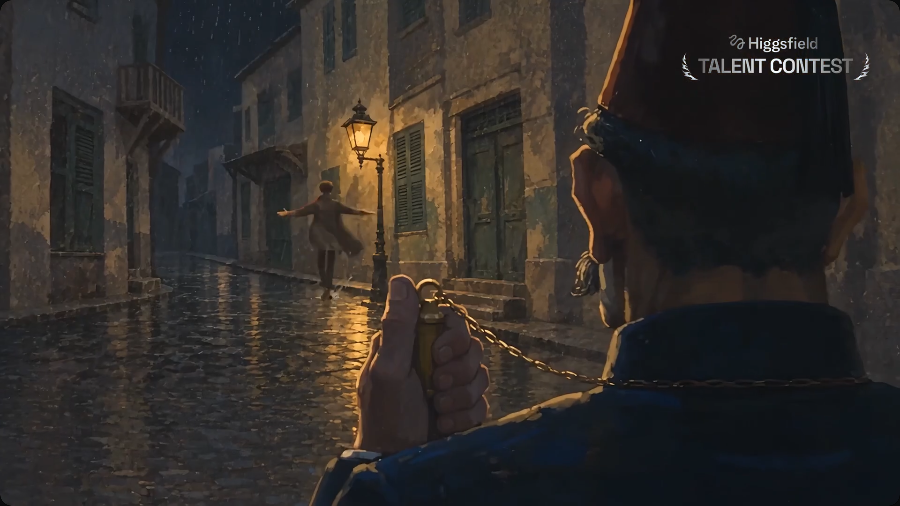
The story’s engine is a sentence Yusuf learned kneeling in a circus tent, from a father in a top hat and white gloves: “Magic is where people look, not what you take. Never take, Yusuf. Only borrow.” Yusuf repeats it like a charm — “Borrowed and returned!” — and the film spends its night testing whether he believes it. The test comes in the sick room, the film’s strongest scene: Nour burning in bed, Fahmy searching his empty pockets — “It was here. It was right here” — and facing the world’s arithmetic: “No money, no medicine. Those are the rules.” His answer is the best line in the film: “Rules don’t have a granddaughter.” Yusuf steals the wallet back from his own sleeping boss, ring and all, runs the rooftops in the rain, and at Fahmy’s door performs the gentlest con of his life: “You dropped this, sir.” Then, from his own pocket: “For the little one, from me.” The ending belongs to Constable Abdo, who has every reason and every right to take him, and who watches him dance in the lamplit street instead: “Not tonight, magician.” The law, the film says, can also choose to borrow its eyes for one night.
Honesty requires two criticisms. The father’s rule — the line the whole film turns on — is clipped in the audio at its first full delivery, and some of the chase and police-station dialogue is muddy enough to lose. And the final stretch, the pharmacy and the giving-back, is static and music-led, so the payoff lands more softly than the build-up promises. Neither fault touches the structure, which is exact: every gift in the last act was planted in the first.
Best Scene (3:30–3:55)
“The Sick Room”
Nour feverish in bed; Fahmy emptying pockets that have already been emptied, praying over a child while the rules of the world are read out to him — and his reply, “Rules don’t have a granddaughter,” turns a theft story into a story about what a person is for. Everything Yusuf does afterward is decided in this room, and he is not even in it.
Final Thoughts
Khaled El Refay tells this story the way his magician father would have wanted: the audience is always looking at the right hand. The painting-craft, the patience, the refusal to make Yusuf either a villain or a saint — he is a thief who returns what he stole and adds to it, which is a harder and better thing to watch than a conversion. I felt like I was in a painting, and I did not want to leave it. Verdict: a small, complete, warm-hearted film — the pickpocket story told as it should be, as a story about giving back.
★★★★ — Never take. Only borrow. And when you return it, add something of your own
Scene Breakdown
0:00–0:40 — The medicine money. Rain over the old city’s rooftops at night. In Fahmy’s home, a worn wallet held over a work table: “It’s enough for the medicine. Just enough.” Nour is burning with fever. Fahmy walks to market through the rain, the camera finding the wallet in his coat pocket.
0:40–1:35 — The theft and the chase. In macro, a hand lifts the glowing wallet: “Pardon me, sir.” “God keep you, son.” A chase through wet alleys; Constable Abdo pursues and loses his own wallet in the doing. At the station: “By tonight, he’s in that cell.”
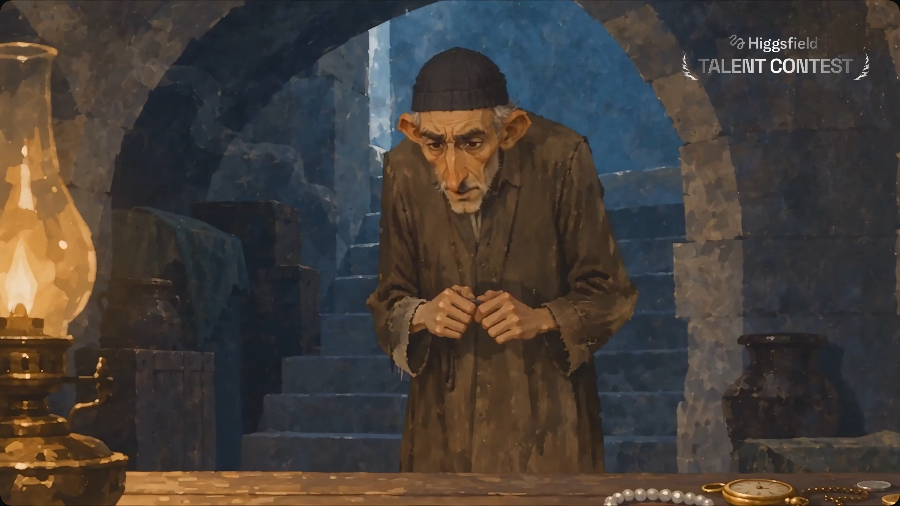
1:35–2:35 — Empty hands. Fahmy alone in a stone stairwell, lamp beside him, head bowed over hands that hold nothing. In the thieves’ den, Yusuf’s takings earn him one coin and contempt: “Your father was a loser with a top hat.” The boss’s gold-ringed hand grips his scarf.
2:35–3:30 — The father’s rule. Flashback, warm gold: the circus tent, the magician kneeling to his young son. “Magic is where people look, not what you take. Never take, Yusuf. Only borrow.” Yusuf’s mantra: “Borrowed and returned!”
3:30–4:30 — The sick room, and the decision. Nour in bed; Fahmy searching, praying: “Rules don’t have a granddaughter.” In silence, Yusuf slips past his sleeping boss and takes back the wallet — and the ring. The boss wakes: “Find him.”
4:30–5:35 — The return. Yusuf across the rain-slick rooftops, red scarf flying. He opens the wallet and finds a small drawing of a little girl among the coins. At Fahmy’s door: “You dropped this, sir.” “God keep you, son.” “For the little one, from me.”
5:35–6:39 — Not tonight. The pharmacy; the medicine bottle in Fahmy’s hands; dawn, and bread, and coins given onward. In the lamplit street Yusuf dances, and Abdo, rain on his face, lets the night keep him: “Not tonight, magician.”
There are no reviews yet. Be the first one to write one.